
An assistant executive engineer of the Public Works Department, Mridul Baglari, was arrested in Dibrugarh, Assam, for accepting a bribe of Rs 30,000. He had allegedly demanded Rs 1.3 lakh for releasing pending bills and was caught in a trap laid by the Directorate of Vigilance & Anti-Corruption.

Trump has enacted a new law imposing significant sanctions on Russia and Iran, which could lead to tariffs of up to 100% on major energy importers like India and China.

The goal is to ensure that your bank works for you, providing liquidity and convenience without charging you for the privilege of holding your own money.

A joint parliamentary committee has received an extension to submit its report on a significant bill. The Constitution (130th Amendment) Bill, 2025, proposes the removal of a prime minister, chief minister, or other ministers if they are jailed for 30 consecutive days on serious charges. The committee, chaired by BJP MP Aparajita Sarangi, needs further consultations before finalising its report.

Amidst opposition protests, the Lok Sabha has successfully passed a crucial bill to expand the Supreme Court's judicial strength from 34 to 38 judges.

The US Senate has overwhelmingly approved a bill, the Lindsey O. Graham Sanctioning Russia and Iran Act of 2026, which aims to punish Russia and its major petroleum product buyers, including China and India. The legislation allows the US President to impose 100 per cent tariffs on goods from the top five importers of Russian oil and gas, and also extends sanctions on Iran's energy sector. The bill, championed by the late Senator Lindsey Graham, now moves to the House of Representatives for further approval.

Bollywood actor Dino Morea was questioned by Mumbai police's Economic Offences Wing (EOW) for six hours regarding the alleged Rs 65 crore Mithi river desilting scam. The investigation focuses on financial irregularities in a Brihanmumbai Municipal Corporation (BMC) sanitation contract, where key accused allegedly siphoned off funds. Morea's name emerged due to communications and suspected financial transactions with one of the accused. Federal agencies, including the ED, are also probing the case for money laundering.

'When the House adjourned, they were not yet getting 360. They were short of that, maybe by six or seven or ten.' 'So they wanted to break more parties and get their support, and they were engaged in that.'

The Shiromani Akali Dal (SAD) has called for the immediate passage of the women's reservation bill and the delimitation bill, advocating for a uniform 50 per cent increase in seats for all states to ensure fair and equitable representation.

Kiren Rijiju has strongly criticised the Congress for allegedly 'unfairly disrupting' the recent monsoon session.

India's Ambassador to the US, Vinay Mohan Kwatra, has clarified that the recent amendments to the Foreign Contribution (Regulation) Act (FCRA) are primarily aimed at enhancing transparency and ensuring accountability in foreign financial flows.

The Indian Parliament is scheduled for a significant legislative day, with the Lok Sabha set to consider and pass the Public Examinations (Prevention of Unfair Means) Amendment Bill, 2026. Concurrently, the Rajya Sabha will introduce the Micro, Small and Medium Enterprises Development (Amendment) Bill, 2026, and pass the Prevention of Insults to National Honour (Amendment) Bill, 2026, highlighting a busy agenda for both houses.

The Congress party has issued a whip to its MPs in both the Rajya Sabha and Lok Sabha, mandating their presence from August 10-12 for discussions on "very important" issues. This directive comes amidst reports of potential debates on the Foreign Contribution (Regulation) Amendment Bill, 2026, and a Constitution Amendment Bill concerning delimitation, though the government's official business list did not explicitly mention these.

Mizoram Chief Minister Lalduhoma met Union Home Minister Amit Shah regarding the Foreign Contribution (Regulation) Amendment Bill, 2026. Shah assured that the bill would not be retrospective. Various church and minority organisations have expressed concerns about the bill's impact on NGOs, schools, and healthcare units, urging its withdrawal or referral to a joint parliamentary committee.

Singing sensation Arijit Singh is set to celebrate two decades in the Indian music industry with an ambitious nine-city India Tour in 2027.

The Mighty Marathas secured their first victory in the second season of the Archery Premier League, defeating Chola Chiefs 6-0 on Saturday. Led by Mike Schloesser and Dhiraj Bommadevara, the Marathas showcased strong performances, bouncing back after two initial losses. The Chiefs, despite tactical efforts, couldn't match the Marathas' precision, suffering their second defeat in three matches.

A US Congressman has raised serious concerns regarding India's proposed amendments to the Foreign Contribution Regulation Act (FCRA), warning that these changes could lead to government takeovers of religious charities and strain bilateral relations.

The Rajya Sabha has passed the Prevention of Insults to National Honour (Amendment) Bill, 2026, making insult to the national song 'Vande Mataram' a criminal offence. The bill, which also covers other national symbols, was passed amidst protests from opposition parties regarding the NEET paper leak. Union Minister Nityanand Rai criticised the opposition's stance, emphasising the song's historical significance and its role in national unity.

The assessee must explain the nature and source of jewellery and support the explanation with evidence, tax experts say.

Monday's proceedings demonstrated that the legislative debate has become inseparable from the broader political crisis surrounding the NEET controversy.
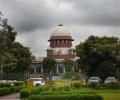
The Joint Parliamentary Committee (JPC) on simultaneous elections had scheduled an "informal interaction" with Supreme Court judges, which was later cancelled by the apex court. The Supreme Court deemed the meeting inappropriate as the proposed constitutional amendment could become subject to judicial review. JPC Chairman PP Chaudhary defended the panel's initial decision, citing precedents, while DMK MP P Wilson, who mooted the idea, expressed disappointment and argued against the notion that such interactions violate separation of powers.

The Chhattisgarh Economic Offence Wing/Anti-Corruption Bureau (EOW/ACB) has filed its 10th supplementary charge sheet in the alleged liquor scam, accusing 20 individuals, including former state Congress treasurer Ramgopal Agrawal, and 22 firms. The 27,000-page document details illegal liquor production, hawala transactions, and investment of illicit proceeds. The scam, estimated by the ED to be between 2019 and 2022, involved a complex network of illegal liquor sales, duplicate holograms, and routing of funds.

The Lok Sabha has passed a Bill to amend the Payment and Settlement Systems Act, 2007, authorising the government to permit banks and service providers to levy charges on UPI and other electronic payment modes. This move aims to create a sustainable revenue model for the digital payments ecosystem, shifting from the current exemption of UPI transactions from such charges.

UPI processed an average 802 million transactions a day in September, about 1 per cent more than the 792 million a day over the same period in August.
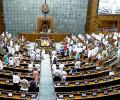
BJP sources said the government would introduce a fresh Bill on the issue and has reached out to parties that opposed the earlier legislation.

Families, especially those with a history of these ailments, must prepare before an emergency strikes.

The Lok Sabha has approved an amendment to India's anti-paper leak law, introducing stricter punishments including jail terms of up to 10 years and fines of up to Rs 50 lakh, in response to recent large-scale student protests and the NEET paper leak case.

A bipartisan group of US Senators has agreed to fast-track a bill allowing the President to impose sanctions on major purchasers of oil from Russia and Iran. This legislation, known as the Lindsey O. Graham Sanctioning Russia and Iran Act of 2026, aims to restrict funding for Russia's war efforts and Iran's energy and weapons sectors, potentially impacting countries like China and India through tariffs and other restrictions.
The Lok Sabha stalemate is expected to conclude as Speaker Om Birla has secured an agreement from all political parties to discuss the Public Examination (Prevention of Unfair Means) Amendment Bill 2026. This bill proposes stricter punishments, including up to 10 years in jail and a Rs 50 lakh fine, for paper leak offences, following recent nationwide student protests over the NEET fiasco.

India is set to introduce a new amendment to its anti-paper leak law in the Lok Sabha, aiming to establish fast-track courts across all states and union territories for swift trials and significantly harsher penalties for exam malpractices, including jail terms of 5 to 10 years and fines up to Rs 50 lakh for individuals, and up to Rs 10 crore for organised crimes.

Jantar Mantar, a historic protest site in New Delhi, is facing de-notification by Delhi Police, raising concerns about its future as a space for public dissent. The site has been central to numerous significant movements, from Anna Hazare's anti-corruption fast and the Nirbhaya protests to recent agitations over NEET paper leaks and wrestlers' grievances. Its proximity to power centres made it a crucial platform for citizens to voice concerns and demand accountability, a role now threatened by its potential loss of status.

The Social Reckoning may lack the crackling energy of The Social Network, but Aaron Sorkin delivers a timely warning about what happens when a world-changing platform escapes the control of its creator.
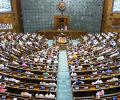
Parliament has passed The Prevention of Insults to National Honour (Amendment) Bill, 2026, making any insult to the national song Vande Mataram a criminal offence, punishable with imprisonment up to three years or a fine.

'It is a blunt and dangerous attempt to pressure India to sign BTA on one-sided terms.'

The Ministry of Home Affairs informed a Joint Committee of Parliament that the number of active NGOs registered under the Foreign Contribution (Regulation) Act has halved over the last decade, even as foreign funds received by them have significantly increased. Christian associations received the largest share of these funds in 2024-25. The report comes amidst discussions on a contentious FCRA amendment bill aimed at tighter government oversight.
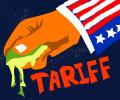
A bipartisan group of US senators has introduced a comprehensive bill imposing extensive sanctions on Russia, with India identified as one of five countries that could incur tariffs for its continued purchase of Russian oil.

US Vice President JD Vance and Prime Minister Narendra Modi held a phone call to discuss expanding the India-US comprehensive global strategic partnership, focusing on trade, defence, energy security, emerging technologies, and critical minerals. The discussion comes amidst rising tensions in West Asia and recent regional realignments, with both leaders reaffirming their commitment to strengthening cooperation.

The Uttar Pradesh Cabinet has officially approved the renaming of the Noida International Airport at Jewar to 'Narendra Modi International Airport, Noida-Jewar', a move Chief Minister Yogi Adityanath described as a "major gift" to the state.

The Public Examination (Prevention of Unfair Means) Amendment Bill, 2026, passed by the Lok Sabha, introduces significantly stricter punishments for individuals and organised groups involved in paper leaks and other unfair means in public examinations. The legislation aims to enhance the integrity of exams conducted by various central government agencies.
The Delhi government has approved a new bill, the Delhi (Right of Citizen to Time Bound and Ease of Delivery of Services) Bill, 2026, which aims to make time-bound delivery of government services a legal right for citizens. This reform seeks to enhance transparency, accountability, and efficiency through a technology-driven framework, including digital service delivery, automatic escalation for delays, and a grievance redressal mechanism.
