
The US and Iranian delegations left Pakistan after failing to reach an agreement in historic talks aimed at resolving the West Asia conflict and stabilising global energy markets.

Amidst the stalling of high-level peace talks between Tehran and Washington, Iran continues to endure severe digital isolation as the nationwide internet blackout reached its 44th day on Sunday.

Pakistan is set to host face-to-face talks between the United States and Iran, aiming to solidify a fragile ceasefire and prevent further conflict in West Asia. The discussions will focus on a long-term peace arrangement, including sanctions relief, regional security, and Iran's nuclear program.

Trump seems to have estimated that Ghalibaf is a pragmatic politician who is receptive to close relations with the US and is enthusiastic about fostering business and economic ties in particular, points out Ambassador M K Bhadrakumar.

The United States' historical strategic alignment with Pakistan, dating back to the Cold War, has consistently aimed to create a political and military parity with India, despite India's significantly larger size and resources. This long-standing relationship continues to influence regional dynamics, particularly in West Asia and the Indo-Pacific.

Trump added that the United States would assist in managing the traffic buildup in the Strait of Hormuz.

Two CoBRA battalion personnel were seriously injured in an IED blast triggered by Maoists during an anti-Naxal operation in Jharkhand's West Singhbhum district.

Chaffing under public ridicule in the US as well as internationally for having 'lost' the war, Trump is under immense pressure to do something, cautions Ambassador M K Bhadrakumar.

US Vice President JD Vance is set to arrive in Islamabad on Monday evening to lead a high-level American delegation in a second round of ceasefire negotiations with Iran, CNN reported, citing White House on Sunday.

...reopen for up to six months. Until then, the Strait stays nearly closed. The world pays. And no one, including the man who started this, can say when it ends, notes Prem Panicker in his must read blog on the Iran War.

Pakistan has increased security measures in Islamabad and surrounding areas as the US and Iran prepare for another round of peace talks. The move follows an announcement by former US President Donald Trump that American negotiators would be in Pakistan for discussions aimed at resolving the conflict between the two nations.

US President Donald Trump on Wednesday backed Israel's ongoing military operation in Lebanon, stating that Hezbollah "was not included" in the recent ceasefire deal between Washington and Tehran, which halted the conflict in West Asia for two weeks.

Hours after ceasefire, US President Donald Trump on Wednesday warned against any country supplying military weapons to the Islamic Republic, stating that he would impose a 50 percent tariff on all goods exported to the United States.

Israel will continue its offensive in South Lebanon aimed at neutralising the threat from Hezbollah, which is backed by Iran.

Iran's foreign ministry spokesperson Esmaeil Baqaei on Sunday said that the recent meeting with US officials was the longest round of negotiations they have had in the past year.
Islamabad's attempt to position itself as a mediator in the West Asia conflict has come to naught with the Iranian side refusing to meet any US-led delegation in Pakistan, reports the Wall Street Journal.

US Secretary of War Pete Hegseth on Wednesday claimed that Tehran "begged" for a truce, maintaining that Washington achieved a "decisive military victory" during 'Operation Epic Fury.'
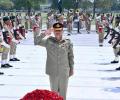
Sections in the US State Department and Pentagon have always felt more comfortable dealing with all powerful Pakistani generals instead of elected civilians, points out Rana Banerji, who headed the Pakistan desk at RA&W.

The delegations from the US and Iran head to Islamabad on Friday, carrying a ceasefire that is already fraying, a Strait that is technically open and practically closed, and a negotiating agenda that would challenge even parties actually negotiating in good faith, which these groups are not. Prem Panicker continues his must read blog on the Iran War.

Pakistan's Prime Minister Shehbaz Sharif has welcomed the ceasefire between the US and Iran and invited delegations from both countries to Islamabad for peace negotiations.

Amidst escalating tensions in West Asia, Pakistan's defence chief visited Saudi Arabia to discuss regional security and the mutual defence pact between the two nations, focusing on de-escalation strategies.

US President Donald Trump said on Wednesday that Washington is considering a "joint venture" with Iran to secure the Strait of Hormuz, following his announcement of a two-week ceasefire.

Iran has announced the Strait of Hormuz is open to commercial vessels, coinciding with a ceasefire between Lebanon and Israel.

The popularity of US President Donald Trump is waning with approval ratings at its lowest, according to former diplomat Mahesh Sachdev, who notes that with two-thirds of Americans not approving of a continuation of the war on Iran, Trump faces the risk of being impeached.

Trump has said he would be present at the signing ceremony in Islamabad. Don't be surprised if the Pakistani hosts make it a grand event in the geopolitics of the region. Trump would love that, notes Ambassador M K Bhadrakumar.

Officials from Pakistan, Afghanistan, and China are meeting in Urumqi to discuss regional security concerns and potential confidence-building measures.

The fragile ceasefire in West Asia between the US and Iran to halt the hostilities in the region for two weeks faces renewed uncertainty as Tehran reportedly moved to block the strategic Strait of Hormuz once again due to Israel's intensified offensive against Hezbollah in Lebanon, according to Iranian state media Islamic Republic News Agency (IRNA), which US President Trump says was "not included" as part of the ceasefire deal.
Direct talks between the US and Iran, mediated by Pakistan, have failed to produce an agreement after 21 hours of negotiations, with disagreements over Iran's nuclear ambitions and sanctions proving insurmountable.

Following a US agreement to a ceasefire, Iran claims victory and outlines conditions for a lasting peace deal, including control over the Strait of Hormuz and the removal of sanctions.

The Congress party has criticised Prime Minister Narendra Modi's diplomatic efforts following the ceasefire agreement between the US and Iran, facilitated in part by Pakistan. The party claims this development undermines Modi's strategy and exposes his perceived failures in foreign policy.

Pakistan's Army chief Asim Munir visited Washington and met with top US political and military leaders, discussing mutual interests and regional security.

'As result, Netanyahu 'convinced' Trump to go to war with the help of overoptimistic Israeli intelligence assessments, essentially explaining to him that they only need to bomb Iran for 3-4 days, and the regime would then collapse.' 'Rather unsurprisingly, Netanyahu is ever since blaming his own intel service for the entire operation failing.'

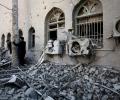
The logic of war plus the gathering storms in US politics as the midterms loom large leave him with no real alternative but to negotiate, points out Ambassador M K Bhadrakumar.

The clock on the ceasefire is running out. But everyone's already whispering about round two, possibly as soon as this weekend.

'The White House lunch that Trump hosted for Munir last year came just after Munir returned from a visit to Iran, at a moment when Israel and Iran were at war.' 'Trump said after that lunch that the Pakistanis know Iran very well. He likely views Munir as a useful interlocutor that can give helpful insights on Iran.'

As he settled down to his job as army chief, General Qamar Javed Bajwa -- who died last week; his passing did not merit even an obituary in major print or electronic media in Pakistan! -- developed a vision of reducing his country's and his institution, the army's traditional hostility toward India, points out Rana Banerji, who headed the Pakistan desk at RA&W.
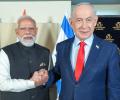
The Congress party has criticised the Indian government's diplomatic strategy, claiming a 'severe setback' if reports of Pakistan mediating between the US-Israel and Iran are accurate. The party alleges Pakistan's diplomatic engagement has surpassed India's, despite military successes.

The core issues to be settled -- access to Hormuz, Israel's aggression in Lebanon, the question of Iran's nuclear programme, sanctions relief and compensation -- are thorny enough to require weeks of patient negotiation. The most likely outcome of the opening sessions is that both sides take the measure of each other, establish what is and is not negotiable, and return home without having broken anything. That would count as progress.
A senior Pakistani official has affirmed Pakistan's commitment to supporting Saudi Arabia, even before assistance is explicitly requested, amidst ongoing conflict in West Asia. This pledge underscores the close ties between the two nations and Pakistan's role in regional stability.
