
Donald Trump had a busy Thursday on the sidelines of the APEC Leaders' Summit in Shenzhen, China. Trump met Chinese President Xi Jinping for talks before holding a separate meeting with Russian President Vladimir Putin.

US President Donald Trump, Chinese President Xi Jinping and Russian President Vladimir Putin held a closely watched trilateral meeting on the sidelines of the APEC Economic Leaders' Summit in Shenzhen, China. These photographs capture key moments from the high-profile gathering, including diplomatic talks, ceremonial meetings and interactions between the three leaders during one of the year's most significant geopolitical events.
Rahul Gandhi stated that if the Congress party were in power, India's Prime Minister would be participating in crucial global discussions alongside leaders like Donald Trump, Xi Jinping, and Vladimir Putin. He criticised the current Prime Minister, suggesting a "compromised PM" cannot hold such a position. His comments followed a trilateral meeting where US, China, and Russia discussed UN reforms and nuclear risk reduction.

US President Donald Trump, Chinese President Xi Jinping, and Russian President Vladimir Putin held an unprecedented trilateral meeting at the APEC Economic Leaders' Meeting in Shenzhen, discussing global conflicts, nuclear arms reduction, and artificial intelligence.

China announced a "ground-breaking" trilateral meeting between the presidents of China, the US, and Russia, scheduled for November 19 in Shenzhen during the APEC summit. This first-ever face-to-face meeting aims to discuss safeguarding world peace, strategic stability, and global challenges like nuclear arms reduction and artificial intelligence. Beijing has shown reluctance on trilateral nuclear arms control due to its smaller arsenal, while the war in Ukraine will not be a discussion point. The APEC summit will also see Japanese Prime Minister Sanae Takaichi's participation, drawing attention due to recent Sino-Japanese tensions over Taiwan.

United States special envoy Steve Witkoff engaged in high-stakes talks with Russian President Vladimir Putin on Wednesday in St. Petersburg. The aim of the meeting was to advance proposals to end the war in Ukraine and establish a pathway towards broader negotiations.
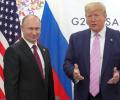
Former President Donald Trump's recent deal with Russia to supply diesel to the US and global markets has ignited a political firestorm, drawing sharp criticism from Ukraine's President Volodymyr Zelenskyy, Democratic leaders, and a segment of Republicans, despite the US Treasury lifting sanctions on Russian diesel supplies.
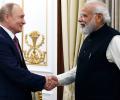
Russian President Vladimir Putin has stated that Prime Minister Narendra Modi possesses "very good ideas" for a mutual settlement of the Ukraine conflict and consistently raises the issue in their meetings. Putin also expressed appreciation for India's cultural diversity and unity, citing Modi's insights on the coexistence of various languages.

The 18th BRICS Summit got underway in New Delhi with leaders of partner countries gathering in the capital to discuss the changing global economic and geopolitical landscape.

One of the important topics of discussion between the two leaders is expected to be the Northern Sea Route and the Chennai-Vladivostok Maritime Corridor.

Putin has issued a stark warning to European nations, declaring that any deployment of troops to Ukraine would be met with 'war with Russia'.

Russia remains India's biggest fertiliser supplier, with imports rising nearly 40 per cent in 2025.

Russian President Vladimir Putin is set to visit India for a three-day trip to attend the 18th BRICS Summit and engage in bilateral discussions with Prime Minister Narendra Modi. The summit will focus on strengthening strategic partnerships and addressing international issues, with Putin also scheduled to meet other world leaders.

Russian President Vladimir Putin has arrived in India for a three-day visit to attend the BRICS summit and hold bilateral talks with Prime Minister Narendra Modi, focusing on expanding trade, investment, and energy cooperation amidst global geopolitical challenges.

US President Donald Trump received a grand welcome from Chinese President Xi Jinping in Shenzhen for the APEC Economic Leaders' Meeting, culminating in an unprecedented trilateral meeting with Russian President Vladimir Putin. The leaders discussed critical global issues including the Ukraine conflict, Iran, artificial intelligence, and nuclear arms reduction, marking significant political gains for each leader on the international stage.

Russian President Vladimir Putin has proposed a new investment platform, based on the New Development Bank (NDB), to fund projects in trade, infrastructure, logistics, and technology across BRICS nations, emphasising that the grouping's expanding economic cooperation is not 'against anyone' but aims to advance members' national interests.

Prime Minister Narendra Modi and Russian President Vladimir Putin held extensive discussions to strengthen bilateral trade, defence, and energy cooperation, while also addressing the ongoing Ukraine conflict and exploring avenues for peace and resolution, with Modi reiterating India's call for dialogue and diplomacy.

US President Donald Trump, Chinese President Xi Jinping, and Russian President Vladimir Putin adopted a joint 'Declaration towards Peace' following their trilateral summit in Shenzhen, committing to dialogue on reducing nuclear risks, ensuring stable energy flows, and preventing the abuse of jurisdiction by the International Criminal Court.

Prime Minister Narendra Modi presented Russian President Vladimir Putin with a Russian translation of the Thirukkural, the classical Tamil work by poet-philosopher Thiruvalluvar, ahead of the BRICS Summit in New Delhi.

Prime Minister Narendra Modi urged Russian President Vladimir Putin to move from 'endless war to the end of war' in Ukraine, emphasising that a peaceful resolution is humanity's shared priority.

Ahead of President Vladimir Putin's visit to India for the BRICS summit, Russia has expressed support for New Delhi's peace initiatives to resolve the Ukraine conflict. Discussions between Putin and PM Modi will cover defence, energy, technology, and the repatriation of Indian nationals from the Russian military, alongside addressing trade and investment ties.

Russian President Vladimir Putin has condemned US and Israeli military aggression against Iran, including strikes on its nuclear facilities, and offered Russia's support to end the ongoing conflict in West Asia, according to Iran's security chief Major General Mohsen Rezaei.

The BJP has strongly criticised Congress leader Rahul Gandhi for his comments on India's global standing and a Trump-Xi-Putin meeting, accusing him of being "clueless on geopolitics" and promoting "pro-Pakistan propaganda." BJP leaders highlighted India's strategic autonomy and engagement with various global forums, while questioning Gandhi's understanding of international diplomacy.

Ukrainian President Volodymyr Zelenskyy addressed the UN General Assembly, accusing Russia of using citizens from over 40 countries, including India, to fight in its war against Ukraine. He urged these nations to prevent their citizens from being drawn into the conflict, highlighting that Ukraine has taken prisoners of war from these countries and that many have perished. Zelenskyy also called for limiting trade with Russia to cut off its war funding and criticised the weakening of sanctions.

Russia on Monday assured India of uninterrupted supply of energy and fertilisers amid disruption caused by the West Asia crisis, as External Affairs Minister S Jaishankar met President Vladimir Putin in Moscow and held talks with his key interlocutors.

Prime Minister Narendra Modi and Ukrainian President Volodymyr Zelenskyy discussed peace efforts for the Russia-Ukraine conflict, with Modi reaffirming India's commitment to a peaceful resolution. Zelenskyy also sought India's mediation in establishing food corridors for Black Sea grain exports.

Union Minister Kiren Rijiju criticised the Congress party and Rahul Gandhi's "compromised PM" remark against Prime Minister Narendra Modi. Rijiju posed four questions to the Congress, including about the 1962 India-China war and India's economic history, while also alleging the party abandoned armed forces during the 1962 conflict. This political exchange follows Gandhi's comments on Modi's absence from a trilateral meeting at the APEC summit.

India is hosting the 18th BRICS Summit in New Delhi, bringing together numerous world leaders including presidents from China, Russia, South Africa, Iran, and Egypt, along with prime ministers and foreign ministers from other nations. The summit will feature bilateral talks and highlights the expanded BRICS grouping's growing global influence and India's significant role as a founding member and current chair.

Nvidia's board is not considering reinstating former CEO Jensen Huang, despite his alleged discussions about returning and a lobbying campaign by prominent tech executives, including Elon Musk. Huang resigned on November 12 amid an investigation into alleged extramarital relationships and questions about chip diversion to China. US President Donald Trump has expressed openness to his return, contrasting with Treasury Secretary Scott Bessent's call for a "dramatic shake-up." The board is exploring successors, with Arm Holdings CEO Rene Haas among potential candidates.

Vance was sceptical about the war against Iran and was the only figure in Trump's circle who refused to endorse Benjamin Netanyahu's bid for re-election as prime minister, points out Ambassador M K Bhadrakumar.
Congress leader Rahul Gandhi has declared Indian democracy 'sacred' and dismissed the idea of boycotting elections, arguing it would dismantle the country's democratic framework. His remarks, made at the University of Chicago, came as the BJP intensified its criticism, accusing him of spreading anti-India propaganda by reiterating vote theft allegations on foreign soil. Gandhi also commented on India's foreign policy and the Israel-Gaza conflict.

On Saturday, on the sidelines of the BRICS Summit 2026, Prime Minister Narendra Modi and other leaders participated in a tree plantation on the lawns of Bharat Mandapam in New Delhi.
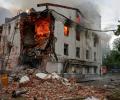
Russia has expressed gratitude for India's readiness to contribute to resolving the Ukraine conflict, while Ukraine's Foreign Minister praised India's ceasefire proposal as the "broadest" among those received. President Putin also acknowledged Prime Minister Modi's "very good ideas" for a mutual settlement, highlighting India's intensified diplomatic efforts focusing on Black Sea safety, grain exports, and energy supplies.

Ukrainian Foreign Minister Andrii Sybiha stated readiness to consider a truce covering energy infrastructure and the Black Sea.

US President Donald Trump has announced an immediate "energy ceasefire" between Russia and Ukraine, noting that both the warring nations have agreed to the truce.

US President Donald Trump has defended a controversial diesel deal with Russia, stating it aims to stabilise the global market despite bipartisan criticism from US lawmakers. The deal, which eases sanctions on Russian diesel shipments until April 2027, has been criticised as a "gift to our adversary" that finances Russia's war efforts and offers little relief to Americans.
US President Donald Trump on Saturday suggested that Ukraine should elect a "new President" capable of negotiating a deal to end the conflict with Russia, while warning Ukrainian President Volodymyr Zelenskyy against targeting Russian oil refineries, a day after announcing a diesel fuel supply agreement with Moscow.

Poland's Secretary of State, Wladyslaw T Bartoszewski, has credited Prime Minister Narendra Modi with preventing Russian President Vladimir Putin from using tactical nuclear weapons in Ukraine in late 2022, highlighting Modi's significant influence on the Russian leader.

The US announced a 60-day pause on sanctions against Russia and tariffs on other countries, including India, to analyse the global economic impact. This decision, made via an executive order by Trump, has drawn significant criticism from both Republicans and Democrats, who had previously passed the Lindsey O. Graham Sanctioning Russia and Iran Act. US officials stated the waiver allows for assessment of global energy pressures and European allies' refusal to impose secondary sanctions on Russian oil buyers.

Russian President Vladimir Putin asserted that any attempts to undermine India's sovereignty through 'threats of sanctions' would 'boomerang immediately' under Prime Minister Narendra Modi's leadership, highlighting India's sovereign decision-making and strong national interests.
