
Global payments solution major Mastercard has fully exited Indian fintech firm Pine Labs, selling its entire 4.31 per cent stake for Rs 933 crore through block deals on the BSE.

The UK has successfully test-fired a US torpedo from an undersea drone, marking a significant advancement in submarine technology for the AUKUS partners (UK, US, Australia). This development coincides with Prime Minister Andy Burnham's visit to the UN General Assembly, where he is discussing global challenges like AI, the Ukraine conflict, and West Asia security with international leaders, and announced the UK will host the G20 Leaders' Summit in Manchester next November.

Trump has announced an 'Infinite Life' agreement with Denmark and Greenland, claiming it grants the United States permanent control over security and the ability to prevent adversaries from establishing a military presence or making sensitive investments on the strategically vital Arctic island.

For a child who is six years old, one hour is the limit, says rediffGURU Dr Deepa Suvarna.
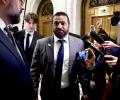
FBI director Kash Patel has escalated his war with the media by filing a massive $250 million defamation lawsuit against The Atlantic and reporter Sarah Fitzpatrick.

An Indian-origin engineer couple, Anuradha and Vikas Sinha, have donated $20 million to the University of North Texas (UNT) to establish the Anuradha and Vikas Sinha College of Artificial Intelligence and Advanced Analytics. This significant gift aims to create new opportunities for students and faculty, focusing on building and deploying intelligent systems and understanding their operation within human contexts. The donation underscores the couple's belief in education and immigrant contributions to the American dream, supporting leadership, scholarships, professorships, research, and entrepreneurship.

Passenger traffic Y-o-Y fell 26.8 per cent in April and 24.6 per cent in May, while capacity declined 9.6 per cent and 11.3 per cent, respectively.

Rs 299,900 can buy you Apple's first foldable iPhone. Or it can buy you a passport full of memories, a suspiciously large holiday wardrobe and enough airport coffee to develop a personality.

Jio Platforms Ltd, the digital services arm of Reliance Industries, has secured Sebi's final observation to launch an initial public offering (IPO) aiming to raise approximately USD 4 billion (Rs 37,700 crore), potentially making it the largest IPO in India's history.

Any military response to a cross-border terror attack from Pakistan will have to take into account the new alignments beginning to take shape in the region, points out former foreign secretary Shyam Saran.
'It beggars belief that Saudi Arabia would deploy military force against India, a top partner and market.'

India is significantly expanding its crude oil sourcing to Latin America, with Venezuela emerging as a major supplier, as geopolitical disruptions in the Middle East and the Strait of Hormuz compel the world's third-largest oil consumer to diversify its energy supplies.

India's Minerva Academy FC has been crowned the World Youth Cup 2026 Champions, defeating Brazil's RS Sports 2-1 in the Under-12 final in Gothenburg, Sweden, marking their third youth world title and becoming the first Indian academy to achieve this feat.

Argentina's football players displayed a political banner claiming "The Falklands are Argentine" after their World Cup semi-final win against England, potentially violating FIFA's code of conduct.

Atlanta Police are implementing enhanced security measures for the World Cup semi-final between Argentina and England, a match deemed high-risk due to the historical animosity between the two nations.

Messi, who said he was thoroughly enjoying the ride at his sixth World Cup and giving no thought to retirement, was looking forward to locking horns with 2010 champions Spain in New Jersey on Sunday.

An Argentine war veterans federation has urged football fans to prioritise the World Cup semi-final against England as a sporting event, rather than using it to reignite sovereignty claims over the Falkland/Malvinas Islands. They emphasised diplomacy for territorial disputes and called for respect for fallen soldiers without promoting hatred.

Azim Premji's private investment firm, Premji Invest, has quietly built a formidable portfolio of 11 AI startups, primarily in the US, with a combined valuation of $43 billion. The firm has participated in 19 funding rounds since 2021, with a notable focus on US-based companies, many of which were founded by Indian entrepreneurs.

The Atlanta Police Department has significantly increased security measures for the World Cup semi-final between England and Argentina, two nations with a historically fierce football rivalry, deploying additional personnel and resources across the city and stadium.

Scientists at the ICAR-CMFRI have identified a new species of deep-sea fish, named Cyttopsis indica (Indian dory), in the Arabian Sea off the Kerala coast. This discovery, based on specimens collected from the eastern Lakshadweep Sea, corrects a long-standing taxonomic misidentification and highlights the rich marine biodiversity of India's southwest coast.

Norwegian parliamentarians recreated the Viking rowing celebration made famous by their soccer fans, showing cross-party unity in support of the national team during the World Cup.

Argentina and England are set to clash in a World Cup semi-final, marking their first such encounter, a match deeply rooted in decades of historical and footballing rivalry, including infamous incidents involving Antonio Rattin, Diego Maradona's 'Hand of God' goal, and the Falklands War.

CAT and MBA expert and rediffGURU Patrick D'Souza explains how a simple daily reading habit can help aspirants clinch 99 percentile in the Common Admission Test this year.

'Control your A, B, C and D.' 'A is A1C, keep your A1C below 7 per cent.' 'B is blood pressure, so keep your blood pressure at 130/ 80 or at least below 140/ 90.' 'C is cholesterol. The bad cholesterol is the LDL cholesterol, and it should be kept below 100, preferably below 70 or 50.' 'D is discipline like diet, exercise, sleep, no smoking, etc.' 'People with diabetes who follow A, B, C and D can live up to even 100 years of age without any complications.'

Manchester City and Belgium footballer Jeremy Doku became a father, welcoming a baby boy named Praise with his wife Shireen. He temporarily left the national team's FIFA World Cup camp in the USA to be present for the birth in London, a decision supported by the Belgian Football Association despite some public criticism.
The US Department of Transportation has proposed new rules to reverse a five-decade ban on overland supersonic flights, driven by advancements in quiet supersonic technology like NASA's X-59 aircraft. This move aims to enable a new era of faster air travel while addressing noise concerns, with final rules expected by mid-2027.
Jio Platforms Ltd, the digital services arm of Reliance Industries, has filed draft papers for an initial public offering (IPO) aiming to raise approximately USD 4 billion (about Rs 37,700 crore), which is expected to be India's largest ever IPO.

'I own a few cars that I have had specified minutely to my taste, and it does feel nice to know that there are no other vehicles like them anywhere in the world.'

Jio Platforms Ltd, the digital and telecommunications arm of Reliance Industries, has approved filing draft papers for an initial public offering (IPO) involving a fresh issue of up to 27 crore equity shares, aiming to unlock value for shareholders and fuel its ambitious expansion into 5G, AI, and global markets.
India significantly increased its crude oil imports from Russia and the United Arab Emirates in June, securing supplies as the Strait of Hormuz began to reopen, with Russian barrels remaining attractive due to discounts and UAE supplies offsetting earlier uncertainties.

Cape Verde's heroic goalkeeper Vozinha will have his mother in the stands when he next takes to the pitch at the World Cup on Sunday, after US officials moved to ensure she could obtain a visa in time.

President Droupadi Murmu on Monday conferred seven Kirti Chakras, including two posthumously, to personnel of the armed forces displaying raw courage, unparalleled bravery and total disregard for personal safety in the line of duty.

A new report indicates India has become the world's fifth most digitalised economy and ranks fourth globally in AI performance, driven by increasing AI adoption and a strong digital infrastructure.

'The flip side of this is that he won't hesitate to call out India if he thinks its policies are hurting US economic interests or border US foreign policy goals.'

If Iran and Oman choose to charge a fee for rendering services to vessels using their territorial waters, so be it. The US is indulging in an irrationally self-destructive act, notes Ambassador M K Bhadrakumar.

US Secretary of State Marco Rubio said that discussions aimed at halting the conflict with Iran have shown "some slight progress," while simultaneously echoing Washington's dissatisfaction with its NATO allies.
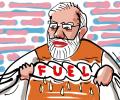
Following through announcements with enforcement of measures is key, as a run through recent Indian economic history shows, points out A K Bhattacharya.

King Charles III reaffirmed the enduring strength of the US-UK alliance, underscored NATO's centrality to global security, and shared light-hearted moments with President Donald Trump during a White House state dinner.
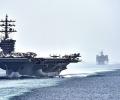
Which are the world's most vital straits, important to shipping?
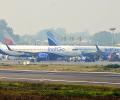
An IndiGo flight from Delhi to Manchester was forced to return to its origin due to last-minute airspace restrictions related to the ongoing situation in West Asia. The flight was using a leased Boeing 787 aircraft.
