
Iranian President Masoud Pezeshkian has confirmed Tehran's participation in Pakistan-facilitated peace talks with the US in Islamabad, according to Prime Minister Shehbaz Sharif. This development follows a conditional ceasefire agreement and aims to address regional tensions.

US President Donald Trump has renewed his call for a high-security ballroom at the White House, citing security concerns after a shooting incident near a journalists' dinner he attended.

Following a shooting incident near the White House Correspondents' Dinner, US lawmakers from both parties have condemned political violence and called for national unity. President Trump and other officials were evacuated unharmed.

President Donald Trump praised the Secret Service for their swift response to a shooting incident at the White House Correspondents' Dinner, identifying the shooter as Cole Tomas and highlighting the need for enhanced security measures.

China's Foreign Ministry has refuted allegations of providing military support to Iran, warning the US against imposing tariffs based on these accusations. The statement follows reports of Iran acquiring a Chinese satellite for targeting US military bases. Meanwhile, a rescheduled meeting between Presidents Trump and Xi Jinping is set for May.

It remains unclear whether United States President Donald Trump or Iranian authorities will pursue the offer.

Melania Trump has publicly denied any connection to Jeffrey Epstein, dismissing allegations as false and politically motivated.

US President Donald Trump has claimed that China has committed to halting weapon supplies to Iran, following his personal diplomatic interventions with Chinese President Xi Jinping.
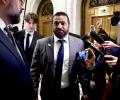
FBI director Kash Patel has escalated his war with the media by filing a massive $250 million defamation lawsuit against The Atlantic and reporter Sarah Fitzpatrick.

US President Donald Trump has stated that the war with Iran is "close to over," while the US Central Command reports blocking traffic to Iranian ports.

The Iranian Foreign Ministry has stated that Tehran currently has no plans for a subsequent round of negotiations with the United States, according to the state media Tasnim news agency. This announcement comes as international mediators had hoped for a follow-up to the Islamabad talks before the looming ceasefire deadline.

The embassy also said that the exit must be undertaken in coordination with the mission.

Donald Trump has issued a stern warning to Iran regarding alleged fees imposed on tankers passing through the Strait of Hormuz, further escalating tensions amid fragile ceasefire agreements and ongoing disputes with Israel over Lebanon.

Iran has denied sending a delegation to Islamabad for peace talks with the United States, contradicting Pakistan's claims of mediating the negotiations. The denial highlights a lack of confidence in Pakistan's ability to ensure security for high-level participants and underscores the fragile nature of diplomatic efforts between the US and Iran.

A spokesperson said the government is carefully assessing these communications in the context of the ongoing regional crisis.

Donald Trump has expressed confidence that Tehran will engage in diplomatic talks, warning that the country will 'see problems' should it refuse to cooperate.

The meeting follows a ceasefire agreement that was announced and welcomed by Shehbaz Sharif, who also extended invitations to both delegations for further negotiations.

Donald Trump has extended the deadline for Iran to reopen the Strait of Hormuz, amid escalating tensions between the two countries. Trump issued a harsh warning to Tehran, threatening to target Iran's energy and civil infrastructure if the Strait is not opened.

Despite outward displays of cordiality, a formal visit by King Charles III to the US revealed underlying tensions between the leaders, highlighted by subtle rebukes and contrasting views on key issues.

Trump was swiftly evacuated from the White House Correspondents' Dinner after a shooting incident near the venue.

World leaders have expressed their relief and condemnation following a shooting incident at the White House Correspondents' Dinner, emphasising that political violence has no place in a democracy.
World leaders have expressed relief and condemnation following a shooting incident outside the White House Correspondents' Dinner, where US President Donald Trump and other top officials were present. Leaders from various countries reiterated that political violence has no place in a democracy.
President Donald Trump and other top White House officials were evacuated unharmed from the annual White House Correspondents' dinner after a gunman opened fire outside the hotel ballroom. The suspect, identified as Cole Tomas Allen, has been arrested. World leaders have expressed relief that Trump and other guests were unharmed, emphasising that political violence has no place in a democracy.

In his resignation letter to US President Donald Trump, Kent called the conflict with Iran unjustified, contending that Washington, DC entered the war due primarily to pressure from Israel and its powerful American lobby rather than clear, direct threats to national security.

US President Donald Trump on Friday referred to the Strait of Hormuz as a potential "gusher" for the world and spoken about "opening it for the world."

The statement comes even as Tehran links the issue to ongoing efforts to bring a complete end to hostilities in West Asia involving the United States and Israel.

Pakistan's skewed foreign reserves got a major boost after Saudi Arabia pledged an additional $3 billion in deposits while extending its existing $5 billion facility for a further three years.

India has expressed strong concerns over attacks on commercial ships in the Strait of Hormuz, citing its importance to India's energy and economic security. Ambassador Yojna Patel highlighted the need to respect international law and ensure the safety of seafarers, while also addressing broader Middle East issues including the situation in Gaza and Lebanon.

Citing sources familiar with the matter, the report said Trump believes the conflict is in its final stages and has urged aides to adhere to the four-to-six-week timeline he has outlined publicly.
Chief negotiators from India and the US are set to begin three-day talks in Washington to recalibrate the bilateral trade agreement (BTA) framework, following significant changes in the US tariff landscape, including a new 10 per cent tariff imposed on all countries.

US President Donald Trump expressed confidence in America's position amid US-Iran peace talks in Islamabad, stating that Washington stands to 'win' regardless of a deal.
India attended the inaugural meeting of US President Donald Trump's Board of Peace on Gaza as an observer country, represented by Charge d'affaires at the Indian Embassy in Washington DC, Namgya Khampa.

Trump's message, posted on his Truth Social platform, is a reminder of his 10-day ultimatum given to the Islamic Republic earlier to make progress toward a deal or reopen the vital shipping lane.

Trump added that the United States would assist in managing the traffic buildup in the Strait of Hormuz.

Elon Musk reportedly participated in a phone call between US President Donald Trump and Indian Prime Minister Narendra Modi to discuss the Iran crisis, raising questions about his involvement in diplomatic discussions.

As the deadline for military action against Tehran approaches, US President Donald Trump has issued a series of provocative statements suggesting a monumental shift in the geopolitical landscape.

Trump claimed on social media that recent US-Iran discussions were 'very good and productive' and aimed at a 'complete and total resolution' of the conflict.

Facing escalating threats from the US, Iran is mobilizing its citizens to form 'human chains' around power plants as a defensive measure against potential airstrikes, raising concerns about international law and civilian safety.

A Middle East expert claims that President Trump's approach to Iran is endangering US interests in the Gulf region, with support for the Iranian regime growing amid US-Israel tensions.

The representative of Iran's Supreme Leader in India expressed gratitude towards Indians, calling India a land of 'loyalty and humanity'.
