
Eleven Naxalites, including five senior operatives with a combined bounty of Rs 68 lakh, have surrendered to police and CRPF forces in Gadchiroli district, Maharashtra, marking a significant blow to Left Wing Extremism in the region.
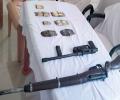
Fifteen Naxalites, including a veteran ultra with a significant bounty, surrendered in Chhattisgarh, effectively dismantling the Maoist movement in the Raipur-Sambalpur region.
Fifteen Naxalites, including a Special Zonal Committee-level member, surrendered to security forces in Chhattisgarh's Mahasamund district, marking a significant development in the state's efforts to combat Naxalism.

Surrendered Naxalites in Madhya Pradesh's Balaghat district are learning new skills such as sewing and driving as part of their reintegration into mainstream society, with the support of the local police.

In a significant victory for the government's anti-Naxal efforts, 108 Maoists, including 44 women, surrendered in Chhattisgarh's Bastar district, citing disillusionment and the appeal of rehabilitation programs. The surrender also led to the recovery of a large cache of weapons and valuables.

Security forces in Chhattisgarh's Gariaband district recovered a significant cache of cash, arms, and ammunition from Maoist hideouts, acting on information from surrendered Naxalites.
The Naxalites, 10 of whom are women, turned themselves in before senior officials of the state police and the Central Reserve Police Force (CRPF), he added.

210 Maoist cadres, including a Central Committee member, surrendered to authorities in Chhattisgarh's Jagdalpur, marking the "largest mass surrender" in the state's anti-Naxal operations. The surrendered Naxalites carried a collective bounty of Rs 9.18 crore and handed over 153 weapons. Chief Minister Vishnu Deo Sai hailed the development as a historic moment for Chhattisgarh and the nation.

Forty-one Naxalites, including 32 carrying a reward of Rs 1.19 crore, surrendered in Chhattisgarh's Bijapur district, citing the government's surrender policy and rehabilitation efforts.
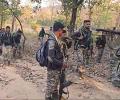
The Madhya Pradesh government promoted 60 police personnel for their role in anti-Naxal operations, celebrating the state's success in eradicating Maoist influence.

Once the might of the Indian establishment turned completely against the Maoists, there was no way they could survive -- either in Gadchiroli or anywhere else, points out M R Narayan Swamy.

Senior Naxalite Mallojula Venugopal Rao, also known as Bhupathi, surrendered to police in Maharashtra's Gadchiroli district along with 60 other cadres. Bhupathi, a key strategist in the banned organization, carried a significant bounty.
Chhattisgarh Deputy Chief Minister Vijay Sharma met surrendered Naxalites at a rehabilitation center in Sukma, offering them a visit to the state assembly and directing officials to improve their living conditions and opportunities.

Security forces killed 14 Naxalites, including wanted ultras Mangtu (DVCM) and Hunga Madkam, in separate encounters in Chhattisgarh's Sukma and Bijapur districts in the Bastar region on Saturday, officials said.

Two senior leaders of the banned CPI (Maoist), including a Central Committee Member underground for over four decades, surrendered to Telangana police, citing health issues, pressure from security forces, and ideological differences.

'Sujatha's decision to surrender reflects the deep crisis of confidence that the Maoist ranks are facing in recent times.'

139 Naxalite cadres surrendered in Maharashtra and Chhattisgarh, marking a significant turning point in the fight against Left Wing Extremism. The surrenders included a top Maoist strategist and were hailed as a sign of the movement's decline.

The Ministry of Home Affairs reports a significant reduction in the number of districts most affected by Naxalism, highlighting the government's efforts to combat Left Wing Extremism.

President Droupadi Murmu stated that government actions against Maoists have improved the atmosphere in Bastar, Chhattisgarh, leading to development. She encouraged those who have left violence to trust the Constitution.

The Maoists in Bastar went from one village to another with kits providing badly needed medical intervention. The medical help was one key reason why the tribals were attracted to the Maoists, points out M R Narayan Swamy.

Top Maoist leader Ganesh Uike and five other red rebels were killed in gun battles with security forces in Odisha's Kandhamal district.

Sixteen Maoists, including top leader Anal, were killed in a gunfight with security forces in Jharkhand's West Singhbhum district on Thursday, Union home minister Amit Shah said.
After recent high-intensity operations in the Bastar region and the neutralisation of several senior Maoist leaders, officials say the insurgency has lost its ability to mount large-scale coordinated attacks.

'The Maoist leadership spread fear that surrender meant torture or death. Once that false narrative collapsed and our operations proved transparent and credible, the surrender momentum became irreversible.' 'From 42,000 square kilometres, Maoist activity is now confined to barely 500-600 square kilometres -- less than two per cent of Bastar. This is their last remaining base area.'

Maoists have admitted that 28 cadres, including their top leader Basavaraju, were killed in an encounter with security forces in Chhattisgarh's Bastar region last week. The Naxals also claimed that some of their cadres had surrendered to police and provided information that led to the operation. Police have recovered a large cache of weapons, including an AK-47 looted by Basavaraju from security forces in a 2010 ambush.

Chhattisgarh Chief Minister Vishnu Deo Sai announced that North Bastar and Abujhmad regions are now free of Naxal violence, with the fight against Naxalism in South Bastar reaching a decisive phase. He attributes this success to trust-building measures and the surrender of Naxal cadres.
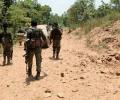
A hill with an altitude of 5,000 feet, once a hub of the Maoists along the Chhattisgarh-Telangana border, was reclaimed by the security forces after driving out the extremists following nine days of intense anti-Naxal operation, official sources said.

Prime Minister Narendra Modi asserted his commitment to eradicating Maoist terror from India, criticizing the previous Congress regime for allegedly supporting 'urban Naxals' and ignoring the violence they perpetrated. He highlighted the significant reduction in Maoist-affected districts and the surrender of numerous Naxalites as evidence of his government's success in combating the issue.

Ten Naxalites were killed in an encounter with security personnel in Chhattisgarh's Sukma district on Friday, a senior police official said. The gunfight broke out in the morning in a forest within the jurisdiction of the Bhejji police station when a joint team of security personnel was out on an anti-Naxalite operation. The operation was launched based on inputs about the presence of Maoists belonging to Konta and Kistaram area committees of Naxalites on forested hills of Korajguda, Dantespuram, Nagaram and Bhandarpadar villages. Chief Minister Vishnu Deo Sai hailed security forces and said the era of peace and progress has returned to the Bastar region, which includes Sukma.
'Handling or mitigating a rebellion is not a corporate plan with quarterly, half-yearly and annual goals and results but an aggregation of the effort of several years.'
Chhattisgarh Deputy Chief Minister Vijay Sharma has reiterated the state government's willingness to engage in unconditional peace talks with Naxalites, following a statement by the Maoist group outlining preconditions for a ceasefire. Sharma, who holds the home portfolio, stated that the government has already made its stance on unconditional talks clear and has implemented a surrender and rehabilitation policy for Naxal cadres. He criticized the Maoists' demands as unreasonable and emphasized the importance of ending violence and joining the national mainstream. Sharma also called on the Naxalites to send a representative if they are serious about peace talks, but ruled out the formation of a separate committee for negotiations. The Maoist statement, released in Telugu, highlighted the group's concerns regarding intensified counter-insurgency operations and alleged human rights violations. They appealed for a positive atmosphere for peace talks, calling for a halt to anti-Naxal operations and the establishment of new security camps.

In a fresh offensive against Naxals, security forces killed at least 30 members of the banned CPI-Maoists in two separate encounters in Chhattisgarh's Bastar region on Thursday, officials said.
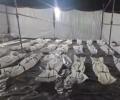
In one of the deadliest blows to Naxalites in Chhattisgarh, security forces on Sunday gunned down 31 rebels, including 11 women, in a fierce encounter in the state's Bijapur district, police said.
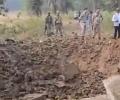
Eight District Reserve Guards (DRG) jawans and a civilian driver were killed in Chhattisgarh's Bijapur district when Naxals detonated an improvised explosive device targeting their vehicle. The incident occurred near Ambeli village while the security personnel were returning from an anti-Naxalite operation. This is the biggest Naxal attack on security forces in the region in the past two years.
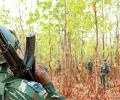
Earlier on Monday, two women Naxalites were killed and one CoBRA jawan was injured in an encounter during the same operation, they said.

With this incident, 154 Naxalites have been gunned down by the security forces in different encounters in Chhattisgarh so far this year, the police said.
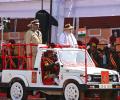
Union Home Minister Amit Shah has declared that Chhattisgarh will be free from the menace of Naxalism by March 31, 2026. He stated that the Centre and the state government are committed to eradicating Naxalism, highlighting the significant achievements of the Chhattisgarh police in the last year. Shah also appealed to Naxalites to surrender and join the mainstream, emphasizing the government's rehabilitation policy. He further praised the Chhattisgarh police's efforts in curbing organized crime and narcotics.
Eight Naxalites were killed in an encounter with security forces in Chhattisgarh's Bijapur district on Saturday. The gunfight broke out in the forest when District Reserve Guard and Special Task Force of the state police along with Central Reserve Police Force (CRPF) and CoBRA (Commando Battalion for Resolute Action) were out on an anti-Naxalite operation. An Insas rifle and a barrel grenade launcher (BGL) were among the weapons recovered from the encounter site. This brings the total number of Naxalites killed in separate encounters in the state this year to 50.


Terming Naxals the biggest human rights violators, Union Home Minister Amit Shah on Monday said security forces have been carrying out 'offensive operations' instead of defensive against the insurgents and have achieved big successes in recent times.
 © 2026 Rediff.com - Advertise with us - Disclaimer - Privacy Policy - Sitemap - Feedback - About us - Terms of use - Grievances