

Once the might of the Indian establishment turned completely against the Maoists, there was no way they could survive -- either in Gadchiroli or anywhere else, points out M R Narayan Swamy.

Key Points
- Naxalism's decline is the result of sustained, localised counter-insurgency.
- The Gadchiroli experiment marked a turning point in the movement against Naxalism.
- The creation of the C-60 unit reversed the asymmetry between Maoist dalam squads and conventional police patrols.
Kamala Alaam's transformation from an Adivasi girl who was awe-stuck by Naxalites to becoming a police commando to hunt down her former comrades is an exposure of the rot that has gripped India's now dying Maoist movement.
Like numerous young tribals at Gadchiroli in Maharashtra, Kamala was initially swayed by Naxalite claims that the government must be fought to prevent the jal (water), jungle and zameen (land) of the Adivasis from being taken away.
It did not take too long for the unlettered Kamala to realise that there was an ocean of difference between what the Maoist radicals preached and practised.
When her grandfather was arrested on false charges of colluding with the Naxalites, Kamala assumed that the local Maoist dalam (group) would provide her lawyers. The Naxalites refused, causing her deep hurt.
One day, she defied a Maoist commander who insisted that she tell her employer in a paddy farm to double her wages from Rs 170 to Rs 350. Kamala said no, saying the higher rate was too much to ask for.
A furious Bhupati Anna, a notorious Naxalite leader, beat her with a bamboo stick as punishment. Kamala's hatred for the Maoists increased.
When Kamala's younger sister was abducted by the Naxalites, she turned to the police for help. Surprisingly, the policemen acted promptly, raided a Naxalite camp on Kamala's tip and freed her sister.
The Maoists were now livid. They tried to kill Kamala twice, but she survived. Isolated and with no other option, she offered her services to the police.
Fortunately, the police officer in charge of Gadchiroli, a known Maoist den, was Krishipal Raghuvanshi, who had been thinking out of the box since he was posted in the backward region with a fiat to stamp out Naxalism.
Despite misgivings amongst his seniors, Raghuvanshi raised a specialised police unit made up of sturdy locals familiar with Gadchiroli's terrain, tribal customs and dialects besides known Maoist tactics. It came to be known as C-60.
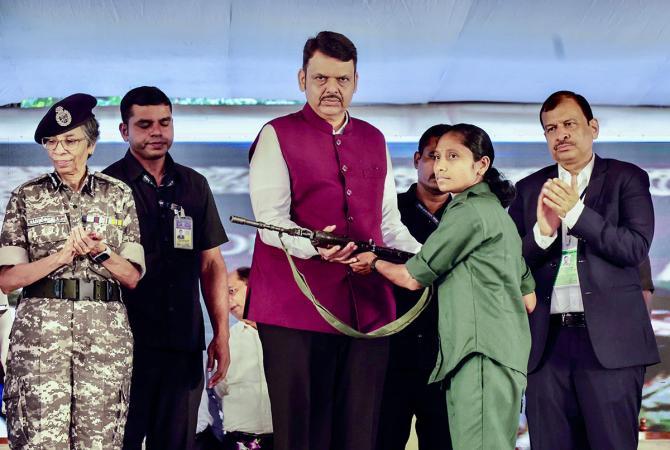
The Rise Of Kamala
On January 1, 1992, Kamala, designated a constable, became the first woman member of the elite unit.
In no time, she became a master interrogator of arrested Naxalites, particularly women. Her talent for getting the detainees to confess sensitive information resulted in more arrests and the recovery of arms and ammunition.
Her recruitment encouraged more and more tribal women to join the police. Kamala's impressive performance led her to be promoted as a police commander in which role she netted more Maoists.
Eventually, her son too joined the police at Gadchiroli in June 2006.
Kamala's metamorphosis forms one of the most delightful parts in journalist Jitendra Dixit's gripping biography of Krishipal Raghuvanshi, titled Trouble Shooter (Pan Macmillan).

How C-60 Proved A Match For Naxalites
C-60 proved more than a match for Naxalites in Gadchiroli and whose success story, in many ways, is now being replicated across the country.
But the triumph didn't come easily. The Naxalites had grown so strong in Gadchiroli that a posting there was seen as a punishment in the Maharashtra police. More often than not, police patrols hesitated to take on the Naxalites even if they were in sight. Such was the Red terror.
Until he was shunted to Gadchiroli, Raghuvanshi knew next to nothing about the Naxalites. All he got as a guide from a senior officer was a copy of Red Star Over China, the first notable work on Mao's revolution in China by veteran American journalist Edgar Snow.
The classic did not take him very far. But a free and frank chat with some of his disgruntled junior colleagues led him to conclude that the Maoist problem would never go away unless one started to think -- and act -- like a Naxalite.
In other words, if the Maoists had their dalam, the police too must have specialised units to sneak into the unfriendly forests and ambush the unsuspecting Naxalites, giving them a taste of their own medicine.
Trouble Shooter is an unintended capsule of what led to the rise of the Naxalites, why the Indian State at one point looked like folding up before them, and why the radicals are now on their last legs -- and in their last bastion.
Gadricholi's tribals suffered like tribals everywhere in the country: They endured malnutrition (hunger), lack of connectivity and healthcare facilities, as well as atrocities by corrupt officials. Tribal women were sexually exploited.
If all this was not enough, a major part of Gadricholi district had no electricity; in a few areas where power was available, it was irregular. The police outposts were little more than tin huts.
Put together, the bleak scenario was an open invitation to Naxalites.
Many of the policemen in Gadricholi were dumped there as punishment for indiscipline, corruption and dereliction of duty. All were depressed. Many policemen succumbed to malaria and dengue. Raghuvanshi wondered how he could fight the Maoists with such living corpses.

Winning The Hearts Of Adivasis
The Naxalites were a determined lot. They used dialects like Madiya and Gond to win over the tribals. Like elsewhere, they redressed the problems of agriculture and forest produce.
The Maoists helped the tribals to build tanks in villages due to lack of irrigation canals. A cooperative system was introduced wherein two-four families ploughed the field and collected firewood together.
Some corrupt officials who harassed the tribals were beheaded. Each time the Naxalites ambushed security forces, they took away the weapons of the dead and the wounded. They also procured arms from insurgents in north east India.
After learning all this, Raghuvanshi told his men to win over the Adivasi hearts -- by helping them and with good conduct. When the policemen started doing this in isolated villages, the tribals were taken aback.
They opened up to the cops, offering them water to drink or a place to rest. The police realised that a section of tribals, more so teachers, hated the Maoists for their cruelty but were afraid of rebelling.
Setting up the C-60 wasn't easy due to lack of institutional support. Raghuvanshi bought uniforms with a friend's help in Mumbai, using secret service funds meant for informers.
Once he got an official nod, he increased the unit's strength to 100.
The Greyhounds, who crushed the Naxalites in Andhra Pradesh, gave specialised training --climbing hills, walking through the jungle with heavy weights, jumping from heights, crossing rivers and surviving the forest.

The Success Of C-60
Once the C-60 began operating, the tide turned. Numerous infamous Naxalites were apprehended. Intelligence came from tribal villagers disgusted with Naxal terror.
The abduction of a popular Congress MLA, Baba Atram, by the Naxalites and the government's decision to free a notorious jailed Maoist, Shivanna, was a blow after the C-60 failed to trace the politician.
But there were successes too. This included the change of heart by a young Maoist, Sunil, who was disgusted by the discrimination in the Red ranks.
The propaganda by the C-60 too helped. Even as the Naxalites killed some security personnel, they continued to suffer heavy reverses.
Shivanna, released by the government, was gunned down, but after Raghuvanshi had quit Gadchiroli. So was the dreaded Santosh Anna, who once tried to kill Raghuvanshi, who narrowly escaped death when the Maoists blew up a wrong vehicle in his convoy.
Such was the reputation he gained thanks to the C-60 that when he was transferred, virtually the entire Gadricholi town turned up to bid him goodbye.
The success the security forces achieved in Gadchiroli is more or less the path that has been followed across India, albeit with minor changes. Trouble Shooter exposes how the Maoist movement, once led by idealist youth, eventually came to be captained by those who strayed into terror tactics and came to lord over the tribals.
There was no way Mao's methods were going to succeed in India.
As long as the ruling dispensation viewed the Maoists with some sympathy, they appeared powerful.
Once the might of the Indian establishment turned completely against the Maoists, there was no way they could survive -- either in Gadchiroli or anywhere else.
Feature Presentation: Aslam Hunani/Rediff






 © 2026