
Ebrahim Azizi, head of Iran's National Security Committee, stated that diplomatic talks with the US are governed by national interest and security, viewing negotiations as an extension of military efforts.

The Iranian Foreign Ministry has stated that Tehran currently has no plans for a subsequent round of negotiations with the United States, according to the state media Tasnim news agency. This announcement comes as international mediators had hoped for a follow-up to the Islamabad talks before the looming ceasefire deadline.

The United States Central Command (CENTCOM) has announced that American forces are maintaining a strict maritime restrictive operation in the region, continuing to enforce a blockade against Iranian ports.

The US military is considering a new wave of military operations in Iran, including potential strikes on infrastructure and securing Iran's stockpile of enriched uranium, amid a fragile ceasefire and stalled nuclear talks.

As the security situation continues to evolve in West Asia and the Gulf region, an Iranian military source has warned the United States against any ground aggression on Iran, calling it a red line and saying a 'surprise' would await US President Donald Trump, Tasnim News Agency reported on Saturday.

The ceasefire is still technically holding, to the extent that no overt hostilities have been reported yet, but the rhetoric has hardened dangerously. The week ahead will also clarify whether the Islamabad failure was a negotiating tactic or whether Washington has genuinely locked itself into a position from which the only exits are climb-down, escalation, or the slow bleed of a new status quo that nobody chose and nobody controls. Prem Panicker continues his must read blog on the Iran War.

US Vice President J D Vance stated that while progress was made during peace talks in Islamabad, it is now up to Iran to further the discussions and address US concerns regarding its nuclear ambitions.

US President Donald Trump on Sunday expressed confidence that Tehran would eventually concede to American demands, while simultaneously issuing a stern warning regarding the potential for total military devastation.

The Pakistan Army intercepted and destroyed Afghan Taliban drones targeting civilian areas, resulting in injuries. This incident has further strained relations between the two countries, with Pakistan reiterating its commitment to combating terrorism emanating from Afghanistan.

...reopen for up to six months. Until then, the Strait stays nearly closed. The world pays. And no one, including the man who started this, can say when it ends, notes Prem Panicker in his must read blog on the Iran War.

The intriguing bit is that Trump is likely to attend the talks in Islamabad this weekend -- if he does, it will be the clearest signal yet that the US is ready to exit the war with some sort of win to show, since he cannot afford to go for the talks and return empty-handed, notes Prem Panicker in his must read blog on the Iran War

The cost of the war is being counted not in the corridors of power in Washington or Tehran, but in Firozabad's darkened furnace rooms, Howrah's idle casting sheds, and a barbershop in Kochi where the wait is suddenly, inexplicably, an hour long, notes Prem Panicker in his must read blog on the Iran War.

For weeks, the war skirted the edge of catastrophe without tipping over. Missiles flew, there was much destruction, commanders were assassinated, cities across the Gulf and even in Israel struggled to absorb the shock. But one line held: Energy infrastructure, the arteries of the global economy, remained largely untouched. That is no longer true. Prem Panicker continues his must read daily blog on the Gulf War.

The LPG squeeze on India's restaurant sector is the quotidian face of a deeper crisis.

The UN Security Council, with India's support, has adopted a resolution condemning Iran's attacks on Gulf Cooperation Council countries and Jordan, demanding an immediate cessation of hostilities and denouncing threats to the Strait of Hormuz.
Very sensitive items -- such as apples, which carry political weight and are closely tied to farmer interests in states like Himachal Pradesh and Uttarakhand -- may face restricted concessions.

Will rising tensions between US-Israel and Iran threaten crude oil supply through the Strait of Hormuz, putting India's fuel prices, imports, and economic stability at risk?

In the wake of the recent hostilities, both sides have moved from weapons to words, with India dispatching several delegations to visit more than 30 capitals across the world. A similar effort by Pakistan is set to start on Jun 2.

Silver prices rallied sharply by Rs 15,000 to hit a lifetime high of Rs 265,000 per kg in the national capital on Monday, and gold advanced to a fresh record of Rs 144,600 per 10 grams, mirroring strong gains in the global markets.

Sustaining 8 per cent-plus growth rates is necessary if we are to reach high-income status by 2047, points out Amitabh Kant.
Following Pakistani airstrikes in Afghanistan's Barmal district of Paktika province, which left 46 dead and six injured, the Ministry of Foreign Affairs of Afghanistan on Wednesday summoned the Charge d'Affaires of the Pakistani Embassy in Kabul.

China has imposed sanctions on 20 US defence firms in response to the Trump administration's approval of a record USD 11.1 billion arms sales package to Taiwan.

When asked whether Iran had crossed the red line he had drawn over the treatment of protesters, Trump said, "They're starting to, it looks like."

'Pakistan's role in Bangladesh will always be negative, since it's a one-point agenda is hostility against India.'

For decades, the Siliguri Corridor was treated as a geographical vulnerability to be quietly managed. Today, it has emerged as a focal point of eastern geopolitics.

Pakistan's former spy chief Faiz Hameed has been sentenced to 14 years in jail by a military court after being found guilty of violating the Official Secrets Act and engaging in political activities. This marks the first time a former ISI chief has been convicted.
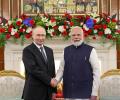
Luckily for us, a Russia that is desperate to stay relevant in an emerging multipolar world finds in India a reliable geostrategic partner. The Russian proximity to India also keeps China from exploiting its economic dominance vis a vis Russia, points out Colonel Anil A Athale (retd).

A Chinese diplomat's aggressive comments threatening the Japanese Prime Minister over remarks about Taiwan have ignited a diplomatic row between China and Japan.

"Indians will decide the fate of India, not the foreigners," Verma told the Montreal Council on Foreign Relations, a prominent think-tank.

'A deal will only be possible if India stops buying Russian oil -- but even then, New Delhi must not compromise its core red lines.'
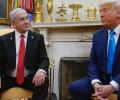
United States President Donald Trump has denied that he recently told Israeli Prime Minister Benjamin Netanyahu to stop being so 'f***ing negative' and 'take the win' after Hamas accepted parts of Washington, DC's proposal for ending the Gaza war, while saying that it would have to hold talks regarding other portions of the plan, The Times of Israel reported.

An aggressive opposition is expected to corner the government over US President Donald Trump's claims that he mediated to avert a nuclear war between India and Pakistan, and got them to agree on a "ceasefire".

Asokan said Ramdev went against the medical profession by saying "modern medicine is a stupid and bankrupt science".

Chief of Defence Staff Gen Anil Chauhan identifies China border dispute as India's biggest national security challenge, followed by Pakistan's proxy war. He also highlighted regional instability, future warfare scenarios, and dealing with nuclear-armed adversaries as major concerns.

For too long has Pakistan gotten away with running with the terrorists and hunting with the forces. This duplicity needs to end, asserts Saisuresh Sivaswamy.

While Asim Malik's role in Pakistan's recent warming up of relations with the US is acknowledged, army watchers note a recent distancing, what with Asim Munir not wanting his DG, ISI to share the limelight during his subsequent sojourns to Tampa and Brussels, points out Rana Banerji, who headed the Pakistan desk at RA&W.

The steep 50 per cent tariffs imposed by the United States on Indian goods are largely a result of President Donald Trump's 'personal pique' at not being allowed to mediate in the India-Pakistan conflict, according to a recent report by American multinational investment bank and financial services company Jefferies.

Jaishankar said the US ambassador will say what he feels is the thinking or position of his government.
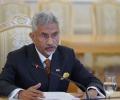
The relations between New Delhi and Washington are on a downturn after Trump doubled tariffs on Indian goods to a whopping 50 per cent, including 25 per cent additional duties for India's purchase of Russian crude oil.
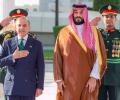
'Saudi-Pak defence pact is to anchor the defence and security of Saudi Arabia and not Pakistan, per se, with Islamabad being the junior partner.'
 © 2026 Rediff.com - Advertise with us - Disclaimer - Privacy Policy - Sitemap - Feedback - About us - Terms of use - Grievances