
India-China border trade via Uttarakhand's Lipulekh Pass is set to resume on August 1 after a gap of more than six years, with the neighbouring country granting permission to 20 Indian traders to visit Purang (Taklakot), according to officials.

Russian President Vladimir Putin stated that Moscow would not interfere in the "delicate" bilateral relations between India and China, expressing confidence in their ability to resolve border disputes amicably. He also discussed Russia's independent partnerships with both nations, touched upon India-Pakistan ties, and highlighted ongoing and proposed defence cooperation with India, including the BrahMos missile and a potential Su-57 fighter jet project.
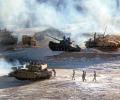
While tensions have eased at several friction points and mechanisms for managing the boundary have been reactivated, underlying differences persist. Disputes over naming practices in Arunachal Pradesh, continued infrastructure development on both sides, and unresolved questions regarding patrolling rights indicate that the structural gap remains, notes Dr Kumar.

Indian and Chinese armies held their first high-level commanders' flag talks in the Arunachal Pradesh sector, following Special Representatives dialogue. These talks, aimed at maintaining peace along the Line of Actual Control, occurred amidst reports of aggressive military posturing and just days before Chinese President Xi Jinping's visit to India for the BRICS summit.

In July, tension emerged in Taksing, a remote village in the Upper Subansiri district of Arunachal Pradesh after locals sighted PLA soldiers.

India and China have agreed to advance discussions on an "Early and Substantial Harvest" of boundary delimitation and border management during the 25th round of Special Representatives talks between National Security Advisor Ajit Doval and Chinese Foreign Minister Wang Yi in Beijing. Both sides reached an eight-point consensus, committing to the 2005 Agreement on Political Parameters and Guiding Principles for Settlement. Key outcomes include enhancing border management, improving understanding of the Line of Actual Control, establishing new meeting points and hotlines, and continuing cooperation on trans-border rivers and pilgrimage.

Indian and Chinese military officials have held corps commander-level talks in Arunachal Pradesh to review the Line of Actual Control (LAC) situation, following recent Special Representative discussions aimed at de-escalating border tensions and fostering bilateral ties.

Foreign Secretary Vikram Misri held extensive discussions with China's Vice Foreign Minister Hua Chunying and other senior officials in Beijing, reviewing bilateral relations, trade, cultural exchanges, and emphasising peace and tranquillity in border areas. His visit aims to advance the vision of both nations as development partners.

India on Tuesday conveyed to China the importance of maintaining peace and tranquility along the Line of Actual Control (LAC) for overall bilateral ties as national security advisor Ajit Doval held talks with Chinese Foreign Minister Wang Yi focusing on delimitation of the frontier and sustaining work on trans-boundary cooperation.

Former CDS Anil Chauhan stated that China poses a long-term and comprehensive challenge to India, with the boundary issue remaining unresolved due to differing perceptions of the Line of Actual Control. However, he emphasised that India's ties with Beijing cannot be solely defined by border disputes, advocating for engagement through platforms like SCO and BRICS. He also highlighted the broader global geopolitical flux and instability in India's neighbourhood as significant security concerns, stressing the need for self-reliance.

India and China are in what experts call 'a cooperation-versus-competition situation'.

Prime Minister Narendra Modi, in bilateral talks with Chinese President Xi Jinping, emphasized that both nations must show sensitivity to each other's core issues and be guided by mutual respect, sensitivity, and interest. Modi highlighted the critical importance of peace and tranquillity along the Line of Actual Control for the development of India-China relations, while also addressing concerns regarding Taiwan and Tibet.

During the 18th BRICS Summit in New Delhi, Chinese President Xi Jinping and Prime Minister Narendra Modi held a bilateral meeting, outlining a four-point approach for the steady and long-term development of China-India relations. The leaders stressed strategic understanding, win-win cooperation, mutual respect, and inclusive multilateral engagement, reaffirming their commitment to resolving the boundary question and addressing economic concerns. They also discussed global challenges and strengthening people-to-people ties.
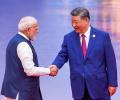
India and China held diplomatic talks to review the situation along the Line of Actual Control (LAC), discussing boundary delimitation, border management, and trans-border cooperation. Both nations stressed the importance of maintaining peace and tranquillity for bilateral relations and agreed to continue using existing channels to resolve outstanding issues.
'Eastern Ladakh set the relationship back by about 10 steps. So far, especially since Galwan, we may have taken just 4 steps forward.'

Chinese Foreign Minister Wang Yi stated that President Xi Jinping and Prime Minister Narendra Modi reached a crucial consensus during the BRICS summit, agreeing that China and India should be partners, not rivals. The leaders pledged to maintain peace and tranquility in border areas, deepen cooperation, and support each other in multilateral forums, aiming to strengthen the Global South and promote a multipolar world order.

Xi's bilateral meeting with Modi was substantial and readouts from both sides gave indications of rapprochement, if not a reset of bilateral relations between India and China, notes Ambassador T P Sreenivasan.

Border trade between India and China through the Lipulekh Pass in Uttarakhand's Pithoragarh district is set to resume this year after a six-year hiatus due to the COVID-19 pandemic.

External Affairs Minister S Jaishankar stated that the stability of the Line of Actual Control (LAC) is essential for normalising India-China relations, asserting that border disturbances will have consequences. He connected trade and investment growth to border peace and highlighted significant economic issues, including a severe trade imbalance and lack of market access for India in China. Jaishankar also referenced the 2020 Galwan clashes as a critical turning point, underscoring the profound impact of border tranquillity on the overall bilateral relationship.

China has issued a Level-IV alert due to a newly formed barrier lake at the Tibet-Nepal border, warning of a high risk of breaching and flooding downstream areas. The lake, formed at the confluence of Chhochen Khola and Purepu Tsangpo rivers, has accumulated an estimated two million cubic metres of water, with inflows expected to increase, raising concerns for areas including Gyirong Port.

A massive mudslide near the China-Nepal border in Tibet has left three people dead and 588 missing. Chinese President Xi Jinping has ordered all-out rescue efforts, with the PLA mobilising forces for search and relief operations in the affected Gyirong County. The Indian Embassy has also issued an advisory for stranded Indians.

China has voiced strong opposition to India's recent decision to standardise names for 28 strategic locations and geographical features in Ladakh.

India has rejected China's objection to New Delhi's standardisation of names for 28 places and features in Ladakh, reiterating that Ladakh is an "integral and inalienable" part of India. China had strongly opposed the move, calling India's establishment of the Union Territory and the naming "illegal and void".

'Therefore, Beijing comes to wrong conclusions.'
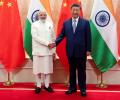
India has asserted that the state of its border with China directly impacts the broader bilateral relationship, emphasising the critical importance of maintaining peace and tranquillity along the Line of Actual Control (LAC). The Ministry of External Affairs also firmly rejected China's claims over Arunachal Pradesh, reiterating its status as an integral part of India. This stance was reiterated during a recent Working Mechanism for Consultation and Coordination meeting, where both sides agreed to continue using diplomatic and military channels to resolve outstanding issues.

India and China held constructive talks on the situation along the Line of Actual Control (LAC) in eastern Ladakh, emphasising that maintaining border peace and tranquillity enabled progress in normalising overall relations.

'We are open to all countries around the world as long as we get a fair deal, as long as we are ensured continuity in the engagement.'

Chinese President Xi Jinping is in New Delhi for the 18th BRICS Summit, where he is scheduled to hold bilateral talks with Prime Minister Narendra Modi. This visit, his first to India in nearly seven years, comes amidst efforts to normalise India-China relations following the 2020 Eastern Ladakh standoff and is expected to have significant implications for bilateral ties and BRICS cooperation.

National security advisor Ajit Doval arrived in Beijing on Monday for a two-day visit to take part in the Special Representatives talks on the India-China boundary question with his Chinese counterpart and Foreign Minister Wang Yi.

Prime Minister Narendra Modi conveyed to Chinese President Xi Jinping that peace and tranquillity along the frontier remains an "essential" basis for the development of India-China relations, even as the two leaders welcomed "steady progress" in bilateral ties during their talks on the sidelines of the BRICS summit.

Until Delhi and Beijing resolve outstanding border issues within an accelerated time frame, standoffs like Doklam will be repeated across various peaks along the Himalayas, says Mathew Maavak.
National Security Advisor Ajit Doval is in Beijing for the 25th round of Special Representatives talks on the India-China boundary issue with his Chinese counterpart Wang Yi. These crucial discussions precede Chinese President Xi Jinping's anticipated visit to India for the BRICS summit, offering a potential opportunity for a meeting with Prime Minister Narendra Modi. The talks aim to address the long-standing border dispute and recurring tensions, with both sides emphasising the importance of peace and tranquillity for bilateral relations amidst recent reports of aggressive Chinese posturing in Arunachal Pradesh.
China has declared India's move to identify 27 places in Arunachal Pradesh by their standard names as "illegal, null and void," reiterating its claim over the region it calls Zangnan. India has consistently rejected China's renaming attempts, asserting Arunachal Pradesh as an integral part of India.

National Security Adviser Ajit Doval held "constructive" talks with Chinese Foreign Minister Wang Yi in New Delhi, focusing on the normalisation of bilateral ties. The discussions reviewed recent developments and progress towards rebuilding trust after the eastern Ladakh border standoff. Both sides have implemented measures, including disengagement pacts and high-level meetings, to improve relations.

'The Chinese military cannot advance much in Ladakh, even if they want to.' 'Similarly, in Arunachal Pradesh, they can rename a village or two, intrude here or there, but cannot do much more realistically.'
Nepal has reiterated its claim over the Lipulekh territory, stating it is an inseparable part of the country, after India and China agreed to resume border trade through the area. The Nepalese government has incorporated the territory into its official map and Constitution. India has rejected Nepal's claims, asserting they are not based on historical facts or evidence.

Bangladesh-China and Bangladesh-US relations have evolved from reluctant engagement to increasingly consequential strategic partnerships.
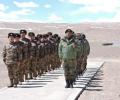
The US hopes that the differences will be resolved peacefully, officials said in Washington.
'When the Galwan incident took place, that was a big break in the trust factor between India and China.'
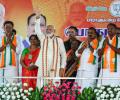
The prime minister should apologise to the 140 crore Indians for deceiving them on national television on June 19th, 2020, with his statement Na Koi Ghusa Hai, Na Hi Koi Ghus Aaya hai
