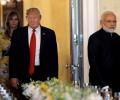
'China was the elephant in the Oval Office and Trump would have sensed that Modi's foreign policy architecture has become disoriented sans the US' pivot to Asia,' points out Ambassador M K Bhadrakumar.
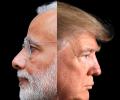
Here's why Rajeev Srinivasan believes there will be nothing particularly positive about the prime minister's US visit.

'Chinese leaders rarely receive their foreign guests in cities other than Beijing. Such respect for India!' 'Does it mean that Modi could replicate "the warmth and unconventional way" by sending Indian troops into Tibet, as Xi did in Chumur (Ladakh) when he arrived in India? Of course, Indians are far too polite to do so,' says Claude Arpi.

'His secretary of defence nominee, General James Mattis, says he expects Pakistan to take action against terrorists operating from its soil.' 'Any pressure the US can bring on the Pakistani regime terror-wise would pay dividends for India.'

Prime Minister Narendra Modi has said India has a chance to rise again as a global economic power and suggested that it could match with China and he has a "clear roadmap" to channelise entrepreneurial capabilities of country's 1.25 billion people.

Tillerson said China's behaviour and action is "posing a challenge to the rules-based international order".

The 2 countries signed 15 agreements including one on defence cooperation after Prime Minister Narendra Modi held 'productive discussions' with President Joko Widodo.

'By the time he came out after nearly five hours, he had a one-to-one conversation with the President, a delegation-level meeting, a reception, a dinner, a tour of the White House and a joint statement of a kind none of his predecessors ever had,' says Ambassador T P Sreenivasan.

Boosting trade and simplifying visa regime, apart from security and defence cooperation, were among the key bilateral issues. The two leaders also discussed regional and international matters of mutual interest.

''There is the perennial worry in the Indian mind regarding the US 'hyphenating' India and Pakistan. Frankly, this is a completely nonsensical hypothesis. The US has always 'hyphenated' India and Pakistan and it couldn't have been otherwise,' says Ambassador M K Bhadrakumar.

President Pranab Mukherjee's recent visit to the Pacific Island nation is path-breaking, but much more needs to be done, says Dr Rahul Mishra.

The readouts by the Indian and Chinese sides on the meeting on Monday between External Affairs Minister Sushma Swaraj and her Chinese counterpart Wang Yi in Moscow bring out that divergences are crowding into the centrestage of their relationship, says Ambassador M K Bhadrakumar.

'While visits and personal meetings are useful, changes of strategic significance have occurred recently, with Beijing trying to take the lead which Modi must take note of.'

Australian Prime Minister Tony Abbott on Monday said it was now "highly unlikely" that any debris of the missing Malaysia Airlines plane will be found on the ocean surface, as he announced a more intensive underwater search

The search for missing Malaysia Airlines flight MH370 has come to an end with passengers' families being informed that the effort to find the plane has been suspended.

'Assuming the official defence allocations represent the true picture, the $142 billion figure still represents a phenomenal increase and surpasses that of Japan ($42 billion), India ($40 billion), South Korea ($33 billion) and several other Asian countries put together and shows that China is flexing its military muscle.'

Confronting a slowdown in growth, China says it will only increase its defence budget by 7.6% this year, against the anticipated rise of between 20% and 30%. 'It is difficult to explain the reduction in the Chinese defence budget,' says Claude Arpi. 'Is there a hidden budget? Possibly!'

ADB has often expressed its interest in promoting sub-regional integration in South Asia and perhaps could be involved as a facilitator.
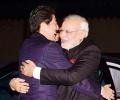
'The regional context and the personal ties between Modi and Japanese Prime Minister Shinzo Abe to a large extent contributed to this dawn of a new era in bilateral relations,' says Srikanth Kondapalli.

'Europe can be discussed on a golf course...' 'North Korea? What do I care what the man with the bad haircut does?'

'A bit of marketing, a bit of positioning, and a lot of strategic thinking is required, and all this should be in aid of India's strategic intent: Becoming the third pole in a global G3 and aiming for Numero Uno,' says Rajeev Srinivasan.

'Difficult issues should not be brushed under the carpet, but should be raised upfront, particularly by India. While engagement and dialogue are always welcome and desirable, there should be some tangible results. Mere signing of agreements, MoUs, joint declarations are not enough.'

'Ensuring through diplomatic means and in conjunction with strategic partners that India will not be required to fight a simultaneous two-front war with China and Pakistan.' Brigadier Gurmeet Kanwal (retd) lists what India must have in its national security strategy.

'If India and China come together, 40 per cent of the world's people are going to be prosperous'
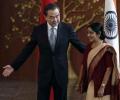
The entire gamut of bilateral ties including the contentious boundary issue was discussed during a "cordial and substantive" engagement between the foreign ministers of India and China in New Delhi who met within two weeks of installation of the Narendra Modi government.

'How can a State, which claims to be a responsible power, unilaterally grab a "disputed" area to build a road on it?' asks Claude Arpi.

One thing Beijing must understand is that India is not obsessed with being a threat to China but only wants a rightful place for itself in the world, says Sanjeev Nayyar.

"India will succeed if it's not splintered on religious lines."

In the case of India, there are no specific references in China's white paper. However, there are several takeaways for India, says Srikanth Kondapalli.

'Extending the range of the DF-21D could challenge Indian aircraft carriers if the missiles are launched from southwest China. Also, if Pakistan acquires these systems, these missiles could directly challenge India's aircraft carriers.'

Modi knew in his heart that India does not have the financial muscle to support the new bank with offers of co-financing international projects, something China can do from the bank's base in Shanghai. If established in Mumbai, it may have employed a few Indian bankers and satisfied the national ego but there was little financial value to be drawn from it.

'This is the first time that the Americans have agreed to refer to "cross-border terrorist attacks" in a joint statement.' 'No wonder Pakistan has called the joint statement "singularly unhelpful" and has blasted it, and its all-weather friend China has applauded Pakistan's frontline role in combating terrorism,' points out former foreign secretary Ambassador Kanwal Sibal.
Seeking to boost the strategic ties, India and the US finalised the text of the Logistics Exchange Memorandum of Agreement.

It seems China is ready to cooperate with India in the central Asian region through the SCO framework, the reasons for which are manifold, says Sana Hashmi.

'India should think big: About how in a multi-polar world, India can indeed be one of the poles, rather than being a secondary power that has to worry about 'alignment' with one of the poles. A G3 in other words, India should look to getting others to align with itself rather than the US or China,' says Rajeev Srinivasan.
In all the noise surrounding the Dok La confrontation, Claude Arpi focuses on a crucial issue that has hardly been covered -- the construction of roads for the armed forces and the local population to reach the most remote border posts.

The US wants to split Sino-India ties, says the Chinese media.

Narendra Modi speaks to CNN's Fareed Zakaria in his first interview after becoming prime minister. The excerpts

The search for the crashed Malaysian jet on Friday dramatically shifted to a new area 1,100 km further northeast in the Indian Ocean after authorities received "the most credible lead" of radar data suggesting the plane flew faster and ran out of fuel more quickly than estimated.

The 'Missing link in India's Act East Policy', as India's former foreign secretary Shyam Saran calls it, needs to be filled sooner rather than later, says Dr Rahul Mishra.
 © 2026 Rediff.com - Investor Information - Advertise with us - Disclaimer - Privacy Policy - Sitemap - Feedback - About us - Terms of use - Grievances