
Kuala Lumpur's delay in roping in India to help track the missing aircraft is an indicator that New Delhi must redouble its diplomacy and capacity demonstration in East Asia, feels Nitin Pai

Stating that India is new bright spot of hope and opportunity for the world, the prime minister said India among other things is igniting the engines of its manufacturing sector and making its farms more productive and more resilient.

'It will make good sense for military men on that side of the table to be confronted by our own.'

India has some ability to influence what the world order will look like, but it needs to make structural changes to the ministries of external affairs and commerce, and evolve formal coordination mechanisms with the ministries of finance and home, says Nitin Pai
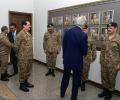
'Both India and Pakistan are now, for the first time in history, very closely allied and connected with the US -- economically and politically.'

There's still little indication of forward movement in Indo-US defence relations.

'China might soon have to seriously consider whether it prefers an Indo-US hyphenation to a Sino-Indian one.'

'This is the first time the US has formally recognised the threat India faces from terrorist organisations based in Pakistan.'
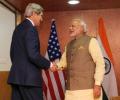
Elaborating on America and India's scope of engagement, Kerry said he has seen first-hand the transformation in Indo-US relationship as well as the ups and downs in the relationship. Kerry says the world's oldest and largest democracy were "finally beginning to captalise on our connections to each other." Sheela Bhatt/Rediff.com reports after the media interaction with the US secretary of state.

After Pyongyang tests a missile potentially capable of reaching the US, Dr Rajaram Panda explores the realistic -- and peaceful -- options before Donald Trump and the international community at large.

Will China's new military reforms endanger Xi Jinping's rule?
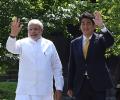
Although the India-Japan relationship has its own driving forces in terms of robust economic ties and shared values, China is the elephant in the room in the strategic parleys between the two countries, says Rup Narayan Das.

'We should hit Pakistan, continue to prepare for surgical strikes, continue to punish Pakistani posts in the proximity of the LoC and we should start adopting counter terrorist measures.' 'That should be India's action without escalating it to a full-fledged war.'
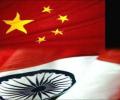
China wants a code of conduct for troops on the India-China border areas. While the Indian side has reacted cautiously, it is not clear what effective additional protocols that the current proposed code will bring forth to usher stability in the border areas, says Srikanth Kondapalli.

'Modi and Obama both had agendas that went beyond the nuclear deal. The threat from the chilly Himalayas had to be tackled in the warm waters of the Indian Ocean.'

Japanese Prime Minister Shinzo Abe may attend the opening ceremony for the Sochi Winter Olympics, but China has ruled out any formal meeting with President Xi Jinping whose attendance at the Games has already been confirmed.

'The Modi-Xi and Modi-Obama meetings, with an interval of just 12 days, are juxtaposed superbly at a crucial point in the prime minister's life. Can Modi carve out a win-win situation with the superpower and the emerging superpower at the same time?'

Dr Manmohan Singh would be faced with very few choices in Beijing given the Chinese conceived notions of the world today and India's low place in their calculus, says Srikanth Kondapalli.

'Obama probably thinks, "He is quite a guy!" Americans on Capitol Hill think, "He has guts. He is a big player".' An Indian official explains the importance of the Modi visit to Sheela Bhatt/Rediff.com

'China made it evident that neither the swing-ride at Ahmedabad nor the red carpet at New Delhi worked, by timing its muscle-flexing in Ladakh to coincide with Xi's visit.'

President Xi Jinping's visit may put relations between India and China on a new trajectory

The prime minister's outreach to Japan is a recognition of the civilisational potential that the two nations hold and can wield in evolving an era of 'Asianism' in global politics, says Anirban Ganguly.
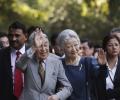
In the media frenzy over inconsequential issues, the visit of the Emperor of Japan to India has been pushed to the margins of public discourse. Colonel (retd) Anil Athale explains the great historical and political significance of the visit.

'The question remains: Was the Obama visit truly a success? Only the future will tell us if the "breakthrough" in the nuclear liability issue will concretise into electricity.' 'As importantly, it will be interesting to watch how India's relations with China will evolve in the months to come.'

Because of India's weak fiscal position, the plethora of debt-burdened infrastructure companies and the poor asset quality of public sector banks, economic growth in 2015-16 may be limited to about six per cent, say Shankar Acharya.

The chaos on its stock markets, a fierce battle between the old and new guard in the Communist Party and the restive border provinces of Tibet and Xinjiang forebode tough times ahead for China, says Claude Arpi.

'If the dimensions of the strategic partnership worked out by India and the US seem like a grand alliance targeted at you-know-who, China had better realise that it has fathered it,' says B S Raghavan, a long time observer of China.

India needs to build its Grand Narrative, and its cultural power, which conquered all of ASEAN (then known as Indo-China), needs to be forcefully projected while simultaneously hard economic and military power are also emphasised, says Rajeev Srinivasan.

India and Japan have a shared interest in countervailing China's hegemonic ambitions in Asia. Although neither has an interest in forming an overt anti-China alliance, Tokyo and New Delhi feel increasingly obligated to work together to find ways to guard against a muscular Beijing's power sliding into arrogance, says Brahma Chellaney.
A sensational interview on India-China ties, with the man most qualified to answer.

'It was China's rise that caused the New Cold War in Asia as it prompted the United States to rebalance its forces in Asia to experiment with engagement and containment at the same time,' says T P Sreenivasan.
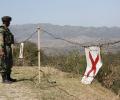
'The response to terror is not always reciprocal terror, nor is launching a conventional response the best response.' 'The best response is to make the sponsor pay a price he cannot afford,' says former RA&W chief Vikram Sood.
Two months after the Malaysia Airlines plane vanished into the skies, conspiracies have floated to explain the enigma of the vanishing flight. Amid these claims, one is that the plane was hijacked and is being prepped for a terror attack by the Taliban or by Israeli terrorists. Anvar Alikhan tries to piece this puzzle together and find out the truth behind flight MH370.

'What if Modi becomes the fascist the leftists paints him as? What if he does suspend the Constitution and declares himself the ruler, with support from the army? What exactly will you do, Mr Leftie?' asks Rajeev Srinivasan.

'Devyani -- she is a public servant and her personal life has already received far too much attention -- and her ambitious father now need to retreat to the background so that wiser diplomatic heads restore sanity to India-US relations as India prepares for parliamentary elections,' says Ambassador K C Singh.
 © 2026 Rediff.com - Investor Information - Advertise with us - Disclaimer - Privacy Policy - Sitemap - Feedback - About us - Terms of use - Grievances