
The clock on the ceasefire is running out. But everyone's already whispering about round two, possibly as soon as this weekend.

Trump said that the strait will be "open very soon" if ongoing negotiations with Tehran continue successfully.

Nobody takes Pakistan seriously and therefore Pakistan's sudden mediating with almost immediate results of a ceasefire seems more contrived than real, points out Vice Admiral Biswajit Dasgupta (retd).

His remarks come after Trump warned Iran of severe consequences if it fails to reopen the strategically vital Strait of Hormuz, a key global energy transit route.

Capex, infrastructure development, and prudent fiscal management are the key focus areas in the Budget, says Nilesh Shah.

The intriguing bit is that Trump is likely to attend the talks in Islamabad this weekend -- if he does, it will be the clearest signal yet that the US is ready to exit the war with some sort of win to show, since he cannot afford to go for the talks and return empty-handed, notes Prem Panicker in his must read blog on the Iran War

The delegations from the US and Iran head to Islamabad on Friday, carrying a ceasefire that is already fraying, a Strait that is technically open and practically closed, and a negotiating agenda that would challenge even parties actually negotiating in good faith, which these groups are not. Prem Panicker continues his must read blog on the Iran War.

By all available indications, the White House drafted a face-saving note and handed it, ready-made, to Islamabad. Pakistani Prime Minister Shehbaz Sharif was supposed to then post it in the guise of a plea urging Trump to extend the deadline by two weeks 'to allow diplomacy to run its course'. Trump would then graciously accept Pakistan's 'request' and declare a ceasefire. Sharif dutifully posted the message on X. Except that he, or whoever was handling the account, forgot to delete the tell-tale first line visible in the edit history: 'Draft - Pakistan's PM Message on X'. Prem Panicker's must read blog on the Iran War.

Amidst rising Middle East tensions, External Affairs Minister S Jaishankar highlights India's strategic dialogue with Iran to safeguard maritime traffic through the Strait of Hormuz, ensuring India's energy security and continued oil trade.

Donald Trump's inconsistent statements and actions regarding the conflict with Iran have drawn criticism and confusion, raising questions about American credibility and the direction of US foreign policy.

Amid rising tensions in West Asia, China is urging all parties to cease military operations, following Trump's appeal for help in securing the Strait of Hormuz.

The Americans can occupy Bab el Mandeb, claim to have 'solved' the Strait of Hormuz crisis, declare victory that President Trump so desperately needs, points out Colonel Anil A Athale, former head of the history division, ministry of defence.

Amid escalating tensions with Iran, President Trump is urging nations dependent on Middle Eastern oil to deploy warships to the Strait of Hormuz to safeguard critical global energy supplies.

A United States missile strike has reportedly hit an educational facility in Khomeyn in central Iran, according to a report by Al Jazeera citing Iran's Mehr news agency. The site was identified as the Dr Hafez Khomeyni School.
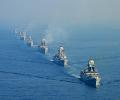
According to sources, the Indian Navy warships are on standby to provide assistance or help required by merchant vessels.

Yousef Pezeshkian, the son of the Iranian President, has confirmed that Iran's Supreme Leader Mojtaba Khamenei is 'safe and sound'. This comes after certain reports claimed that he had been injured during the ongoing strikes by the United States and Israel, according to Al Jazeera.

The Ministry of External Affairs (MEA) has stated that Prime Minister Narendra Modi and External Affairs Minister S Jaishankar are actively engaged with world leaders to promote dialogue and diplomacy for peace in West Asia, while also ensuring the safety and well-being of the Indian community in the region.

24 Indian-flagged vessels with 677 Indian seafarers were currently located west of the Strait of Hormuz, and four vessels with 101 Indian seafarers were stationed east of the strategic waterway.

Addressing the 36th extraordinary session of the Council of the International Maritime Organisation (IMO) held on Thursday in London, the Indian envoy said, "India remains deeply concerned about the evolving situation and continues to call for de-escalation through dialogue and diplomacy, with utmost restraint and priority being given to the safety of civilians."

"The US President's statements are within the framework of efforts to reduce energy prices and gain time to implement his military plans," the ministry stated.

IRGC said vessels seeking to sail through the strategically critical Strait of Hormuz must obtain Iran's approval; otherwise, they could become targets of Iranian attacks.
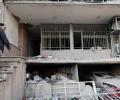
Trump said he is unwilling to make a deal with Tehran at this stage despite indications the country wants negotiations.

Hegseth said the military campaign, code-named Operation Epic Fury, against Iran is "laser focused" and "decisive," with objectives set directly by the US administration remaining unchanged since the start of operations.

A disruption in the supply of LPG cylinders caused by tensions in the Strait of Hormuz is impacting Indian kitchens, leading to restaurant closures, price hikes and a surge in demand for electric cooktops.
US Secretary of War Pete Hegseth on Friday claimed that Iran's new supreme leader, Ayatollah Seyyed Mojtaba Hosseini Khamenei, is "wounded and likely disfigured" in strikes by the US on the country.
Fathali further stated that Tehran has instructed its embassy in India to facilitate the Indian government, ensuring smooth operations amid the ongoing regional conflict.
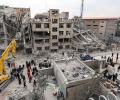
The call came before Iran's new supreme leader Mojtaba Khamenei vowed vengeance and urged citizens to continue their fight against the attacks by US and Israel.

The government has introduced a mandatory 25-day gap between LPG cylinder bookings due to supply concerns arising from global disruptions and tensions in the Strait of Hormuz. This measure aims to prevent hoarding and prioritise essential non-domestic sectors, while domestic LPG production is being increased to mitigate shortages.
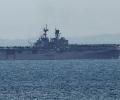
Although extensive air attacks have been carried out to destroy most of Iran's defence capabilities, the latter's resilience and sustenance during the war clearly indicate that the US landing force would encounter severe resistance in the operation, explains Commodore Venugopal Vengalil (retd).
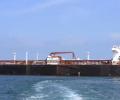
Despite ongoing tensions in West Asia, the successful arrival of the LPG carrier 'Nanda Devi' in Gujarat ensures a steady supply of liquefied petroleum gas to India, highlighting the country's efforts to secure its energy needs.

'In such a scenario, Iran could proclaim itself victor, rebuild, re-enforce its diminished regional proxies to further destabilise neighbouring nations and take control of the Persian Gulf and Strait of Hormuz.'
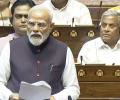
Prime Minister Narendra Modi addresses the Rajya Sabha, detailing India's strategies to navigate the global energy crisis sparked by the West Asia conflict, including securing diverse energy sources and expanding strategic oil reserves.
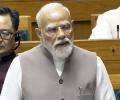
Prime Minister Narendra Modi addressed Parliament on the West Asia crisis, advocating for dialogue and diplomacy, ensuring the safety of Indians in the region, and addressing concerns about fuel and food security.

Aseem Mahajan, Additional Secretary (Gulf) in the Ministry of External Affairs, on Saturday informed that five Indians have been killed and one is missing due to the ongoing conflict in West Asia. He added that Indian missions remain open round the clock and are constantly working to provide assistance.

A senior government official confirms that Indian vessels do not require permission to navigate the Strait of Hormuz, despite regional tensions. Several Indian ships, including LPG tankers, have safely crossed the strait, ensuring continued supply of essential commodities to India.

We cannot simply have a 60-65 per cent import dependency in LPG, the bulk of which comes from just one volatile region -- West Asia, points out R Jagannathan.

Discovering the stunning land of breathtaking temples.

An Indian-flagged crude oil tanker, Jag Laadki, safely sailed from the UAE's Fujairah port despite an attack on the terminal and is scheduled to reach India. The Indian government is working to ensure the safe passage of remaining Indian-flagged vessels in the region.

Qatar has halted liquefied natural gas (LNG) production after its facilities came under attack amid the ongoing West Asia conflict, disrupting supplies to India and squeezing feedstock availability for key domestic sectors.

Trump also called upon China, France, and Japan, among others, to send ships to the Strait of Hormuz.
