

Prime Minister Narendra Modi addresses Parliament on the West Asia crisis, reaffirming India's commitment to peaceful resolution through dialogue and diplomacy while ensuring the safety of Indian citizens and securing the nation's fuel and food supplies.

Key Points
- Prime Minister Modi stresses India's commitment to dialogue and diplomacy to resolve the West Asia crisis, highlighting the unacceptability of attacks on commercial ships.
- The Indian government is actively ensuring the safety and well-being of Indian citizens in the war-affected region, maintaining communication with West Asian leaders.
- India is taking proactive measures to secure its energy needs, engaging with various suppliers to maintain oil and gas supplies and ensuring adequate coal stock for power plants.
- India possesses significant strategic petroleum reserves and is expanding storage capacity to mitigate potential disruptions in the global energy market.
- Despite the ongoing conflict, India is well-prepared in terms of food security, with ample food grain reserves and arrangements for fertiliser supply to support agricultural activities.
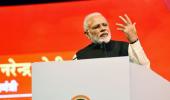
Asserting that India is advocating dialogue and diplomacy to resolve the West Asia crisis, Prime Minister Narendra Modi on Monday said that attacks on commercial ships and the disruption of the Strait of Hormuz are unacceptable and the government is in touch with suppliers from different countries to meet oil and gas needs.
In a statement in the Lok Sabha, Modi also said that every Indian in the war-affected region is being given every possible help, noting that he has spoken to the heads of state of West Asian countries and all have ensured the safety of Indians.
Addressing apprehensions of fuel shortage, he said the government is in constant touch with suppliers from various countries to ensure that oil and gas supplies continue from wherever possible and informed that all power plants in the country have adequate coal stock. He also said that India is well prepared in terms of food security.
'Dialogue and diplomacy are the solutions'
"India has always raised its voice for peace in the interest of humanity. Dialogue and diplomacy are the solutions to this problem. Our efforts are aimed at reducing tensions and ending this conflict," the prime minister said.
The war is not in the interest of humanity. Therefore, India's effort is to encourage all parties to swiftly pursue a peaceful resolution, he said, amidst the thumping of desks by the members of the ruling alliance.
Prime Minister Modi said from the very beginning of the conflict, when the US and Israel attacked Iran and the latter retaliated by targeting its Gulf neighbours and Israel, India has expressed deep concern over the conflict.
"I have spoken to the leaders of West Asia and requested them to end the escalation. India has opposed attacks on civilian, energy, and transport infrastructure.
'Attacks on Hormuz unacceptable'
"Attacks on commercial ships and disruptions in waterways such as the Strait of Hormuz are unacceptable," he said, adding that through diplomacy, India is making continuous efforts to ensure the safe movement of Indian ships in this situation.
He termed the ongoing conflict as "worrisome" and said the challenges posed by the crisis have economic, national security and humanitarian aspects.
India's Strategic Petroleum Reserves and Refining Capacity
Modi said India has more than 5.3 million metric tonnes of strategic petroleum reserves, and the country is also working on arrangements for more than 6.5 million metric tonnes of additional storage.
Apart from this, he said, there are reserves held by the domestic oil companies.
"In the last 11 years, our refining capacity has increased significantly, and the government is in constant touch with suppliers from different countries. The effort is to ensure that oil and gas supplies continue from wherever possible," he said.
Concern for Indian Nationals and Trade Routes
The prime minister said West Asia is important to India as nearly one crore Indians live and work in the Gulf countries. Among the commercial ships that sail in these seas, the number of Indian crew members is also very high.
"Due to these varied reasons, India's concerns are naturally greater. Therefore, it is essential that a unanimous and united voice from India's Parliament on this crisis reaches the world," he said.
Modi said the region where the war is taking place is also an important route for India's trade with other countries of the world, and a large quantity of essential items such as crude oil, gas and fertilisers come to India through the Strait of Hormuz.
'Ordinary families should face little trouble'
Since the war began, he said, the movement of ships through the Strait of Hormuz has become highly challenging, but despite this, the government's effort has been to ensure that the supply of petrol, diesel and gas is not excessively disrupted.
"Our effort is that ordinary families in the country face as little trouble as possible. This has been our focus," he said, adding that because of such efforts, many of the country's ships that were stranded in the Strait of Hormuz have also arrived in India.
The Prime Minister said, unfortunately, several lives were lost and some people were injured during the conflict and their families are being given the necessary help, and treatment of the injured is being ensured.
Food Security and Electricity Supply
He said another question is the impact of the war on agriculture, but the good part is that the country's farmers have filled the food grain reserves, so India is well prepared in terms of food security.
"We are also making efforts to ensure that the Kharif sowing takes place properly. For this, the government has made adequate arrangements for fertilisers to deal with any emergency. In the past as well, our government did not let any global crisis impact our farmers," he said.
Modi said that as the summer season has begun in India, electricity demand has increased, but all power plants in the country have adequate coal stock available.
"India has created a record by producing more than 1 billion tonnes of coal for the second consecutive year. In the last decade, the country has also taken major steps towards renewable energy," he said.




 © 2026