
The meeting between Prime Minister Nawaz Sharif and his Indian counterpart Narendra Modi drew mixed reactions in Pakistan, with most of the political parties accusing Sharif of failing to highlight Kashmir but the media was generally positive.

Prime Minister Narendra Modi has "strongly" and "clearly" conveyed concerns to Chinese President Xi Jinping over Beijing blocking a proposal for action by the United Nations against Pakistan on the release of jailed Mumbai attack mastermind Zaki-ur-Rehman Lakhvi, with India rejecting the "weak evidence" theory propounded by Beijing in this regard.
With Shanghai Cooperation Organisation set to admit India and Pakistan amid growing rancour over their Nuclear Supplies Group membership bid, a Chinese state-run daily expressed concern on Friday that the hostility between them may have a "negative effect" on the security grouping.

The Congress on Monday accused the ruling National Democratic Alliance of making a "fundamental departure" in New Delhi's position on Indo-Pak ties and of 'disrespecting' Parliament, as the government assured that External Affairs Minister Sushma Swaraj will make a statement on the issue later this week.

Shortly after Pakistan Prime Minister Nawaz Sharif raked up Kashmir issue once again in his address at the UN General Assembly and termed his country as a victim of terrorism, India, in perhaps its harshest ever response, said de-militarising Kashmir was not the answer for achieving peace but "de-terrorising" Pakistan is.

The Pakistan high commission has invited Kashmiri separatist leaders for consultations with Sartaj Aziz ahead of the National Security Advisor-level talks with India in New Delhi next week.

Almost every claim made by India about Pakistan's role in the 2008 Mumbai attacks has been backed by investigator, who probed the case in Islamabad.

To persist with talks in the face of continuing terrorism that puts hundreds of Indian lives at stake is not only naive but morally repugnant and ethically unacceptable. It is time to see through this charade and abandon a path of high risk and no returns, says Vivek Gumaste.

'In this Spy versus Soldier game,' says Rajeev Sharma, 'the two sides will size up each other like never before.'

'The biggest stumbling block will come from the traditionalists in the Pakistan army who have grown on a diet of anti-Indian propaganda and thinking on which much of their role -- both militarily and politically -- is centered upon.'

'Pakistan's military leaders have to accept that the policy of proxy wars has damaged Pakistan more than it has damaged the enemy,' says former R&AW chief Vikram Sood.

Sayeed said he was disappointed over the abrupt cancellation of talks but hoped that break would be "temporary".

India's blunt message followed a series of ceasefire violations along the LoC in Jammu and Kashmir by Pakistan which resorted to mortar shelling of Indian areas.

'Diplomatic engagement will continue even as India keeps all its options open with respect to discretely targeting the Pakistani military and its terrorist proxies.'

'I was a bit startled when our host spoke with such force and at such great length about Terrorism.' 'Where did that come from?' 'He kept insisting that it comes from across the border.' 'I could not remember who all are across India's borders and was looking puzzled, but Zuma who understood my predicament, whispered "Pakistan".'
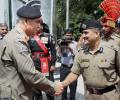
Talks between the two sides were last held in December, 2013, in Lahore.
'The BJP has bent. Pakistan has not changed a single thing. It is the BJP and its supporters who have changed. And this is a very good thing,' says Aakar Patel.

It is time to forge a credible New Delhi-Srinagar axis, says Ajai Shukla.

BJP general secretary Ram Madhav said the two neighbours needed to inject informality in their relations, as is the case in many places of the world like the EU and ASEAN.

'Pakistan has responded with appropriate contempt -- hrowing our national dignity into the waste paper basket.'

'There is a consensus within the Indian security establishment -- at least among those who draw their conclusions from data instead of speaking from nationalist sentiment -- that India lacks the offensive capability to defeat Pakistan in a short war.'

'The two NSAs, who have been mandated to address mutual concerns on terrorism, will need to devise credible and irreversible measures to see that the likes of Hafiz Saeed and Masood Azhar do not ever get a free hand to run riot again,' says Ambassador G Parthasarathy, India's former high commissioner in Pakistan.
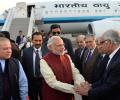
Some members of the Obama administration have worried that Pakistan's heightened anxieties about India might lead Islamabad to take reckless measures, so they have wanted New Delhi to pursue more diplomatic engagement with Islamabad.

'The softening of India's attitude towards Pakistan -- whatever the compelling reasons -- opens up the BJP to harsh scrutiny.' 'This is a high stakes gamble with the potential for devastating losses,' warns Vivek Gumaste.
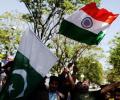
'The talks held in Bangkok, virtually on Indian terms, is an event where Pakistan seems to have blinked first.'

'We should not have waited for the political crisis in Nepal to erupt before being galvanised into action,' says Shyam Saran. 'We should have seen what was coming and not accepted assurances from the leaders of the political parties at their face value.'

Brutal and ruthless, with terrible human rights records, these autocrats will welcome Narendra Modi to their realm this coming week.
'India should be more confident and let Pakistanis meet Hurriyat leaders. India's main concern is terrorism, and India should talk terrorism. If that means talking Kashmir, so be it. India can't answer terror with terror because we don't have terror factories. India can't answer terrorism with war because we both have nuclear weapons. That leaves talks as the only option,' says Shivam Vij.
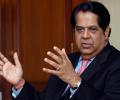
Kamath also said that the new bank, set up by India and four other members of the BRICS grouping, will strive to approve its first loan before end of the current fiscal.

It seems China is ready to cooperate with India in the central Asian region through the SCO framework, the reasons for which are manifold, says Sana Hashmi.

The cascade of cordiality on both sides after the Modi-Sharif handshake in Paris was preceded by much planning and even goading from UK, US and Germany.
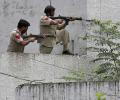
'The target for all our counter-terror operations ought to be Pakistani Punjab's population,' argues Colonel Anil A Athale (retd).
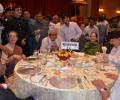
Sonia Gandhi's iftar was meant to be a powerful show of unity of Opposition parties to take on the Modi Sarkar, but that was not to be...

'The book has immense value because it reveals the inner workings of the think-tank which appears to provide facts and insights to Modi, though he himself takes the final decisions and articulates them in his characteristic rhetorical style,' says Ambassador T P Sreenivasan.

'We will have to wait till the snows melt in June/July 2016 before we can get a clearer idea of whether Pakistan intends to get serious about ending support for cross-border terrorism,' says G Parthasarathy, India's former high commissioner to Pakistan.

'There cannot be any compromise on that. After all, all instrumentalities of the State have been made to serve it. Why was the Constitution made? It was made to serve the cause of India.'

'When it comes to India-Pakistan relations, seminal moments of progress invariably bring out saboteurs of peace -- whether we're talking about fresh provocations along the LoC, or even a terror attack in India.'

'The Modi regime, after experimenting with its own versions of neighbourhood policy for 18 months, has now reached the exact stage where the Manmohan Singh government had left it in so far as our Pakistan policy is concerned,' says former senior RA&W officer Vappala Balachandran.

'The message to India is (with attacks like Pathankot) basically what the Pakistani army is trying to test is how serious are you when it concerns the peace process with that country.'

Do Modi's foreign visits actually serve India or they nothing more than expensive tools for domestic positioning and image-building, asks Shehzad Poonawalla.
 © 2026 Rediff.com - Advertise with us - Disclaimer - Privacy Policy - Sitemap - Feedback - About us - Terms of use - Grievances