
United States President Donald Trump boards Air Force One for his return home following diplomatic engagements in Beijing.

Following his visit to China, US President Donald Trump has suggested a potential shift in Washington's approach to Taiwan, expressing reluctance to engage in military conflict over Taiwan's independence and cautioning against unilateral moves.

Donald Trump says several issues were settled during the final day of talks with Xi Jinping covering trade, tariffs, and diplomacy.

United States and China have agreed that "Iran can't have nuclear weapons," and that the Strait of Hormuz must be opened, according to US President Donald Trump.

US President Donald Trump will visit China from May 13 to 15 at the invitation of President Xi Jinping. The visit occurs amidst global tensions, including the war in West Asia and trade disputes between the US and China. Discussions are expected to cover China-US relations, world peace, and economic issues.

Citing sources familiar with the matter, the report said Trump believes the conflict is in its final stages and has urged aides to adhere to the four-to-six-week timeline he has outlined publicly.

Russian President Vladimir Putin is set to visit China for talks with Chinese leader Xi Jinping, shortly after US President Donald Trump's visit to Beijing. The visit underscores the close strategic ties between China and Russia amid global tensions.

US President Donald Trump met with Chinese President Xi Jinping in Beijing to discuss trade, technology, Taiwan, and the Iran war. Xi Jinping said that 2026 will be a 'historic, landmark year' for China-US relations.

US President Donald Trump will travel to China in May for a rescheduled summit with Chinese President Xi Jinping, following a postponement due to the war in Iran. The White House has announced the new dates and indicated a reciprocal visit to Washington DC is planned.

US President Donald Trump concluded his Beijing summit with Chinese President Xi Jinping, describing it as 'incredible' and highlighting 'fantastic trade deals' and a 'very strong' relationship between the two leaders.

US President Donald Trump is set to visit China for talks with President Xi Jinping on trade, global issues, and the Gulf war. The visit aims to address trade frictions and other key issues, with high expectations for progress.

Amid rising tensions in West Asia, China is urging all parties to cease military operations, following Trump's appeal for help in securing the Strait of Hormuz.

Chinese President Xi Jinping warned US President Donald Trump that mishandling the Taiwan issue could trigger conflicts between the two countries during wide-ranging talks on trade, Iran, and energy security.

US President Donald Trump received a red carpet welcome in Beijing for talks with Chinese President Xi Jinping on trade, the Iran war, and other key issues. The visit underscores the importance both nations place on their relationship amid ongoing tensions.

The US-China rapprochement, however tenuous, is not without implications for India. Both China and Pakistan have become closer to the US, notes Ambassador T P Sreenivasan.
Delhi must now purge the delusional hopes of being a 'counterweight' to China in the US calculus, argues Ambassador M K Bhadrakumar.

US President Donald Trump and Chinese President Xi Jinping met in Beijing to discuss a range of issues, including trade frictions and the war in Iran.
Chinese leaders, including its generals, will have to weigh whether they can win a war if they ever attack Taiwan and if at all, can they sustain the subsequent devastation, notes Rup Narayan Das.

The Beijing summit may have reduced immediate diplomatic uncertainty, but it did not resolve the deeper structural contest between the United States and China. That contest appears likely to define the coming decade, notes Varun Arya.

For the foreseeable future, the most likely outcome remains continuation of the status quo. Taiwan will remain self-governing without formally declaring independence, while China continues to apply sustained pressure short of war, predict Krishnan Srinivasan and Manoj Mohanka.

India would confront a more entrenched China, a less dependable United States, and a regional order increasingly shaped by great-power bargaining over which it exercises limited influence, notes Amberish K Diwanji.

Chinese President Xi Jinping warned that the Taiwan issue could lead to clashes and even conflicts between China and the United States if not handled properly. He emphasised the importance of safeguarding peace and stability across the Taiwan Strait for stable relations.

China's Foreign Ministry has refuted allegations of providing military support to Iran, warning the US against imposing tariffs based on these accusations. The statement follows reports of Iran acquiring a Chinese satellite for targeting US military bases. Meanwhile, a rescheduled meeting between Presidents Trump and Xi Jinping is set for May.

Vietnam is an emerging regional power and a closer relationship with Hanoi is closely aligned with Prime Minister Narendra Modi's Act East Policy, points out Dr Rajaram Panda.
China has called on Iran to reopen the Strait of Hormuz and expressed appreciation for Tehran's commitment not to develop nuclear weapons, a key demand of the US to end the conflict.

Trump's outburst comes amid escalating tensions between the US and its northern neighbour, following recent remarks by Canadian Prime Minister Mark Carney at the World Economic Forum (WEF) in Davos.

President Donald Trump is a big fan of India and Prime Minister Narendra Modi, US Secretary of State Marco Rubio said on Monday, seeking to dismiss allegations of rising anti-India rhetoric in the US.

China has criticised the US blockade of the Strait of Hormuz, calling it a dangerous and irresponsible move, and urged Washington and Tehran to honour the ceasefire. Beijing also denied aiding Iran militarily and threatened countermeasures if the US imposes tariffs.

Russian Foreign Minister Sergei Lavrov will visit Beijing to discuss the West Asia conflict, the Strait of Hormuz blockade, and bilateral relations with Chinese leaders.

Much will depend on how the protagonists use the current interlude to work proactively for the beginning of a durable settlement or, on the contrary, prepare for a new round of escalation, points out Ambassador M K Bhadrakumar.

Chinese President Xi Jinping has arrived in Pyongyang for his first official visit in seven years, meeting with North Korean leader Kim Jong-un to reaffirm their long-standing friendship and pledge further development of bilateral relations amidst Pyongyang's deepening military ties with Moscow and China's assertions against Japan's 'new militarism'.

'We caught General Pervez Musharraf talking over the phone with his Chief of General Staff Lieutenant General Mohammad Aziz. Musharraf was visiting China; Aziz was in Rawalpindi.'

Trump has said he would be present at the signing ceremony in Islamabad. Don't be surprised if the Pakistani hosts make it a grand event in the geopolitics of the region. Trump would love that, notes Ambassador M K Bhadrakumar.

The Congress on Sunday lashed out at Prime Minister Narendra Modi over the US' statements after three Indian sailors were killed in American attacks on ships, with party leader Rahul Gandhi saying the "compromised PM" listens "like an obedient servant" and "complies with the orders".

'They talked bad about our leaders. They said India was a dead economy. They were not sensitive to the Indian psyche.'

Indian benchmark equity indices, Sensex and Nifty, saw gains in early trade, driven by strong performance in banking shares and positive sentiment from Asian markets, alongside optimism surrounding the ongoing US-China Summit.

The US has seized an oil tanker, 'Skywave', linked to Iran in the Indian Ocean, as part of efforts to disrupt Iran's oil shipments and enforce sanctions. The vessel was part of a network transporting sanctioned Iranian crude oil, with the seizure occurring amid heightened tensions between Washington and Tehran.

The United States has paused a proposed USD 14 billion arms sale to Taiwan due to concerns about maintaining sufficient munitions for potential conflicts, particularly in light of the ongoing situation with Iran.

Russian President Vladimir Putin and Chinese President Xi Jinping have reaffirmed their commitment to dismantling global hegemonism and building a 'multipolar world' during high-level talks in Beijing.
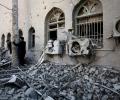
The logic of war plus the gathering storms in US politics as the midterms loom large leave him with no real alternative but to negotiate, points out Ambassador M K Bhadrakumar.
