
There are enough people at the top decision-making level in Tehran who are still willing to negotiate, provided Trump can create the right setting for the negotiation to acquire a dynamic of its own, points out Ambassador M K Bhadrakumar.

The government has dismissed speculation of an imminent increase in petrol and diesel prices, assuring citizens that there are no plans for a hike despite rising crude oil costs.

Amid ongoing tensions with the US, Iran's IRGC Navy has issued new directives restricting maritime movement through the Strait of Hormuz, allowing only civilian vessels on Iranian-designated routes and barring all military ships.

Two more Indian-flagged LPG tankers have begun their journey from the Persian Gulf, navigating the Strait of Hormuz amidst regional conflict, following disruptions caused by recent tensions in the Middle East.

US President Donald Trump indicated the possibility of further military operations against Iran's Kharg Island, a key oil export hub, claiming previous strikes had significantly damaged its infrastructure.

Top government sources in India have dismissed claims that the Indian Navy provided intelligence to the US regarding an Iranian frigate that was sunk by a US submarine.

Conflicting reports emerge regarding the effectiveness of the US blockade on Iranian ports, with Iran claiming successful transit of vessels and the US asserting complete maritime dominance.

An art exhibition in New Delhi showcased drawings by children killed in a school bombing in Iran, offering a poignant reminder of the human cost of conflict.

The vessels are carrying around 92,600 metric tonnes of LPG and have 33 and 27 Indian seafarers onboard, respectively. Visuals showed Pine Gas crossing the critical chokepoint.
India has expressed strong concern over the targeting of commercial shipping in the Strait of Hormuz during the West Asia conflict, urging for the restoration of unimpeded navigation and global commerce.

The tanker reportedly switched off its Automatic Identification System (AIS) transponder while navigating the high-risk stretch of the strait and reappeared on tracking systems on March 9.

IRGC said vessels seeking to sail through the strategically critical Strait of Hormuz must obtain Iran's approval; otherwise, they could become targets of Iranian attacks.

Is the current rally telegraphing a durable peace plan in West Asia, boosted by United States (US) President Donald Trump's incoherent and contradictory posts on social media?

The United States Central Command (CENTCOM) has confirmed the implementation of a naval blockade on Iranian ports, enforcing strict measures on vessels entering or departing, significantly escalating tensions between the two nations.

External Affairs Minister S Jaishankar has emphasised India's commitment to safe maritime transit and condemned attacks on merchant shipping amidst the ongoing West Asia conflict and global energy market disruptions.

If the oil infrastructure is attacked by the United States, the whole area could be flooded with oil, spilling into the Persian Gulf.

A projectile struck near Iran's Bushehr Nuclear Power Plant, resulting in one security personnel casualty and damage to an auxiliary building. The incident has raised concerns about nuclear safety and potential regional consequences, drawing criticism from Iranian officials and prompting calls for restraint from the IAEA.
India is sending a shipment of diesel and petrol to Sri Lanka to help alleviate the country's energy crisis amidst regional instability.

External Affairs Minister S Jaishankar addresses the Indian Ocean Conference, expressing deep concern over the West Asia conflict and its economic repercussions on energy, trade, and food security. India calls for a swift return to peace and opposes targeting civilians and infrastructure.

Addressing the 36th extraordinary session of the Council of the International Maritime Organisation (IMO) held on Thursday in London, the Indian envoy said, "India remains deeply concerned about the evolving situation and continues to call for de-escalation through dialogue and diplomacy, with utmost restraint and priority being given to the safety of civilians."
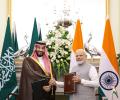
Prime Minister Narendra Modi spoke with Saudi Arabia's Crown Prince Mohammed bin Salman about the ongoing conflict in West Asia, emphasising the need to ensure freedom of navigation and secure shipping lanes.

A US-sanctioned tanker carrying Iranian crude oil is heading to India, marking the resumption of oil imports from Iran after seven years.

US President Donald Trump on Sunday announced that the American Navy will henceforth block all maritime traffic entering the Strait of Hormuz.

West Asia conflict triggers sharp sell-off in Indian markets, with realty, banking and auto stocks leading losses amid energy shock fears.

US President Donald Trump has announced plans to clear the Strait of Hormuz to secure the vital oil corridor, citing risks to global energy supplies and criticising other nations' inaction.

Two Indian nationals have been confirmed dead and one is missing following attacks on merchant vessels amidst the ongoing conflict in West Asia. The Indian government has reiterated its commitment to the welfare of its citizens in the Gulf region.

Iran has placed anti-personnel and anti-armour mines around the island, where US troops could potentially stage an amphibious landing.

Trump's remarks marks one of the most direct rebukes yet from Washington to its allies over their refusal to support US-led military operations in Iran and over the energy crisis triggered by disruptions in the Persian Gulf.

US President Donald Trump is considering ending the military operation against Iran even if the Strait of Hormuz remains closed, according to the Wall Street Journal.

Indian-flagged vessels are navigating the Strait of Hormuz safely despite ongoing tensions in the region, ensuring the continued flow of vital energy supplies to India.

The United States' historical strategic alignment with Pakistan, dating back to the Cold War, has consistently aimed to create a political and military parity with India, despite India's significantly larger size and resources. This long-standing relationship continues to influence regional dynamics, particularly in West Asia and the Indo-Pacific.

While investors would focus on the results and guidance for the third quarter of financial year 2025-26 (Q3FY26) in the normal course of business, the US-Israeli attack on Iran and the latter's retaliation at Gulf allies of the US has forced them to weigh the consequences of the event.

An Indian-flagged crude oil tanker, Jag Laadki, safely sailed from the UAE's Fujairah port despite an attack on the terminal and is scheduled to reach India. The Indian government is working to ensure the safe passage of remaining Indian-flagged vessels in the region.
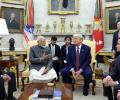
Prime Minister Narendra Modi and US President Donald Trump discussed the Middle East crisis, with a focus on the Strait of Hormuz.

Amidst global energy market volatility driven by the West Asia crisis, Russia has proposed increasing its crude oil and natural gas supplies to India, strengthening bilateral energy ties and aiming for USD 100 billion in annual trade by 2030.
Iran has reportedly allowed select "friendly nations" including India and Pakistan limited access to the Strait of Hormuz amid ongoing conflict, easing some energy supply concerns. Here's what the move means for global trade and oil routes.

Iran's ambassador to India, Mohammad Fathali, has described India as a "reliable and compassionate" partner while asserting Tehran's territorial authority over the Strait of Hormuz amidst ongoing regional tensions.
The Indian government has refuted reports suggesting a deal with Iran involving the release of seized oil tankers in exchange for safe passage of Indian vessels through the Strait of Hormuz.

Donald Trump claims a senior defence official urged military action against Iran, revealing escalating tensions and ongoing negotiations in the Middle East.

10 stocks from the Nifty 200 index that offer good growth potential and scope to deliver decent returns from current levels, based on brokerage estimates.
