
'My suggestion to Nandan Nilekani is that it would be worthwhile for him to take a holistic review in a manner in which examination is just one critical component.'

The Supreme Court has urged the Central Board of Secondary Education (CBSE) to consider exempting Class 6 students from its three-language policy for the current academic year. The policy, which mandates the study of three languages including two native Indian languages, is challenged by petitioners who question CBSE's jurisdiction over classes 6-8. The court emphasized finding a solution that avoids student pressure and suggested a potential deferral for Class 6.

India's student housing shortage is widening, but high land costs, weak rental yields and regulatory hurdles are keeping organised developers away.

Union Education Minister Pralhad Joshi announced that revised NCERT textbooks for classes 10 to 12 are being prepared in "mission mode," while textbooks for classes 1 to 9 under the new National Curriculum Framework have already been released. He emphasised NCERT's role in building a 'Viksit Bharat' and highlighted the need for curricula to evolve with AI advancements and the importance of India's young population as a global asset.

A parliamentary panel flagged staffing shortages at NCERT and CBSE, inadequate education spending, falling enrolment and poor internet connectivity in government schools.

The Supreme Court has urged the CBSE to reconsider the implementation of its three-language policy for Class 9 students, emphasising that children should not be subjected to undue pressure. The court highlighted concerns about infrastructure, the starting point of the policy, and the definition of 'native' languages.

Dharmendra Pradhan's political career faced an unexpected jolt as he resigned as Education Minister following nationwide protests over the NEET paper leak, marking a significant departure from the government's initial dismissive response to the agitation.

Prime Minister Narendra Modi extended birthday wishes to Union Education Minister Dharmendra Pradhan, commending his significant contributions to the implementation of the National Education Policy. This praise follows the successful re-examination of NEET-UG, despite earlier controversies surrounding paper leaks.

The Indian Embassy in the US strongly refuted a New York Times headline referring to "Pakistani Kashmir," asserting that there is only Pakistan-occupied Kashmir (PoK) and that Jammu & Kashmir and Ladakh are integral parts of India. The embassy highlighted Pakistan's illegal occupation and exploitation of these territories, linking it to ongoing protests in PoK.

Student organisations across India celebrated the resignation of Union Education Minister Dharmendra Pradhan, attributing it to their nationwide protests against alleged NEET irregularities. While welcoming the move as a victory, groups like NSUI, AISA, and SFI affirmed their commitment to continue agitations until broader demands for accountability, transparency, and education reforms, including scrapping the NTA and NEP, are met.

How did hundreds of errors slip through multiple stages of drafting, editing, proofreading, expert review and final approval before making their way into classrooms?

The proposed order will state that students currently in Classes 7, 8 and 9 who have opted for two foreign languages under the existing framework will be allowed to continue with the same combination until Class 10.

Nearly one in two children still leave the school system before completing higher secondary education.

90 per cent of institutions recorded no improvement in international student metrics, despite government initiatives such as the Study in India programme, UGC regulations on internationalisation, and efforts to attract foreign students.
Senior CPI(M) leader V Sivankutty has criticised the Kerala UDF government for allegedly spreading misinformation about the Centre's PM SHRI scheme and attempting to implement it despite earlier opposition. He clarified that the previous LDF government froze the agreement over concerns about the National Education Policy and that funds received were not for PM SHRI. The scheme continues to be a politically contentious issue in the state.

Education sector experts agree that using the "best technology" was essential to ensure students did not have to sit for an examination all over again because of a question paper leak.

'We can integrate AI and tech into education, but that is just a means and not an end.' 'Ultimately, we need to control what happens in a classroom and we need to let teachers innovate their teaching style to suit the needs of Gen Z and beyond.'

'After more than 12 years in power, he has been forced to retreat under public pressure. The education minister's resignation is the biggest political climbdown of his government so far.'

Mizoram's school education minister inaugurated the northeast region's first 'New Age Tech Skills Centre' at the Government Comprehensive Model School in Aizawl. The centre, established under Bharat Forge Limited's CSR initiative, will offer training in AI, robotics, IoT, 3D printing, CAD, CNC simulation, and drone technology.

Michel Danino, one of the NCERT academics previously barred by the Supreme Court over a controversial chapter on the judiciary, maintains the content was 'correct' and defends its inclusion in the textbook.

'I obsessively close the apps on my phone all the time.'

A parliamentary panel has decided to review the implementation of reforms in the National Testing Agency (NTA) as well as the NEET-UG 2026 paper leak case and has summoned NTA Chairperson Pradeep Kumar Joshi and other bureaucrats for deliberations.
The CBSE has mandated the study of three languages, including at least two native Indian languages, for Class 9 students starting July 1, aligning with the National Education Policy (NEP) 2020 and the National Curriculum Framework for School Education (NCF-SE) 2023.

NIT Rourkela has announced the launch of four new academic programmes for the 2026-27 session, focusing on emerging technologies such as semiconductors, artificial intelligence, and quantum technologies.
The Supreme Court has agreed to examine a plea challenging the CBSE's policy mandating the study of three languages, including two native Indian languages, for Class 9 students starting July 1. The court has sought responses from the Centre, CBSE, and NCERT and will hear the matter in July.
Tamil Nadu is set to protest against the National Education Policy (NEP) on February 18, with the ruling DMK and its allies announcing a demonstration. The state government has been at odds with the Centre over the implementation of the NEP and the three-language formula proposed in the policy. Union Education Minister Dharmendra Pradhan dismissed the state's opposition as "politics" and asserted that the Centre is committed to implementing the NEP across the country. The DMK, however, accused the Centre of encroaching on the state's rights and using the office of the Governor to push the NEP.

Indian table tennis players showcased their dominance by securing 13 gold medals at the South Asian Youth Table Tennis Championships, also qualifying for the Asian Youth Championships.

A parliamentary panel has criticized the Indian government for withholding funds from states that have not agreed to implement the PM SHRI schools scheme, calling the reasoning behind the decision "not factual or justified." The panel has recommended the immediate release of pending funds to states like Kerala, Tamil Nadu, and West Bengal, which have been significantly impacted by the delays.
"Permitting students to discontinue studies is akin to asking them not to study," Stalin said, addressing an event organised by the Parents-Teachers Association in Cuddalore.

The new NCERT Class 9 mathematics textbook, 'Ganita Manjari', integrates ancient Indian mathematical systems and historical context, marking a shift from previous editions by emphasising indigenous contributions and linking concepts to ancient texts and scholars.

Union Education Minister Dharmendra Pradhan launched an artificial intelligence and computational thinking curriculum for classes 3 to 8, aiming to integrate structured AI education into the school system.
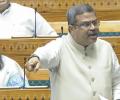
The DMK protested in the Lok Sabha after Union Education Minister Dharmendra Pradhan criticized the Tamil Nadu government for refusing to implement the National Education Policy (NEP) and accused them of "politics." Pradhan alleged that the state had initially agreed to the PM SHRI scheme but later backed out. The DMK, however, asserted that they have issues with the NEP and the three-language formula, and cannot accept it in full. The protests disrupted House proceedings, leading to an adjournment. The DMK members were angered by Pradhan's accusations, demanding the release of funds allocated for education in the state.
Union Education Minister Dharmendra Pradhan announced that all high schools in India will have broadband internet connection within the next 2-3 years, with a focus on integrating Artificial Intelligence (AI) into education.
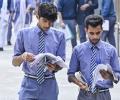
Educationists and parents are raising concerns about the CBSE's implementation of the three-language policy for Class 9, questioning the timing and preparedness of schools.

Union Education Minister Dharmendra Pradhan advocates for the establishment of 'Mahakal Standard Time' based on Ujjain's historical significance in time calculation, challenging the dominance of Greenwich Mean Time.

IIT-Gandhinagar is reviewing Michel Danino's position as guest professor after the Supreme Court directed institutions to disassociate from him due to a controversy over a chapter on judicial corruption in a withdrawn NCERT textbook.
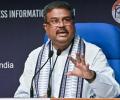
Union Education Minister Dharmendra Pradhan has advocated for the establishment of 'Mahakal Standard Time' (MST), citing Ujjain's historical significance as a centre for time calculation and astronomy.
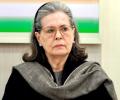
Noting that these three Cs haunt Indian education today, the Congress Parliamentary Party chairperson said in an article that this "carnage" of India's public education system must end.

The clarification by board comes after it received a few requests stating that, because of some reasons, Class 10 students will not be able to appear in the first board exam, hence should be allowed to appear in second board exam.

Only about a quarter of institutions show any meaningful alignment between academic curricula and industry requirements.
