
Art education, physical education and wellbeing, vocational education and interdisciplinary studies will be compulsory.

The government has intensified its Study in India programme and is working closely with universities and states to achieve this goal.
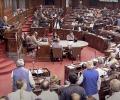
Opposition MPs in the Rajya Sabha criticised the Modi government's economic policies, citing the LPG crisis, lack of energy security, and concerns over the Economic Stabilisation Fund.

Paying tributes on the occasion of Language Martyrs Day, Stalin said, "a state that loved its language like its life, unitedly struggled against Hindi imposition; protested with the same intensity every time it was imposed."

Purnendu Maji and Srinivas Bhogle present Rediff's Most Valuable Player Index of T20 World Cup 2026 after Game 52.

Purnendu Maji and Srinivas Bhogle present Rediff's Most Valuable Player Index of T20 World Cup 2026.

Purnendu Maji and Srinivas Bhogle present Rediff's Most Valuable Player Index of T20 World Cup 2026 after Game 48.

Nagaland Governor Ajay Kumar Bhalla announced the state government's plans to form an interim council for the Frontier Nagaland Territorial Authority (FNTA) and highlighted key achievements and future priorities across various sectors during the Budget Session.
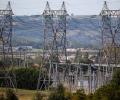
The government on Wednesday put out the draft of a new policy that projects the country's power sector will need Rs 50 trillion in investments by 2032 and Rs 200 trillion by 2047, proposing ambitious reforms in generation, transmission and distribution.
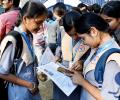
As per the updated policy, class 10 and class 12 students can appear for an improvement exam in the same academic year to enhance their scores if they are not satisfied with their performance.

'We are receiving a steady stream of interest from well-established foreign universities.'
Are you a news junkie? Think you know all that happens around you? Syed Firdaus Ashraf puts your knowledge to the test...
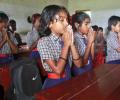
'Education will definitely benefit by making the child's first language the medium of instruction, by making examinations less prone to rote-learning, by setting up national research universities, all recommendations of the NEP,' observe Pankaj Jain and Shreekant Sambrani.
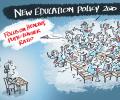
Dominic Xavier says there is an urgent need to implement the NEP and quickly reduce the gap in the pupil-teacher ratio.
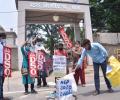
Nishank's clarification, through a tweet in Tamil, comes in the backdrop of opposition to NEP in Tamil Nadu on the grounds that the policy allegedly imposed Hindi and Sanskrit.

A startling United Nations study finds that only 10 per cent of students in India ever access professional career counselling.

'For tech fields like AI-DS, the US, Canada, UK, Germany and Australia are popular due to strong research and industry links', says rediffGURU Dr Karan Gupta.

"We have to collectively address all doubts. The vision of flexibility with which this policy was brought... We will have to show in a similar way maximum flexibility in implementing it," Modi said while addressing the 'Governors' Conference on the Role of NEP in Transforming Higher Education'.
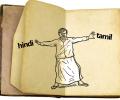
The three-language formula proposed in the National Education Policy 2020, is at the centre of the political row between the Dravida Munnetra Kazhagam-led Tamil Nadu government and the central government.

In the academic year 2024-2025, the IB had 258 authorised schools in India, up from 183 schools in 2019.

According to CBSE officials, an expert committee will be formed and a content development agency may be engaged to ensure updated textbooks are ready for the next academic session.

An amended government order issued on Tuesday said Hindi will "generally" be the third language, instead of being mandatory, but gave an option to opt out if 20 students per grade in a school express the desire to study any Indian language other than Hindi.
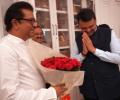
Maharashtra Navnirman Sena (MNS) president Raj Thackeray has slammed the state government's decision to make Hindi a mandatory third language in schools from Classes 1 to 5, calling it an attempt to "Hindi-fy" the state. Thackeray has vowed to oppose the decision vehemently and ensure it is not implemented. The move is part of the new curriculum implementation under the National Education Policy (NEP) 2020, which mandates a three-language formula for classes 1 to 5. Thackeray argues that Hindi is not a national language but a state language and its imposition undermines the principle of linguistic regionalization. He also questioned why Hindi is being forced on Maharashtra but not in southern states. The Opposition Congress has also criticized the move, calling it an imposition of Hindi and a threat to Marathi sentiment. The state government, however, defended its decision, stating that Hindi is a means of communication in the entire country and that Marathi is already compulsory.

The Kerala government will review the implementation of the Centre's PM SHRI scheme in the state following controversies and concerns. A cabinet sub-committee has been formed to study the scheme, and further proceedings are on hold pending the committee's report.

Can change happen? Not unless the changemakers themselves want it since they benefit the most from the status quo, warns Biswajit Dasgupta.
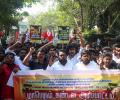
Tamil Nadu Chief Minister M K Stalin has reiterated the state's opposition to Hindi imposition by the Centre, calling it a 'mask' for Sanskrit. He also claimed that the National Education Policy (NEP) is being used to promote Sanskrit in many states, and that the Centre is trying to do away with languages like Tamil and impose Sanskrit. Stalin's statement comes amid growing concerns over the alleged imposition of Hindi in non-Hindi speaking states.
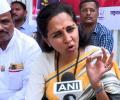
NCP (SP) leader Supriya Sule has criticized the Maharashtra government's decision to make Hindi a mandatory third language in schools, stating that it will not tolerate any undermining of the Marathi language. Sule also criticized the state's implementation of the National Education Policy (NEP) 2020, expressing concerns about its potential impact on students and teachers. She also questioned the appointment of a retired bureaucrat as the chief economic advisor to the chief minister and criticized the state's performance in areas like fiscal deficit management and the Jal Jeevan Mission.
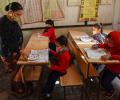
Union Education Minister Dharmendra Pradhan on Tuesday said the Centre is planning to set up 'PM Shri Schools' which will be aimed at preparing students for future and will be the laboratory of new National Education Policy (NEP). nbsp
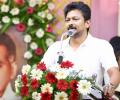
Whether or not today's protest against NEP escalates into a full-fledged struggle across the state remained in the hands of the Prime Minister Narendra Modi-led BJP government, he said.
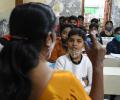
The Maharashtra government has reversed its decision to make Hindi a mandatory third language in schools after facing widespread opposition. The move comes after the state's language consultation committee urged the Chief Minister to revoke the decision. The government will now issue a revised order making Hindi learning voluntary. The decision had been met with criticism from various quarters, including opposition parties and the Maharashtra Navnirman Sena, which had called for a protest against the move.

The Central Board of Secondary Education has approved the norms for conducting board exams twice a year for Class-10, a move recommended in the new National Education Policy.

The Rajya Sabha MP said the National Entrance-cum-Eligibility Test has prevented access to medical education for so many children and the strength to change that rule of exam could emerge only from education.
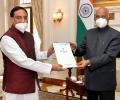
The implementation of the NEP and four-year undergraduate programme were approved by the Standing Committee on Academic Matters and the Academic Council last week.
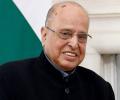
K Kasturirangan, former chairman of the Indian Space Research Organisation (ISRO), passed away at the age of 84 in Bengaluru on Friday. He was suffering from age-related ailments for the past few months. Kasturirangan, who also served as the chairperson of the drafting committee on the New National Education Policy (NEP), was a renowned space scientist and had a distinguished career spanning several decades. He was known for his contributions to ISRO's successful space programs and his role in shaping India's education policy.
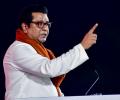
Maharashtra Navnirman Sena chief Raj Thackeray on Wednesday asked what was the need to "impose" Hindi on students and appealed to schools in Maharashtra to foil the government's "hidden agenda to deliberately create a language divide".

Maharashtra Chief Minister Devendra Fadnavis warned against violence and linguistic chauvinism related to the Marathi language, emphasizing constructive promotion and legal action against those taking the law into their own hands.
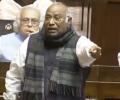
The Rajya Sabha witnessed an uproar on Tuesday over an unparliamentary remark by Leader of Opposition Mallikarjun Kharge, who apologized to the Chair while clarifying that it was meant for the government that was "trying to create a regional divide" in the country. The controversy stemmed from a statement by Education Minister Dharmendra Pradhan, who slammed the Tamil Nadu government for its stand on the three-language policy under the National Education Policy (NEP). Kharge's use of a Hindi expression, deemed unparliamentary, sparked outrage from the treasury benches. He subsequently apologized for the remark, stating it was directed at the government's policies and not the Chair.
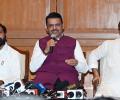
Facing mounting opposition to the introduction of Hindi language in Maharashtra schools from classes 1 to 5, the state cabinet on Sunday decided to withdraw two GRs (government orders) on the implementation of the three-language policy.
Initially, we will look to take a small batch of a few hundred students, with a plan to increase this to 5,000 students in the next five years, and eventually 10,000 by 2036.'
