
US Vice President J D Vance is expected to travel to Islamabad for peace talks with Iran to end the seven-week war, amid a fragile ceasefire and ongoing tensions.

Pakistan has announced its commitment to continue facilitating talks between the United States and Iran, urging both nations to uphold the ceasefire agreement. Deputy Prime Minister Ishaq Dar highlighted Pakistan's role in mediating recent discussions and expressed hope for durable peace and regional stability.

US President Donald Trump has stated that the war with Iran is "close to over," while the US Central Command reports blocking traffic to Iranian ports.

Russian President Vladimir Putin has offered his support to help bring peace to West Asia, praising the Iranian people for their resilience. This comes as Iran seeks to resolve the conflict with the US, following discussions with Pakistani and Omani leadership.

US Vice President J D Vance stated that while progress was made during peace talks in Islamabad, it is now up to Iran to further the discussions and address US concerns regarding its nuclear ambitions.

An Iranian delegation, led by Foreign Minister Abbas Araghchi, concluded high-level meetings in Islamabad, delivering an 'official list of demands' to Pakistani leaders for the US and Israel. This comes as President Trump cancelled his envoys' visit to Islamabad amid ongoing efforts to facilitate peace talks between Iran and the US.

Talks between Iran and the US in Pakistan concluded without a deal due to disagreements over key issues, including Iran's nuclear programme and sanctions, despite efforts to find common ground.

US President Donald Trump expressed confidence in America's position amid US-Iran peace talks in Islamabad, stating that Washington stands to 'win' regardless of a deal.

Indian-American scientist Amit Kshatriya's journey from watching rocket launches in Houston to becoming NASA's Associate Administrator is a testament to his dedication and expertise in space exploration.

The US President clarified that these negotiations do not involve the new Supreme Leader, Mojtaba Khamenei.

Chaffing under public ridicule in the US as well as internationally for having 'lost' the war, Trump is under immense pressure to do something, cautions Ambassador M K Bhadrakumar.

US President Donald Trump threatened to bomb Iran if a deal is not reached before the ceasefire ends, while Pakistan urged both sides to extend the truce and pursue diplomacy.

Iran has reiterated that key preconditions must be met before negotiations with the United States can begin to resolve the conflict in West Asia, including a ceasefire in Lebanon and the release of blocked Iranian assets.

Pakistan has increased security measures in Islamabad and surrounding areas as the US and Iran prepare for another round of peace talks. The move follows an announcement by former US President Donald Trump that American negotiators would be in Pakistan for discussions aimed at resolving the conflict between the two nations.

The United States and Iran concluded the first phase of in-person talks in Islamabad, with both delegations exchanging written texts to formalise areas of understanding. The discussions, involving key representatives from both sides, are aimed at reducing tensions and exploring possibilities of a structured understanding.

The US Navy seized an Iranian-flagged cargo ship in the Gulf of Oman, escalating tensions as ceasefire talks face uncertainty. The incident raises concerns about the fragile ceasefire and the ongoing blockade of the Strait of Hormuz.

Direct talks between the US and Iran, mediated by Pakistan, have failed to produce an agreement after 21 hours of negotiations, with disagreements over Iran's nuclear ambitions and sanctions proving insurmountable.

Congress leader Shashi Tharoor discusses India's role in the US-Iran peace talks taking place in Islamabad, emphasising the importance of peace over competition with Pakistan and highlighting India's regional interests.

One of the most uncivilised characteristics of this war has been the total disregard for international law and the laws of armed conflict, asserts Vice Admiral Biswajit Dasgupta (retd).

As the negotiations continued, the Iranian government said on social media that "talks between Iran and the US in Islamabad entered the expert-level stage as economic, military, legal, and nuclear committees joined in".

Karex, the Malaysian company that makes roughly one in five of the world's condoms -- about five billion a year, supplying Durex and Trojan among others -- announced this week that it is raising prices by up to 30 percent. The reason is the Strait of Hormuz.

Pakistan is set to host face-to-face talks between the United States and Iran, aiming to solidify a fragile ceasefire and prevent further conflict in West Asia. The discussions will focus on a long-term peace arrangement, including sanctions relief, regional security, and Iran's nuclear program.

Former US President Donald Trump claimed victory over Iran, stating they agreed to never have a nuclear weapon and provided a 'significant prize' related to the Strait of Hormuz. He also suggested a change in Iranian leadership and acknowledged Pakistan's role in facilitating talks.

The White House has responded cautiously to reports of Pakistan offering to mediate between the US and Iran, amid ongoing tensions and potential talks.

Pakistan's Prime Minister Shehbaz Sharif has offered to host talks between the US and Iran to help resolve the ongoing conflict in the Middle East, following reports of Pakistan's involvement in backchannel diplomacy.
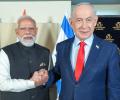
The Congress party has criticised the Indian government's diplomatic strategy, claiming a 'severe setback' if reports of Pakistan mediating between the US-Israel and Iran are accurate. The party alleges Pakistan's diplomatic engagement has surpassed India's, despite military successes.

EU leaders convened an emergency summit in Brussels to address transatlantic tensions as President Trump threatened new tariffs on member States linked to his Greenland acquisition demands.

Both sides have now revealed a preference for escalation over strategic defeat, and each new provocation narrows the space for the next pause. The Touska seizure, Iran's refusal to negotiate under blockade, Israel's strikes on Iranian oil infrastructure -- all of these add up to an increasingly untenable situation. This makes the wild card -- Trump and his motormouth -- more consequential than ever, notes Prem Panicker in his must read blog on the Iran War.

'Jews are very much safe in Iran. They are our brothers. There is a difference between a Jew and a Zionist.' A conversation around a tea table in Mumbai serves as an eye-opener for Syed Firdaus Ashraf.

The core issues to be settled -- access to Hormuz, Israel's aggression in Lebanon, the question of Iran's nuclear programme, sanctions relief and compensation -- are thorny enough to require weeks of patient negotiation. The most likely outcome of the opening sessions is that both sides take the measure of each other, establish what is and is not negotiable, and return home without having broken anything. That would count as progress.

The United States, which entered this war in expectation of a short, sharp win along the Venezuela model, is now preparing for deeper involvement in a conflict it does not fully control, without the allies it typically relies on, against an adversary that is not behaving as expected, in a global environment that is already absorbing economic shock. Prem Panicker continues his must read daily blog on the Gulf War.

What we are watching is something different: A fog manufactured and maintained by the people who started the war, so that the question of why it was started never has to be answered, observes Prem Panicker in his must read blog on the war in the Middle East.

For weeks, the war skirted the edge of catastrophe without tipping over. Missiles flew, there was much destruction, commanders were assassinated, cities across the Gulf and even in Israel struggled to absorb the shock. But one line held: Energy infrastructure, the arteries of the global economy, remained largely untouched. That is no longer true. Prem Panicker continues his must read daily blog on the Gulf War.

The pause gives the US time to breathe, to regroup, to move its expeditionary force into position without risk of interception along the way. It gives Iran nothing -- on the ground, attacks against its infrastructure continue apace. Prem Panicker in his must read daily blog on the Gulf War.

United States President Donald John Trump and Ukrainian President Volodymyr Zelenskyy met for lunch at Trump's Mar-a-Lago club in Palm Beach, Florida, on Sunday. This was their first one-on-one meeting after their disastrous encounter at the White House in March.
The invitation comes as the US administration moves forward with formalising the "Board of Peace" structure linked to Trump's broader Gaza roadmap.

Putin argued that European countries are putting forward demands related to the conflict that Russia cannot accept. He further accused Europe of obstructing initiatives by the United States and President Donald Trump to pursue a negotiated settlement.

India is yet to take a call on United States President Donald Trump's invitation to be part of the 'Board of Peace' that will work towards bringing lasting peace to Gaza and possibly resolve global conflicts, people familiar with the matter said on Wednesday.

India was among the countries not present in Davos when US President Donald Trump unveiled his "Board of Peace" that seeks to work towards bringing lasting peace to Gaza and possibly resolve global conflicts. India is yet to take a call on it, people familiar with the matter said when asked about Trump's invite to PM Modi.

Trump's 'Board of Peace' is being projected by Washington, DC as a new international body to usher in peace and stability in Gaza and beyond, triggering speculation that it could throw a challenge to the United Nations.
