
President Ram Nath Kovind said he was 'a determined champion of democracy during the Emergency' and would be missed by his readers.
Escalating further the controversy over his interview to Doordarshan, Narendra Modi on Saturday rued the "decline" in journalistic freedom in the public broadcaster and invoked "horrific" memories of the Emergency days in 1975.

Prime Minister Narendra Modi has managed to pull off what was unimaginable a year back -- adopting a much-needed centre-left approach, says Devanik Saha.
As it completed an eventful 100 days in office, the Aam Aadmi Party government on Sunday mounted a blistering attack on Modi dispensation accusing it of making a "U-turn" on granting full statehood to Delhi and indicated tabling a resolution to reject the "unconstitutional" notification giving absolute powers to the Lt Governor.
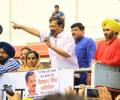
'...a dazzling flash, and then, fizzle,' argues Shekhar Gupta.

Should the party expand to Punjab, Bihar and other places, or should it consolidate its gains in Delhi? This was one of the questions before the party when it split sometime back. An answer is yet to emerge.
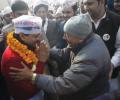
Kejriwal in his public meetings took up issues, which garnered him strong support

Kapil Mishra was one of the closest aides of Delhi Chief Minister Arvind Kejriwal. However, in May 2017, the tides turned. A loyalist of the Aam Aadmi Party founder, Mishra shocked one and all by openly accusing him of corruption, a claim that the AAP dismissed. Since then Mishra has become one of the most prominent AAP rebels. In the face of the sit-in by Kejriwal, his deputy Manish Sisodia and ministers - Satyendar Jain and Gopal Rai at Lieutenant Governor Anil Baijal's office, Mishra spoke to Syed Firdaus Ashraf/Rediff.com and said that this is the first time in history that a sitting chief minister of a state in India has kidnapped himself.

The party needs to fight competition not by acting like others, but by finding a strong narrative of its own.

Can un-democracy be the foundation for a democratic party that aspires to be different from all other parties in India.

'Dalits are not going to vote for the BJP in 2019.'

The street-fighter is back and the introspecting, sparingly speaking avatar of Kejriwal has gone on an extended recess. In this grime of heightened Delhi politics, all the good work done by the Delhi government may go down the drain, warns Sudhir Bisht.
Aam Aadmi Party chief Arvind Kejriwal's jail stay was extended till June 6 on Friday as he remained adamant on not furnishing bail bond in a criminal defamation case against him by the Bharatiya Janata Party leader Nitin Gadkari, with a Delhi court chiding him for "legal illiteracy" and asking him to be "sensible".
The debacle that pollsters faced in the Bihar assembly elections is in part being blamed on the small sample size and lack of advancement in field surveys, says Sahil Makkar

Is politics gaining at the expense of civil society?
'The irresistible charm of Indian politics is it can always throw up surprises -- even when it looks as predictable as in Tamil Nadu,' discovers Shekhar Gupta.
The fiasco over the former Delhi law minister's college degrees has damaged the reputation of the Aam Aadmi Party, says Nupur Sharma.

Dissident Aam Aadmi Party leaders Yogendra Yadav and Prashant Bhushan on Monday hit back at the party leadership, claiming that it indulged in "gross violation" of the constitution and accusing national disciplinary committee members Pankaj Gupta and Ashish Khetan of accepting donations from dubious companies and doing a 'paid news' story favouring a company.

'Kejriwal's way of working is 'my way or the highway'. If you don't say Kejriwal zindabad then you will be thrown out of the party.' 'I feel Kejriwal is a very darpook (frightened) man. When he lost in the Lok Sabha elections his strength disappeared and he started compromising.' Aam Aadmi Party rebel Pankaj Pushkar speaks out.

The more mud his opponents fling, the stronger Arvind Kejriwal emerges.
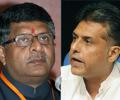
The Aam Aadmi Party has demanded the dismissal of Telecom Minister Ravi Shankar Prasad alleging a conflict of interest that has prevented him from issuing a notice to Mukesh Ambani's Reliance Jio on the 4G issue, a charge vehemently denied by Prasad who said he never gave advice or appeared for the company.

'Drought in the 1990s was essentially the drought of a poor India.' 'This 2016 drought is of a richer and more water-guzzling India.' 'The severity and intensity of the drought is not about lack of rainfall.' 'It is about the lack of planning and foresight, and criminal neglect.'
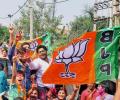
The Bharatiya Janata Party's solid solo performance in Maharashtra and Haryana assembly elections confirms continuation of some of the trends that emerged in the Lok Sabha elections in May this year.

For the third front to become a reality, it needs a party that has a pan-India presence and wins more Lok Sabha seats than all other parties in the front, say experts.

'Swaraj Samvad sees itself in the role of a watchdog in Delhi,' Professor Anand Kumar tells Rediff.com.

The media wittingly or otherwise has been a key player in stymying the AAP. It is not so much the rivals, but the media, mostly the television and from its cues, large sections of the print segment, who got the trophy. The political parties, especially BJP and Congress, can now laugh in their sleeves, says Mahesh Vijapurkar.

Madhu Kishwar, noted activist, has raised eyebrows with her stand on Narendra Modi, another instance of her long insistence on questioning of peer opinion, notes Aparna Kalra.
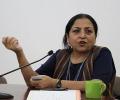
Madhu Kishwar, noted activist, has raised eyebrows with her stand on Narendra Modi, another instance of her long insistence on questioning of peer opinion.
Honesty coupled with pragmatism translates to good governance. Honesty plus hubris and self-righteousness spells disaster: that is what the AAP is, says Vivek Gumaste
AAP is arguing quietly that indifference, alienation have to go. These are symptoms of disempowerment. For AAP, the battle to empower people demands new engagements with the marginals and corporations, says Shiv Visvanathan.
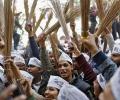
Now that the AAP has turned from an anti-corruption movement to a political party running a government in New Delhi, it may find that the media is no more a collaborator, says Mahesh Vijapurkar.
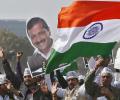
From his run-ins with the Centre to his political knack to sail through choppy waters, the Delhi CM has shown uncommon talent in running a 'common man's' government.

Should candidates for particular positions in the government be permitted to agitate for changing the recruitment process itself? The candidates have to meet the requirements of the jobs rather than ask for their own standards to be accepted as the requirement of the jobs. Those who cannot meet those criteria should seek other jobs that match their skills, says T P Sreenivasan.

'Over 50 crore Indians are currently suffering from a livelihood crisis, something to which the whole country had shut its eyes to for the past six months.' 'We woke up only after the IPL was affected.'

The fight over FYUP is between a highly controversial decision taken during the United Progressive Alliance rule and how the National Democratic Alliance government perceives it and how it is determined to resolve it in its own way, reports Sheela Bhatt.

'Unlike in other states, minorities form a significant number in Kerala. They have money and political power. In such a society, the emergence of a new communal power is not a healthy thing.'

Aam Aadmi Party on Wednesday came out with its manifesto for the December 4 Delhi polls, promising to enact Jan Lokpal Bill in 15 days if voted to power.

Why are so many people so reluctant to give up on Arvind Kejriwal? The simple answer is 'Narendra Modi', or rather the fear of Narendra Modi,' says T V R Shenoy.

AAP has been vociferous since its inception and has mainly raised issues pertaining to corruption. A political party must have crisp and specific standon all issues which concern the nation not just corruption or secularism; and AAP has failed to deliver on all these counts, says Aditya Shah and Aadit Kapadia.

'It is good for the country, but it is not good for a politician... What we call impatience is actually desperation to needing something NOW.' 'Our politics is restricted by one factor; that our Parliament is full of villages. 40% of the country now lives in cities but only 25% of Parliament is coming from the cities.'
 © 2026 Rediff.com - Advertise with us - Disclaimer - Privacy Policy - Sitemap - Feedback - About us - Terms of use - Grievances