
'Agreements signed between the Maldives and China have seriously worried India.'

Meet Srihari Sathe. Producer. Director. Professor.
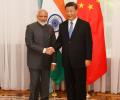
'The fact that Modi and Xi exuded confidence to accelerate the negotiations for a border settlement alone underscores that the Russia-India-China triangle has become very dynamic,' notes Ambassador M K Bhadrakumar.

President Pranab's four-day visit to China that saw him meeting the top Chinese leadership and discussing the sticky boundary issue and cooperation in combating terrorism besides the need for a predictable nuclear regime.

Would it serve India's interest to go to war with China over the Maldives, asks Aditi Phadnis.

On the second leg of his trip to Central Asia, Narendra Modi makes quite an impression in Astana, as he talks about terror and trade, films and the future
'India and China have to make concrete progress with regard to the border issue, addressing the trade deficit, and facilitating people-to-people interactions. This has to happen in the next two, three years.' China expert Tansen Sen tells Sheela Bhatt/Rediff.com how India and China can take their relations to the next level.

'Trump's anti-trade, anti-immigrant rhetoric reminds me of Chinese history,' says A V Rajawade.

With PM Modi's visit, the time has come for a relook at India-Myanmar ties, and elevate the relationship to higher levels, says Dr Rahul Mishra.

'The men in black suits and hair dye in Beijing have not only completely blown the cover story of "peaceful rise," but have managed to antagonise regional powers in the Indo-Pacific.'
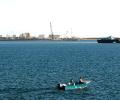
The Modi government's appalling inefficiency and lack of purpose stand exposed, says Ambassador M K Bhadrakumar.

China is pulling out all the stops to give a 'state visit-plus' reception to Trump on his maiden visit.

'Modi's recent decisions to improve India-China relations, adjust India's neighbourhood policies and to rebalance India's ties with the major powers are linked to his political agenda.' 'Of course, the good part is that this agenda is also in the national interest,' says Ambassador M K Bhadrakumar.
Modi talking about Balochistan, PoK and Gilgit is a tectonic shift in India's policy towards Pakistan, says Abhay Jere.
Prime minister likely to visit Beijing, Shanghai; also President Xi's home province, Shaanxi. Nayanima Basu reports

Seeking to allay India's concerns, ambassador Luo had offered to rename the CPEC which passes through Pakistan-occupied Kashmir, insisting it was an economic cooperation and connectivity enhancement project devoid of "sovereignty issues".
China has demonstrated that it has the power to not be isolated, and it is likely to become more powerful over time.
India has moved beyond the traditional trappings of non-alignment

Gwadar port India is hardly taking any note of developments in Balochistan. To counter and restrict China influence there, India needs to aggressively move forward on further consolidating its friendly relationship with Iran and Afghanistan, says Abhay Jere.

Hailing India for keeping "neutral stand" over the South China Sea issue despite pressure from the US and Japan, state-run Chinese media on Wednesday said there are some contradictions and frictions between the two nations but the overall bilateral relations have been developing smoothly.

'Gwadar has the potential to facilitate PLAN's operations in the Arabian Sea and Indian Ocean.' 'Reports of China setting up electronic eavesdropping posts at Gwadar to monitor US and Indian naval activity and shipping traffic through the Straits of Hormuz and the Arabian Sea lend credence to this,' says former RA&W officer Jayadeva Ranade.

The Chinese leader will display his grip on the Communist party and chart his plans for his country's future.

Since 55 per cent of Indian trade passes through the South China Sea, and with over $5 billion investments in the energy sector in Vietnam, it is imperative India actively pursues its national interests in the region, says Srikanth Kondapalli.

The PM on Tuesday officially announced his visit to China from May 14 to 16.

China's South China Sea build-up and 'territorial sea' construct potentially affects 55 percent of Indian trade passing through the region. Hence, coordinating with the US and Japan could provide dividends to India in the longer run,' says Srikanth Kondapalli.

He said he has always maintained that instead of fighting with each other, India and Pakistan should together fight against poverty.

'He still has to deal with party norms and traditions and has been careful to follow the order of seniority,' points out Claude Arpi.

'China, which had earlier blockaded New Delhi's bid to join the Nuclear Suppliers Group by citing the nuclear non-proliferation law, finds itself in an awkward position and international isolation.' 'India needs to pursue a policy of mediation between China and the Southeast Asian countries for regional security,' says Srikanth Kondapalli.

'While visits and personal meetings are useful, changes of strategic significance have occurred recently, with Beijing trying to take the lead which Modi must take note of.'

Brushing aside India's concerns, China on Monday cemented its "all-weather ties" with Pakistan by agreeing to build a strategic $46 billion (Rs 2.9 lakh crore) economic corridor through Pakistan-occupied Kashmir as part of 51 deals signed, expanding the communist giant's influence in the region.

It is important the SCO focus strongly on economic development and regional integration that leads to greater benefits for the least developed regions of member-countries, writes Sana Hashmi.

'Assuming the official defence allocations represent the true picture, the $142 billion figure still represents a phenomenal increase and surpasses that of Japan ($42 billion), India ($40 billion), South Korea ($33 billion) and several other Asian countries put together and shows that China is flexing its military muscle.'

The developments in Af-Pak region, particularly the fall out of Pak political paralysis, would make President Xi Jinping's task a little more complicated, says Colonel R Hariharan.

The new government needs to clearly insist on diplomatic reciprocal arrangements with China. While reciprocity is a function of power in bilateral relations, the Modi-led government's responses should be based on India'S inherent strengths, says China expert Srikanth Kondapalli.

'By the time he came out after nearly five hours, he had a one-to-one conversation with the President, a delegation-level meeting, a reception, a dinner, a tour of the White House and a joint statement of a kind none of his predecessors ever had,' says Ambassador T P Sreenivasan.

'If India and China come together, 40 per cent of the world's people are going to be prosperous'

The agreement on pricing last month marks a significant step towards promoting energy security in the region, say Nisha Taneja & Samridhi Bimal.

In the case of India, there are no specific references in China's white paper. However, there are several takeaways for India, says Srikanth Kondapalli.

There are still a few lingering issues towards the progress of India-China bilateral relations, the approach for dealing with each other seems to be quite different. With Modi-Xi bonhomie strengthening, it seems that India and China are ready to recalibrate their approaches towards each other, says Sana Hashmi.

'Extending the range of the DF-21D could challenge Indian aircraft carriers if the missiles are launched from southwest China. Also, if Pakistan acquires these systems, these missiles could directly challenge India's aircraft carriers.'
 © 2026 Rediff.com - Investor Information - Advertise with us - Disclaimer - Privacy Policy - Sitemap - Feedback - About us - Terms of use - Grievances