The issue combined with its alliance with anti-Congress parties in 1989 won the BJP 85 seats in Lok Sabha elections against mere two in 1984.
Shah pulled no punches in lambasting the RJD supremo for alleged nepotism, accusing him of making his wife the chief minister, getting his daughter elected to Parliament and "now both his sons want to become the CM".
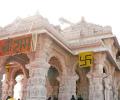
The BJP's Murshidabad unit in West Bengal announced plans to construct a Ram temple in Berhampore, days after TMC MLA Humayun Kabir proposed to set up a mosque modeled after the Babri Masjid in Beldanga. The temple construction, estimated to cost Rs 10 crore, is expected to begin on January 22, 2025, one year after the inauguration of the Ram temple in Ayodhya. Kabir's announcement sparked political controversy, with opposition parties accusing him of attempting to polarise communities for political gain. The BJP's counterproposal is seen as a strategic move to strengthen its presence among the Hindu community in Murshidabad.
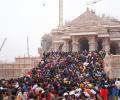
The three-day celebrations began on Saturday with a recital of Yajurveda and Chief Minister Yogi Adityanath performing an 'abhishek' on the Ram Lalla idol.
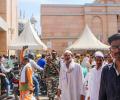
The Act prohibits conversion of any place of worship and provides for the maintenance of the religious character of any place of worship as it existed on August 15, 1947.
The Mathura Shahi Masjid Eidgah Committee has approached the Supreme Court, requesting the court to prevent the central government from filing a response to a petition challenging the Places of Worship Act's constitutional validity. The committee accuses the BJP-led government of intentionally delaying its response. The court had previously issued a notice to the government in March 2021, but the government has yet to submit its reply despite numerous opportunities. The committee argues that the government's delay is intended to obstruct those opposing the challenge to the Places of Worship Act from filing their own responses. The petition also states that the pleas challenging the law's validity are scheduled for hearing on February 17, and closing the government's right to respond would serve justice. The Supreme Court previously issued a ruling in December 2022 that stopped courts from entertaining new lawsuits or issuing interim or final orders regarding the reclaiming of religious places, particularly mosques and dargahs. The ruling halted proceedings in 18 lawsuits filed by Hindu groups seeking surveys to confirm the original religious character of 10 mosques, including the Gyanvapi Masjid in Varanasi, the Shahi Idgah Masjid in Mathura, and the Shahi Jama Masjid in Sambhal. This decision was made in response to six petitions, including one filed by lawyer Ashwini Upadhyay, challenging various provisions of the Places of Worship Act. The 1991 law prohibits the conversion of places of worship and guarantees the preservation of their existing religious character as it stood on August 15, 1947. Notably, the dispute regarding the Ram Janmabhoomi-Babri Masjid in Ayodhya was excluded from this law. There are also several cross-petitions advocating for a strict enforcement of the 1991 law to uphold communal harmony and maintain the current status of mosques that Hindu groups seek to reclaim, claiming they were temples before being destroyed by invaders.
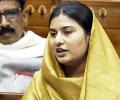
Samajwadi Party leader and Kairana MP Iqra Choudhary has moved the Supreme Court seeking effective implementation of the Places of Worship (Special Provisions) Act, 1991. This move comes amidst several petitions challenging the law's validity, including those filed by the Akhil Bhartiya Sant Samiti and lawyer Ashwini Upadhyay. The Supreme Court, in December 2022, had restrained all courts from examining fresh suits and passing interim orders in pending cases seeking to reclaim religious places. The Act aims to maintain the religious character of places of worship as they existed on August 15, 1947, but the dispute relating to Ram Janmabhoomi-Babri Masjid at Ayodhya was kept out of its purview. The court has listed Choudhary's plea with other pending pleas for February 17.
Temples across Uttar Pradesh were packed with devotees on Sunday for Ram Navami, with Chief Minister Yogi Adityanath leading prayers at the Gorakhnath Temple. Heavy crowds were witnessed at temples in Lucknow, Gorakhpur, and Varanasi, where security was heightened. In Gorakhpur, Adityanath performed the traditional kanya pujan ritual, while in Varanasi, a 51-foot statue of Lord Ram has become a major attraction. The festival was celebrated with enthusiastic fervor across the state.
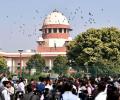
A bench comprising Chief Justice Sanjiv Khanna and Justice Sanjay Kumar also indicated that it may not take up the pending scheduled petitions, heard earlier by a three-judge bench, during the day as it was sitting in a combination of two judges.

'Even if the government does not implement an all-India NRC before 2024, it will be part of the party's long-term project.'

Chief Justice of India (CJI) D Y Chandrachud on Monday said there was 'nothing wrong' in Prime Minister Narendra Modi's visit to his residence on Ganpati Puja and underscored the need for a 'sense of maturity in political sphere' on such issues.

He said he would offer worship at the Ram temple only when the "shikhar" (topmost part) of the structure is fully constructed.
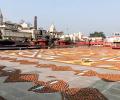
The government aims to better its last year's Guinness World Record by lighting 25 lakh diyas on the banks of Saryu river.
The Supreme Court of India will hear a plea from the mosque management committee challenging an order rejecting its petition in the Krishna Janmabhoomi-Shahi Idgah dispute in Mathura, Uttar Pradesh on January 15. The Allahabad High Court had rejected the mosque committee's plea, stating that the religious character of the Shahi Idgah mosque needed to be determined. The case involves claims that the mosque was built after the demolition of a temple, a claim disputed by the mosque committee. The Supreme Court will now decide on the maintainability of the mosque committee's plea.
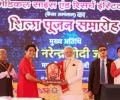
'While suppression of information is acceptable for the government, the Opposition's efforts at pinning the government and its leaders is labeled anti-national,' points out Nilanjan Mukhopadhyay.
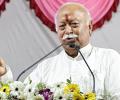
RSS chief Mohan Bhagwat has said that the date of Ram temple consecration in Ayodhya should be celebrated as "Pratishtha Dwadashi" as it marks the "true independence" of India, which faced "parachakra" (enemy attack) for several centuries. Bhagwat said that the Ram temple movement was not started to oppose anyone, but to awaken the "self" (swa) of Bharat so that the country could stand on its own feet and show the path to the world. He also said that the invaders destroyed temples of the country so that the "self" of India also perishes.

As many as 3,800 bamboo and 36 projector lights worth over Rs 50 lakh installed on Bhakti Path and Ram Path, located in a high-security area in Ayodhya, were allegedly stolen, according to police.

Can ordinary citizens counter this backward march? Can peace activists ensure that the two communities retain their bonds? Do they have a choice, asks Jyoti Punwani.

The Vishva Hindu Parishad on Sunday said 'some people' have been seeking funds in the name of the Ayodhya Ram temple trust without any approval and a complaint has been made to Uttar Chief Minister Yogi Adityanath and the Union home ministry requesting for immediate action against them.

Shri Ram Janmabhoomi Teerth Kshetra General Secretary Champat Rai has shared glimpses of the remains of an ancient temple discovered during excavation at the Ram Janmabhoomi in Ayodhya.

Shatrughan Vishwakarma was deployed as part of the Special Security Force (SSF) set to provide security at the temple premises.
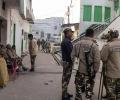
A four-member team from the Archaeological Survey of India (ASI) conducted a survey of the recently-discovered Shri Kartik Mahadev temple, five pilgrimage sites, and 19 wells in Sambhal, Uttar Pradesh, India. The survey followed the discovery of three damaged idols inside a well of the Bhasma Shankar temple, which was reopened after being shut for 46 years. The Shri Kartik Mahadev temple, also known as the Bhasma Shankar temple, was reopened on December 13 after authorities found the covered structure during an anti-encroachment drive. The temple houses an idol of Lord Hanuman and a Shivling and had remained locked since 1978. The district administration has requested carbon dating of the temple, including the well, from the ASI. Meanwhile, the Supreme Court has restrained courts across India from entertaining new lawsuits or passing any orders in pending ones seeking to reclaim religious places, especially mosques and dargahs, until further notice. This action halts proceedings in approximately 18 lawsuits filed by Hindu parties seeking surveys to determine the original religious character of 10 mosques, including the Gyanvapi at Varanasi, the Shahi Idgah Masjid at Mathura, and the Shahi Jama Masjid at Sambhal, where four individuals died in clashes. The Supreme Court will examine the legality, scope, and boundaries of the Places of Worship (Special Provisions) Act, 1991, which prohibits the conversion of places of worship and ensures the preservation of their religious character as it existed on August 15, 1947.

What some of our leaders were up to this week.
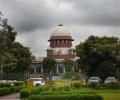
Commencing hearing on pleas challenging the constitutionality of the Places of Worship Act, 1991, the Supreme Court asked the Centre to reply to cross-pleas against or seeking implementation of statute.

Dropping references to the demolition of Babri Masjid in Ayodhya, the killing of Muslims in Gujarat riots and Hindutva, and tweaking the reference to Manipur's merger with India are among the latest set of revisions made public by the National Council of Educational Research and Training (NCERT) in its textbooks.
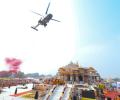
Ayodhya is decked up for the grand pran pratishtha (consecration ceremony) of Lord Ram Lalla in the newly built Ram Janmabhoomi Temple.
It will be heard by a five-judge Constitution Bench headed by Chief Justice Ranjan Gogoi.
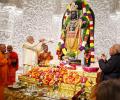
Prime Minister Narendra Damodardas Modi was the centre of attention at the pran pratishtha ceremony of the Shri Ram Janmabhoomi temple in Ayodhya.

The temple trust shared the incident, that took place on Tuesday night, on its official 'X' handle.

Besides, various representatives of the Shri Ram Janmabhoomi Teerth Kshetra, members of the Rashtriya Swayamsevak Sangh, Vishwa Hindu Parishad and their allies are also aiding in hand-delivering the invitations.
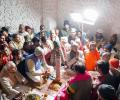
The ministry of home affairs (MHA) has sent a high-level team to Ayodhya to deal with cyber threats ahead of the inauguration of the Ram Temple in the historical town on January 22.

The Shri Ram Janmabhoomi Teerth Kshetra Trust has sent invitations to 7,000 people, including 3,000 VVIPs, for the consecration.
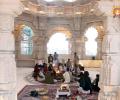
'They are from the north, east, west, south and northeast part of India. They will be the 'mukhya yajmaan' (main hosts)'

The Shri Ram Janmabhoomi Teerth Kshetra Trust has got 'mahaprasad' prepared for the VIPs coming to attend the consecration ceremony in Ayodhya on Monday.

"There was no water leakage but the rainwater came down from the pipes fixed to install electric wires," Mishra said.

On January 16, 2024, devotees in Ayodhya lit the 108-feet incense stick that sent from Gujarat in the presence of Shri Ram Janmabhoomi Teerth Kshetra President Mahant Nrityagopal Das Maharaj.
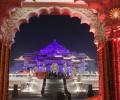
The old idol of Ram Lalla, kept in a makeshift shrine, will be placed in front of the new idol which will be consecrated at the temple in Ayodhya on January 22, said Govind Dev Giri, the treasurer of Shri Ram Janmabhoomi Teerth Kshetra Trust.

On Tuesday, devotees made offerings in cash at the temple counters and online donations, totalling Rs 3.17 crore, Mishra told PTI.
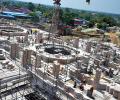
Swami Giri said the trust has so far collected more than Rs 3200 crore in donations from individuals and organizations within the country.

Participating in the eighth edition of Deepotsav in Ayodhya - the first since the consecration of Ram temple on January 22, Adityanath said, "This is a historic first as after 500 years, Lord Ram is now in his abode in Ayodhya for Diwali."
 © 2026 Rediff.com - Investor Information - Advertise with us - Disclaimer - Privacy Policy - Sitemap - Feedback - About us - Terms of use - Grievances