
Amidst escalating regional tensions, Sri Lanka is carefully considering its response after a second Iranian ship requested entry into its waters following a reported US submarine attack on an Iranian frigate near Galle.

Sri Lanka will repatriate the bodies of Iranian sailors killed on the IRIS Dena, which was reportedly sunk by a US submarine. The government is also addressing potential impacts on food security and fuel supplies due to the war situation.

Experts' worries intensified after Pakistan commissioned its first Chinese-built Hangor-class submarine, PNS Hangor, last month.

At least 101 people are missing and 78 are injured after a suspected submarine attack on an Iranian naval ship off Sri Lanka's southern coast on Wednesday, Reuters quoted sources in Sri Lanka's Navy and defence ministry as saying.
Over 230 Iranian sailors were repatriated from Sri Lanka after incidents involving two naval vessels, including a reported US submarine attack and an engine failure.
Sri Lanka has completed the post-mortem examination of Iranian sailors recovered from the frigate IRIS Dena, which allegedly sank after a US submarine attack. Eighty of the 84 bodies have been identified by survivors, and an opposition protest was held against military aggression against Iran.

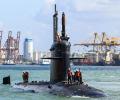
Equipped with advanced weaponry, the HMS Anson is fitted with "Tomahawk Block IV land-attack missiles" with a range of 1,600 km and "Spearfish heavyweight torpedoes," providing formidable offensive capabilities.

The Sri Lanka Navy rescued 32 Iranian sailors from a sinking naval ship off the southern coast, while also recovering several bodies. The incident occurred outside Sri Lankan waters but within its search and rescue zone.

A lesson for India is to clearly define objectives beforehand, so that the adversary or other parties do not attempt to mitigate them midway.

The vessel sank on March 4, 2026, approximately 20 nautical miles west of Galle, after reportedly being struck by a torpedo from a United States submarine.
For India, China's Indian Ocean power projection, maritime domain awareness, dual-use ports, underwater surveillance, antisubmarinewarfare, naval exercises with Pakistan, pose considerable pressure, depleted India's strategic depth and marginalises Indian role, points out Srikanth Kondapalli.

Major General Amir Hatami, commander-in-chief of the Iranian Army, condemned the attack on the vessel, one of the country's newest warships, which occurred while it was returning from a military exercise.

India is increasingly focusing on long-range weapons capable of reaching targets across China.

While the Andaman and Nicobar islands serve as a vital, stationary asset for projecting power in the Indian Ocean, referring to them as an unsinkable aircraft carrier ignores key military and geopolitical limitations, explains Commodore Venugopal Menon (retd).

Tensions escalated dramatically on March 5, 2026, as the United States and Israel launched coordinated strikes on Iran, triggering retaliatory explosions across Tehran, Sanandaj, and beyond.

Sri Lanka is deliberating appropriate action after a second Iranian ship sought entry to its territorial waters, following an attack on an Iranian frigate near the island nation. The government is focused on safeguarding lives and regional peace.
'Torpedoes travel at more than 100 kilometres per hour, about 50-60 knots.' 'It must have been a matter of a few minutes before it detonated under the Iranian ship.' 'The Iranian ship would have probably got three, four minutes and wouldn't have known till they actually heard the whirr of the torpedo.'

If Iran and Oman choose to charge a fee for rendering services to vessels using their territorial waters, so be it. The US is indulging in an irrationally self-destructive act, notes Ambassador M K Bhadrakumar.

At least 22 Iranian sailors from the IRIS Dena, which sank after being torpedoed, have been discharged from a Sri Lankan hospital. Another 10 remain under treatment, while arrangements are being made to repatriate the bodies of 84 sailors recovered after the incident.
Sri Lanka has allowed a second Iranian ship, IRINS Bushehr, to dock at Trincomalee port after it reported engine failure, following the sinking of an Iranian frigate. The move comes amidst heightened regional tensions and a joint US-Israeli attack on Iran.
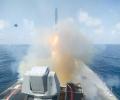
'India was not obliged to protect the Iranian ship.' 'Once the Iranian ship left Indian waters, she was on her own.' 'Guilt tripping India is wrong.'
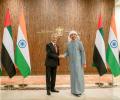
Frankly, was it really necessary in the middle of a fratricidal war for External Affairs Minister S Jaishankar to travel to Abu Dhabi for a one-on-one with the sheikh on April 12?Or, for National Security Advisor Ajit Doval to follow up on April 26? Or, for PM Narendra Modi to follow through today? There are no easy answers, notes Ambassador M K Bhadrakumar.
Following the death of Iranian sailors in the Indian Ocean, Iran's navy has threatened 'deadly retaliation,' accusing the US of attacking its warship off the coast of Sri Lanka, escalating tensions in the region.

King Charles III reaffirmed the enduring strength of the US-UK alliance, underscored NATO's centrality to global security, and shared light-hearted moments with President Donald Trump during a White House state dinner.
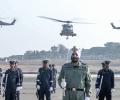
The Indian Navy commissioned its second squadron of MH-60R (Romeo) anti-submarine helicopters, INAS 335 'Ospreys', at INS Hansa naval base. The commissioning ceremony was attended by Chief of Naval Staff Admiral Dinesh Tripathi, who emphasized the importance of strengthening maritime security.

Top government sources in India have dismissed claims that the Indian Navy provided intelligence to the US regarding an Iranian frigate that was sunk by a US submarine.
Amid rising tensions, Iran threatens retaliation after the United States confirms sinking its warship, IRIS Dena, in international waters, escalating conflict in the region.

The US blockade on Iranian ports is aimed to curb Iranian energy exports, thereby crippling its economy to force Iran back to the negotiating table, points out Commodore Venugopal Menon (retd).

In a post on Truth Social, Trump outlined key goals of the campaign, including degrading Iran's missile capabilities, dismantling its defence industrial base, eliminating naval and air power, preventing Tehran from acquiring nuclear capability, and protecting United States allies such as Israel, Saudi Arabia and the United Arab Emirates.
'There's an urgent requirement, particularly for the Indian Ocean region, as China's naval presence grows, and with Pakistan also acquiring more submarines.'

An Army brigadier and his son were allegedly assaulted in Delhi after the officer objected to public drinking near their home. Police have registered an FIR and initiated an inquiry into the incident.

India granted emergency docking to an Iranian ship, IRIS Lavan, in Kochi due to technical issues, accommodating its crew amidst regional naval activity and tensions.

An Army brigadier and his son were allegedly assaulted in Delhi after the officer objected to public drinking. Police have registered an FIR and are investigating the incident.

Beijing has been wary of Sanae Takaichi's efforts to boost Japan's military profile since taking office six months ago, points out Dr Rajaram Panda.
The US torpedo attack on the Iranian warship IRIS Dena in international waters was a lawful act of war between belligerents, not a diplomatic or strategic embarrassment for India, asserts Vice Admiral Biswajit Dasgupta (retd).

Admiral Dinesh K Tripathi awarded Yudh Seva Medals to Vice Admiral A N Pramod and Vice Admiral Rahul Gokhale for their distinguished service during Operation Sindoor. The operation involved a strong naval response to security concerns, showcasing strategic planning and effective deployment of naval assets.

Hegseth said the military campaign, code-named Operation Epic Fury, against Iran is "laser focused" and "decisive," with objectives set directly by the US administration remaining unchanged since the start of operations.

The BJP has criticised the Congress party for allegedly prioritising its vote bank and outdated ideologies over India's national interest and citizen safety in its foreign policy approach towards Iran.

India has expressed condolences over the death of Iran's Supreme Leader Ayatollah Ali Khamenei following a joint US-Israel strike, amidst rising tensions in West Asia and criticism over the sinking of an Iranian warship.

India has firmly denied allegations that the US Navy is using its ports to launch attacks against Iran, reaffirming its commitment to strategic autonomy and non-alignment in international conflicts.
