
Describing the visit as "productive" in a post on X, the PM said he emphasised India's position on key global issues during his engagements.

Prime Minister Narendra Modi is embarking on a two-nation tour to Uzbekistan and the Kyrgyz Republic, where he will attend the SCO Summit. He aims to advance India's vision for the region, focusing on security, connectivity, and opportunity, and to strengthen strategic partnerships in Central Asia, fostering a region free from terrorism.

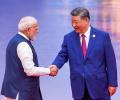
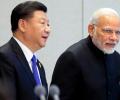
Modi was received at the venue by Chinese President Xi Jinping and First Lady Peng Liyuan. On arrival, the Prime Minister exchanged greetings with the Chinese President before joining other leaders for the customary family photo session.

Prime Minister Narendra Modi and Chinese President Xi Jinping are expected to hold bilateral meetings on the sidelines of the SCO summit in Tianjin, as both nations look to strengthen ties amid global trade tensions.

China on Friday said the Shanghai Cooperation Organisation (SCO) summit to be held in Tianjin later this month will be the largest in the bloc's history, with 20 world leaders, including Prime Minister Narendra Modi, attending it.
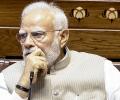
China welcomes Prime Minister Narendra Modi's planned visit to the Tianjin Summit of the Shanghai Cooperation Organisation (SCO), expressing hope that the event will be a 'gathering of solidarity, friendship and fruitful results'.
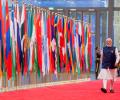
During a special briefing in Tianjin, Misri confirmed that the prime minister will first address the SCO plenary session before meeting President Putin.

India has highlighted 13 key outcomes from the recent Shanghai Cooperation Organisation (SCO) summit, focusing on enhanced cooperation in security, counter-terrorism, and addressing transnational threats. These outcomes include the establishment of a Universal Centre for Countering Challenges and Threats to Security, a strong stance against state-sponsored terrorism, and agreements on narcotics control, climate change, and artificial intelligence, reinforcing India's engagement in the Eurasian region.
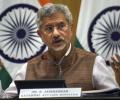
The last Indian external affairs minister to visit Pakistan was Sushma Swaraj. She had travelled to Islamabad in December 2015 to attend a conference on Afghanistan.
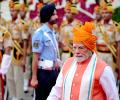
Prime Minister Narendra Modi will travel to China to attend the Shanghai Cooperation Organisation (SCO) summit, marking his first visit in over seven years. The visit signals a potential improvement in India-China relations after recent tensions.

Prime Minister Narendra Modi, addressing the SCO summit in Bishkek, called for a united front against terrorism and its financing, rejecting double standards. He emphasised resolving conflicts through dialogue and diplomacy, not battlefields. Modi also highlighted that connectivity projects must respect national sovereignty and territorial integrity, a veiled reference to China's Belt and Road Initiative. India's vision for SCO rests on security, connectivity, and opportunity.

Prime Minister Narendra Modi says India-China relations have made steady progress in the last 10 months, guided by respect for each other's interests and sensitivities. He made the remarks after meeting with Chinese Foreign Minister Wang Yi.
Ahead of Xi Jinping's visit, National Security Advisor Ajit Doval and Chinese Foreign Minister Wang Yi held extensive talks in Beijing on August 25 on the boundary issue and reached an eight-point consensus.

Russian President Vladimir Putin has arrived in India for a three-day visit to attend the BRICS summit and hold bilateral talks with Prime Minister Narendra Modi, focusing on expanding trade, investment, and energy cooperation amidst global geopolitical challenges.
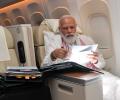
The summit will be attended by leaders of SCO member states, observer states, Secretary General of the SCO, Executive Director of the SCO Regional Anti-Terrorist Structure (RATS), President of Turkmenistan and other invited guests, a Ministry of External Affairs statement said.

Prime Minister Narendra Modi met Iranian President Masoud Pezeshkian at the SCO summit, advocating for dialogue and diplomacy to resolve the West Asia conflict and expressing India's desire to expand and diversify trade with Iran. Pezeshkian, in turn, urged India to leverage its contacts to promote peace.
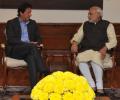
It is also learnt that Khan congratulated Modi on his election victory during their first face-to-face interaction.

Chinese President Xi Jinping's first visit to India in seven years for the BRICS Summit and bilateral talks with Prime Minister Narendra Modi is set to address crucial aspects of India-China relations, including trade, investment, and persistent border tensions.

Ahead of President Vladimir Putin's visit to India for the BRICS summit, Russia has expressed support for New Delhi's peace initiatives to resolve the Ukraine conflict. Discussions between Putin and PM Modi will cover defence, energy, technology, and the repatriation of Indian nationals from the Russian military, alongside addressing trade and investment ties.

Prime Minister Narendra Modi urged Russian President Vladimir Putin to move from 'endless war to the end of war' in Ukraine, emphasising that a peaceful resolution is humanity's shared priority.

US Secretary of State Marco Rubio stated he does not believe India and Iran are pursuing a trade deal, despite a recent meeting between their leaders. He acknowledged that many countries engage with the Iranian regime but reiterated President Trump's warning against helping Iran evade sanctions, threatening penalties for nations that do so.

The two leaders shook hands and exchanged pleasantries at the end of the media briefing which was addressed by Chinese President Xi Jinping. China is the host and chair of the SCO.

The Shanghai Cooperation Organisation is very much aligned with the foreign policy priorities of the Modi 2.0 government, says Sana Hashmi.

Prime Minister Narendra Modi, in bilateral talks with Chinese President Xi Jinping, emphasized that both nations must show sensitivity to each other's core issues and be guided by mutual respect, sensitivity, and interest. Modi highlighted the critical importance of peace and tranquillity along the Line of Actual Control for the development of India-China relations, while also addressing concerns regarding Taiwan and Tibet.

However, there is no official word on whether there will be any interaction between Modi and Pakistan President Mamnoon Hussain, who is scheduled to attend the meeting in China.
Modi would be attending the Shanghai Cooperation Organisation summit in Kyrgyzstan's capital Bishkek on June 13-14.

Xi brought in asymmetrical power play by stating that India should have 'strategic cognition' and 'strategic judgement made on the basis of the stage of development the two countries are at'. This is a very nuanced way of asserting China's coercive diplomatic posture and reflects Beijing's penchant to unleash border instability at will, restrict rare earth metal exports, exert pressure on India at global and regional orders, asserts China expert Srikanth Kondapalli.

India, along with Pakistan, is set to be inducted as full members into the bloc, which mainly deals with issues relating to security and defence.
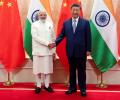
India has asserted that the state of its border with China directly impacts the broader bilateral relationship, emphasising the critical importance of maintaining peace and tranquillity along the Line of Actual Control (LAC). The Ministry of External Affairs also firmly rejected China's claims over Arunachal Pradesh, reiterating its status as an integral part of India. This stance was reiterated during a recent Working Mechanism for Consultation and Coordination meeting, where both sides agreed to continue using diplomatic and military channels to resolve outstanding issues.

Prime Minister Narendra Modi and Russian President Vladimir Putin held extensive discussions to strengthen bilateral trade, defence, and energy cooperation, while also addressing the ongoing Ukraine conflict and exploring avenues for peace and resolution, with Modi reiterating India's call for dialogue and diplomacy.

Prime Minister Narendra Modi conveyed to Chinese President Xi Jinping that peace and tranquillity along the frontier remains an "essential" basis for the development of India-China relations, even as the two leaders welcomed "steady progress" in bilateral ties during their talks on the sidelines of the BRICS summit.

Modi will hold several bilateral meetings with the leaders of the SCO member countries including China's Xi Jinping.

External Affairs Minister S Jaishankar met his Chinese counterpart Wang Yi in Manila, reiterating that peace and tranquillity in border areas are prerequisites for normal India-China relations. He stressed the importance of mutual respect, interest, and sensitivity, while also raising concerns about market access, trade imbalance, and supply chain uncertainties.
India and China held diplomatic talks to review the situation along the Line of Actual Control (LAC), discussing boundary delimitation, border management, and trans-border cooperation. Both nations stressed the importance of maintaining peace and tranquillity for bilateral relations and agreed to continue using existing channels to resolve outstanding issues.

National Security Adviser Ajit Doval held "constructive" talks with Chinese Foreign Minister Wang Yi in New Delhi, focusing on the normalisation of bilateral ties. The discussions reviewed recent developments and progress towards rebuilding trust after the eastern Ladakh border standoff. Both sides have implemented measures, including disengagement pacts and high-level meetings, to improve relations.

After visiting two Central Asian countries, Prime Minister Narendra Modi arrived in Ufa on Wednesday on a three-day trip during which he will attend the BRICS and Shanghai Cooperation Organisation summits.

Russia on Monday assured India of uninterrupted supply of energy and fertilisers amid disruption caused by the West Asia crisis, as External Affairs Minister S Jaishankar met President Vladimir Putin in Moscow and held talks with his key interlocutors.
The Ministry of External Affairs (MEA) on Friday said Modi will lead the Indian delegation at the summit. "The prime minister will lead the Indian delegation to the 20th summit of the SCO council of heads of state which will be held in the virtual format on Nov 10. The meeting will be chaired by Russian President Vladimir Putin," MEA Spokesperson Anurag Srivastava said.

'Clearly, the warming of ties can be a 'win-win' for India and China,' says Ambassador M K Bhadrakumar.

'India needs to be cautious that its differences with Pakistan do not obstruct SCO's functioning,' says Sana Hashmi.
