
As Pakistan celebrated its Independence Day on Thursday, the fear of violence loomed large with the capital turned into a fortress ahead of two massive anti-government rallies, demanding the resignation of Prime Minister Nawaz Sharif and fresh elections.
Bruce Riedel, a former CIA analyst who was one of the key architects of US President Barack Obama's Af-Pak policy during his first term, has called for an offensive strategy against terrorist networks and this includes hitting out at terrorist groups inside Pakistan.

Chinese President Xi Jinping arrived in Islamabad on Monday on his first visit to Pakistan where he is expected to sign a deal for an economic corridor worth $46 billion and other agreement.
Denying the Pakistani investigators access to the Pathankot base on operational grounds would not, the government felt, compromise national security, reveals Rajeev Sharma.

'History will repeat itself after a decade or so and historians will point to the folly of May 2017 as the event that sowed the seeds of another 9/11,' warns Colonel Anil A Athale (retd).

'The China Pakistan Economic Corridor is Pakistan's number one preoccupation today -- and tensions with India and the $46 billion projects simply do not go together,' points out Ambassador M K Bhadrakumar.

The Afghan deputy foreign minister explains how his nation's President became disillusioned with Pakistan. Ajai Shukla listens in.

Even as Prime Minister Nawaz Sharif headed to the United States for the 70th session of the UNGA and for bilateral meetings to be held on the sidelines of the multilateral summit, back home all that is expected of him is to internationalise the Kashmir issue, or as Pakistan puts it, the 'Kashmir dispute'.

Amid Pakistan Army's mediation efforts, protesters have stepped up pressure on the embattled government with cleric Tahir-ul-Qadri setting yet another deadline of 24 hours for Prime Minister Nawaz Sharif to quit.
The Tehrik-i-Taliban Pakistan have claimed responsibility for the attack.
Pakistan's Punjab province Home Minister Shuja Khanzada was on Sunday assassinated along with eight others when a suicide bomber blew himself up at his house in Shadi Khal village in Attock district.

Pakistan's former president Asif Ali Zardari has returned to the country, ending his 18-month-long self-imposed exile, amidst speculations about his future role in the Pakistan Peoples Party, which has threatened a major protest against the Nawaz Sharif government.

It is quite likely that the Pakistanis are cleverly using the Jadhav card to derail the outcome of the JIT process.

'There are retaliatory incursions, ambushes, captures and killings by Indian forces along the 700 km border; alleged spies are caught on both sides, then mutually traded as pawns; envoys are summoned in both capitals to be routinely given dressing downs.' 'And there is always a handy courier pigeon, like Sajjan Jindal, sent over to test the troubled waters,' says Sunil Sethi.

'The biggest stumbling block will come from the traditionalists in the Pakistan army who have grown on a diet of anti-Indian propaganda and thinking on which much of their role -- both militarily and politically -- is centered upon.'

Operation Radd-ul-Fasaad launched to fight terrorism across country.

Legendary Pakistani philanthropist Abdul Sattar Edhi, who had dedicated his life to humanity and serving the poor, died in Karachi from renal failure. He was 92.

'A Russia-Iran-China-Pakistan geopolitical grouping is evolving at this point of time.' 'Given that the grouping is in its nascent stages, will this week's terrorist attack in Mirjaveh affect it?' asks Aveek Sen.

'Bolstering India's conventional military capability against China is in America's strategic interest,' says military historian Colonel Anil A Athale (retd).
It has been over two years since Husain Haqqani was forced to resign from the coveted post of Pakistan's envoy to the United States.

Conversations between one of the seven terrorists and his handler have been recovered before he blew himself up inside the ArmyPublic School

Shaken by the Taliban terror attack in which 148 people, including 132 school children, were killed in Peshawar on Tuesday, Pakistan has pledged to announce a "national plan" to tackle terrorism within a week with Prime Minister Nawaz Sharif saying "this entire region" should be cleaned of terrorism.
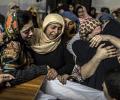
No one should be allowed to use Pakistan's territory to import or export terrorism, says Hamid Mir.

'Here in Delhi, the Modi government is supposedly looking at 'options' to hit back at Pakistan in any whichever way it can, while in Washington, the Obama administration is looking for ways to strengthen US military cooperation with Pakistan,' says Ambassador M K Bhadrakumar.

Pakistan's powerful army chief has stepped in to mediate between the embattled government and the protesters seeking resignation of Prime Minister Nawaz Sharif, bringing the military back into the centre stage and signaling a possible end to the high-political drama.
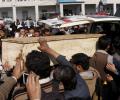
Extensive firing continues in the area and heavy contingents of elite force have been deployed.
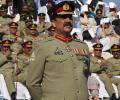
The recent postings and promotions of three-star generals in the Pakistan Army have propelled some of former chief Ashfaq Parvez Kayani's favourites to traditionally important positions
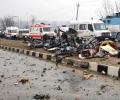
'A resurgent Jaish could be a reflection of the Pakistani security establishment's view that with the region moving ever closer to a post-US Afghanistan, it is time to redirect attention to Kashmir.'

'Pakistan will try to escalate covert operations through terrorism,' says Dr Shalini Chawla.

The known unknowns in Prime Minister Modi's Saudi visit assume great significance, says Ambassador M K Bhadrakumar.

'In order to achieve Pakistan's psychological isolation and pariah status, breaking all cultural, economic and people to people contacts must become a government policy with clear linkage to a change in behaviour by the Pakistani regime.'

With Pakistan's powerful army chief Gen Ashfaq Parvez Kayani's term coming to an end in November, names of top generals who are likely to succeed him are being discussed in the political circles and in the corridors of power.

Confrontation between Pakistan government and the opposition escalated on Wednesday with Prime Minister Nawaz Sharif rejecting demands for his resignation and Imran Khan calling off the dialogue with his regime until he quits.
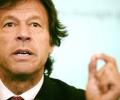
Opposition leader Imran Khan's political party on Monday decided to withdraw its lawmakers from the National Assembly and all provincial assemblies except Khyber Pakhtunkhwa, piling pressure on beleaguered Prime Minister Nawaz Sharif to quit, even as efforts by the ruling PML-N to reach out to anti-government protesters failed.

The 5-day political stand-off between the Pakistan government and anti-Sharif protestors intensified on Monday as efforts by the ruling PML-N to reach out to Opposition leader Imran Khan and cleric Tahir-ul Qadri failed with both the leaders remaining adamant on the ouster of the embattled prime minister.

General Qamar Bajwa, his colleagues say, is a firm opponent of extremism and terrorism. He may prove even more forceful in the fight against terrorism than his predecessor, who is credited with launching Operation Zarb-i-Azb, which helped lower the frequency of terrorist attacks.

Brushing aside India's concerns, China on Monday cemented its "all-weather ties" with Pakistan by agreeing to build a strategic $46 billion (Rs 2.9 lakh crore) economic corridor through Pakistan-occupied Kashmir as part of 51 deals signed, expanding the communist giant's influence in the region.

'China's growing nexus with Pakistan and the two countries' unresolved territorial disputes with India continue to pose a formidable national security threat to India,' says Brigadier Gurmeet Kanwal (retd).
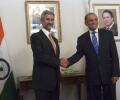
Pakistan's holy trinity -- its government, military establishment and the ISI -- differ on Pakistan's domestic and foreign policy issues. So when India talks to Pakistan's political leadership it can't be sure that the promises can be delivered, says Brigadier S K Chatterji (retd).
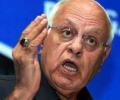
National Conference leader and former Jammu and Kashmir chief minister Farooq Abdullah has rejected the notion that the threat of a nuclear war would solve the Kashmir issue, asserting that the region would never be a part of Pakistan and dialogue is the best way to "move forward".
 © 2026 Rediff.com - Investor Information - Advertise with us - Disclaimer - Privacy Policy - Sitemap - Feedback - About us - Terms of use - Grievances