
Describing the protests as a "mutiny against Pakistan", the government on Tuesday turned to Parliament for support as demonstrators continued to put pressure on a defiant Nawaz Sharif to quit as prime minister.

'Some Pakistani generals are saying -- a little more so now than before -- that the biggest threat to Pakistan is not external -- not India -- but internal.' 'The proof of that will be their change of policies and that is going to be the challenge,' Rakesh Sood, one of India's most distinguished diplomats, tells Aziz Haniffa/Rediff.com in Washington, DC.

The question really is whether the US can be persuaded to embark on a path of calibrated and stronger sanctions on Pakistan.

'There were assurances that Jaish-e-Mohammad was being reined in as was the Lashkar-e-Tayiba, but Pakistan's security forces could not risk opening too many dangerous new fronts,' notes former foreign secretary Ambassador Shyam Saran, who has just returned from a visit to Lahore.

Pakistan, which has propped up the new Taliban leadership, would be keen to use its influence over the group to neutralise India's presence in the region.
Some members of the Obama administration have worried that Pakistan's heightened anxieties about India might lead Islamabad to take reckless measures, so they have wanted New Delhi to pursue more diplomatic engagement with Islamabad.
New Delhi's decision not to call for a flag meeting underlines its conviction that the military cost will soon become too high for Pakistan.
'Over the last year, Bajwa has created the environment to support bold moves on India. The ball is in India's court,' a senior Pakistan military officer tells Ajai Shukla.
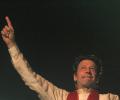
Both Messrs Imran Khan and Tahirul Qadri claim to march independently, but most of Pakistan believes they are marching to the Army's tune

'Nawaz Sharif knows a coup in 2016-2017 will not only complete Pakistan's isolation, but even a whiff of instability will frighten the world into imagining another Islamic State-zone, and this in a fully nuclearised subcontinent,' says Shekhar Gupta.

While Prime Minister Modi may pursue the laudable aim of building a cooperative relationship with Pakistan, he and his advisers should never think that concessions (and dialogue is a concession in itself) will change the Pakistan army's approach to India, says Vivek Katju.

'The combination of the LeT and the ISI is the most dangerous terrorist challenge in the world because it carries a real and present danger of provoking nuclear war.'

'China might soon have to seriously consider whether it prefers an Indo-US hyphenation to a Sino-Indian one.'

The cascade of cordiality on both sides after the Modi-Sharif handshake in Paris was preceded by much planning and even goading from UK, US and Germany.
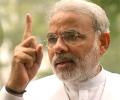
To be sure, Modi is no Vajpayee; at least that is the impression he gives. However, this doesn't mean that he will be looking for a fight. All it means is that if Pakistan seeks a fight, he will not back down. What it also means is that the pusillanimous approach of the previous governments to ceaseless provocations from Pakistan will probably change, says Sushant Sareen.

'The public has unfair expectations from Mrs Swaraj who is in Islamabad primarily for the Heart of Asia Conference. To restore India's position among stakeholders on Afghanistan is a fair one but to expect her to do more on the Indo-Pak front without requisite preparatory work is unrealistic.'

The outcome of the Bangkok NSA-level talks underscores that Pakistan has got exactly what it wanted -- talks at different levels, talks on Kashmir, talks on mutual concerns regarding terrorism, talks on ceasefire on the border. What if any has been India's gains remains unexplained, says Ambassador M K Bhadrakumar.

A grieving Pakistan's policy shift towards the Taliban has comes at a great cost, says Shahzad Raza.

'It will make good sense for military men on that side of the table to be confronted by our own.'
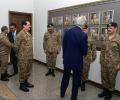
'Both India and Pakistan are now, for the first time in history, very closely allied and connected with the US -- economically and politically.'
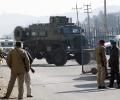
'India has already suffered in the raid of January 2, and taken punishment. If comparable or higher retribution does not visit Pakistan, there is no reason why it should not undertake such a misadventure again,' says Lieutenant General Ashok Joshi (retd).

'Modi wants to be pragmatic -- acknowledge the problem of Pakistan and that full reconciliation is essentially a non-starter, but at the same time grab the low-hanging fruits (such as trade) to put things on a more even keel, to engender enough stability in the relationship to allow him to focus on other priorities.'

After weighing all the costs and benefits, the next administration is likely to reduce and restructure assistance to Pakistan but not to end it altogether, says Daniel S Markey.
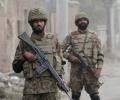
India must watch for signs after Peshawar that Pakistan is waking up to the dangers of Islamism, muses Ajai Shukla
'A close look at the time-lines tells you that exactly as the back-channel negotiations were in their most crucial stage, "somebody" was planning the 26/11 attacks in Mumbai,' says Shekhar Gupta questioning Khurshid Mahmud Kasuri's account of a peace deal with India.

The brutal Tehrik-e-Taliban Pakistan assault has claimed 141 lives, including 132 school children, six terrorists and three armymen.

'Kargil was Pakistan's strategic blunder. India must remain on guard against such sinister operations being launched in future by Pakistan's vengeful and devious military leadership that continues to have a hate-India mindset and the mentality of primitive warlords,' says Brigadier Gurmeet Kanwal (retd).

'The question remains: Was the Obama visit truly a success? Only the future will tell us if the "breakthrough" in the nuclear liability issue will concretise into electricity.' 'As importantly, it will be interesting to watch how India's relations with China will evolve in the months to come.'
By weakening Sharif, the corps commanders could have a final say in important matters like relations with India, dealing with Taliban militants, interacting with Americans and once again achieving strategic depth in post-NATO Afghanistan. Which is why they may be behind the unrest in Pakistan led by Imran Khan and Dr Tahirul Qadri, says Shahzad Raza.

'The clique that runs that country is treating us like suckers. We are very foolish, giving people money who involve themselves in activity that's harmful to America.' 'When you look at the cold hard facts, Pakistan is not an ally to the United States. They have facilitated, they have encouraged, they have been a protector of enemies.'

B S Prakash takes a tongue-in-cheek look at what India's neighbours think about the proposal of a SAARC satellite.

'Pakistan may feel emboldened to give an upswing to the proxy war in J&K, having secured a better international consensus on its strategic importance.' 'The raising of Pakistani flags by separatists in J&K is an attempt to win psychological space and more of this can be expected as we go into the summer.' 'Pakistan should remain warned that pushing India on this issue will be dangerous.'

'The ISI has given a stunning display of its capacity to do with impunity what it likes within Kabul. Incensed over the triumphalism of the hardliners in Kabul, the ISI has hit out; it is a typical ISI reflex action that Indians are familiar with,' says Ambassador M K Bhadrakumar.

'It is in the interest of both sides that the visit of the US President is seen as being successful. Both sides have invested considerable political capital in it. This rapid exchange of visits and the decisions taken have to be justified, beyond the symbolism, which is no doubt important in itself. This opportunity to impart a fresh momentum to ties should not be missed,' says former foreign secretary Kanwal Sibal.

Rediff.com reproduces this 2014 interview with Tim Kaine where in he discusses the new opportunities to foster Indo-US trade and the improvement in ties.

'For so long as the rulers of Pakistan remain committed to confronting and vanquishing India, they will sustain delusions, breed terrorists, and export them.'
'ISI mouthpieces in the media have been quick to blame India for the attack. Clearly, the intellect and worldview of these characters (which includes fairly senior retired military officers) is based on Bollywood movies like Ek Tha Tiger and Agent Vinod... More seriously, the fact that ISI touts have been using this opportunity to train their guns on India raises serious questions about all the talk of the army being on the same page as the civilian government on the issue of improving relations with India,' says Sushant Sareen.

'Clearly, from the Indian viewpoint, the US retrenchment from Asia cannot be happening as good news.' 'The abandonment of the US' pivot to Asia exposes the US-Indian partnership to be a mere transactional relationship,' says Ambassador M K Bhadrakumar

'When it comes to India-Pakistan relations, seminal moments of progress invariably bring out saboteurs of peace -- whether we're talking about fresh provocations along the LoC, or even a terror attack in India.'

'Whether it's investments in Kashmir, building naval facilities, or selling top-of-the-range military equipment, Pakistan could well benefit more under Xi's watch.' 'Do Chinese concerns about the 'Islamisation' of Pakistan give it pause about how quickly to move forward with security and economic projects? At the moment the indication is quite the opposite: China is doubling down on its support to Pakistan, partly because of its fears about where the country is headed.'
 © 2026 Rediff.com - Investor Information - Advertise with us - Disclaimer - Privacy Policy - Sitemap - Feedback - About us - Terms of use - Grievances