'We need to be very vigilant as we are passing through some fraught times.'
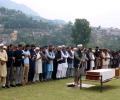
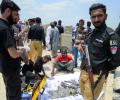
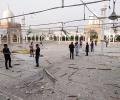
The Pakistan Army and members of the banned Jamaat-ud-Dawah (JuD) of Hafiz Saeed attended the funeral of three persons killed in the Indian military strikes on the terror group's headquarters in Muridke, some 40 kms from Lahore. The funeral prayer was held amid high security, with members of the civil bureaucracy also present. Qayyum, a JuD spokesperson, said the three persons were sleeping in a room adjacent to the mosque when the Indian attack occurred and the mosque was destroyed. He said Malik, Khalid, and Mudassir, believed to be members of the JuD, served as the mosque's prayer leaders and caretakers.

President Droupadi Murmu and Prime Minister Narendra Modi on Saturday led the nation in paying tributes to military personnel who fought valiantly in harsh conditions to hand Pakistan a crushing defeat in the 1999 Kargil conflict.

The Indian Army responded in a measured and effective manner to the provocation.
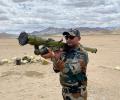
The new supplies of the Igla-S air defence missiles have been received by the Indian Army a couple of weeks ago and are being provided to the forward formations for taking care of the threat from enemy fighter aircraft, choppers and drones on the borders.

India has to fill in all the critical gaps in missiles, ammunition, sensors and stockpile in the fastest possible manner, focusing on the critical instruments that worked this time, asserts Shekhar Gupta.

'What the Americans want is to destabilise Iran. For destabilising Iran, you need access. 'One access is through Iraq. The other access is through Pakistan.'

'America holds about 16% of IMF voting rights, giving it crucial influence over Pakistan's desperately needed bailout loans.'
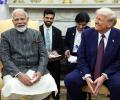
Congress general secretary Jairam Ramesh said Modi should take inspiration from former prime minister Indira Gandhi and stand up to the president of the United States.
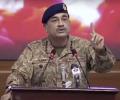
Pakistan's army chief, General Asim Munir, has warned that the country will respond with "full force" to preserve its "national prestige" and the wellbeing of its people if its sovereignty and territorial integrity are violated. He made the comments during a workshop on Balochistan, emphasizing that Pakistan seeks peace but will not tolerate threats to its security. General Munir also highlighted foreign-sponsored terrorism as a major threat to Balochistan's security and development, vowing to counter it with unwavering national unity.
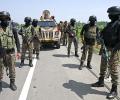
India needs to be technologically and militarily prepared to defend itself from both Pakistan and China, alerts Ramesh Menon.
'Had Haji Pir and/or Skardu been taken, the message would have gone out not just to General Asim Munir and his cohort in the Pakistan army but to the Pakistani people that every terrorist incident in India would lead to substantial loss of territory in PoK.'

Rahul Gandhi accuses PM Modi of prioritizing his image over national security after the Pahalgam attack, challenging him to refute Trump's claims of brokering a ceasefire between India and Pakistan.

The worst-hit in the Pakistani shelling was Poonch district which accounted for all the civilian deaths, the officials said, adding 28 persons were also injured and the condition of some of them was stated to be critical.
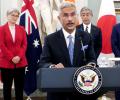
If the only superpower, which calls India an ally, sees the region through an India-Pakistan prism, it is unacceptable. Rather than endorse India's sphere of influence, this undermines it, asserts Shekhar Gupta.
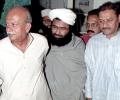
The Pakistan army's Bahawalpur Corps has always had a special significance for India as it keeps an eye on the Jaish e Mohammed, explains Rana Banerji, who headed the Pakistan desk at RA&W.

Pakistan's record on terrorism is "very clear" and the Pahalgam attack is only the recent example of cross-border terrorism, the ministry of external affairs said on Thursday.

The Pakistan army is staring at the greatest, scariest, existential threat to its power in their country. This threat has come from a populist riding democratic power, observes Shekhar Gupta.
Asim Munir and his brand of short-sighted army officers give no inkling of paying heed, changing course or learning lessons from the past, observes Rana Banerji, who headed the Pakistan desk at RA&W.
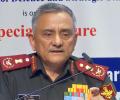
Pakistan's decision to talk to India on May 10 stemmed from realisation that it will suffer more if its operation continues, Gen Chauhan said.
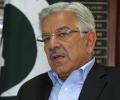
Regarding the possibility of talks, the minister said he was not aware of any such potential engagements.
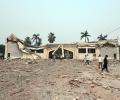
'Every decision India makes along the LoC, it must also consider implications along the LAC.'

A resident of a village in Kaithal, Haryana, was arrested for allegedly passing information to the Pakistan army and Inter-Services Intelligence during the recent India-Pakistan conflict.

Union Home Minister Amit Shah said on Friday that the Operation Sindoor undertaken by the Indian armed forces in retaliation for the Pahalgam terror attack has "completely exposed" the fact that terrorism in India is sponsored by Pakistan. Shah also said that the operation showed the "firm" political will of Prime Minister Narendra Modi, the "precise" intelligence inputs from agencies, and the "lethal" capabilities of the armed forces. He added that the operation was successful as it used the correct firepower and achieved its aims besides "showing the reality" to Pakistan.
'This strike has certainly enhanced your image.' 'Otherwise, people would have called you a damp squib, capable of doing nothing except talking big.'

US President Donald Trump has called for an end to the escalating tensions between India and Pakistan, expressing concern over the situation and offering to help resolve the conflict. Trump said he wants to see the two countries "stop" and work it out, adding that he has "good relationships" with both nations. He said he hopes the hostilities will end "very quickly", expressing sadness over the situation.

The Pakistan Army has vowed to respond to Indian air strikes that targeted locations in Pakistan-occupied Kashmir and Punjab. The strikes were carried out from within Indian airspace, according to the army spokesman, who said that Pakistan will respond at a time and place of its choosing. The army is currently assessing the damage caused by the strikes.
'Operation Sindoor is still ongoing. The Prime Minister himself said that blood and water cannot flow together, that talks and terrorism cannot go together. So how can we have a cricket match with a country that indulges in terrorism?'
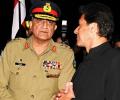
How Pakistan army chief General Qamar Javed Bajwa deals with the ensuing reshuffle of lieutenant generals would be interesting to watch, notes Rana Banerji, who headed the Pakistan desk at the Research and Analysis Wing, India's external intelligence agency.
'War is not an answer. War is not a solution.' 'Deterrence is a solution. We should have the stick with us with which we can beat Pakistan.'
'With the US having entered the war, raising the risks of a wider conflict, those impacts could be even more damaging.'

In a post on X, he said the people of Balochistan have given their "national verdict" and that the world must no longer stay silent.
'The Pakistani State has to realise that the pigeons have come home to roost.'

Security agencies have identified 11 Indians who spied for Pakistan. Look at what they did for a living.
India on Wednesday dismissed claims on Pakistan social media about 'Operation Sindoor', saying the neighbouring country has unleashed a 'full-blown disinformation offensive' with 'lies' and digital theatrics to control the narrative.

Congress leader Rahul Gandhi visited Poonch in Jammu and Kashmir, offering condolences to families affected by cross-border shelling and encouraging students who lost two classmates to the violence. During an hour-long visit, Gandhi met with students at the convent school that lost the twins, and visited families whose homes were damaged in the shelling.
'Unlike the surgical strikes and the Balakot air strikes across the LoC, we have gone further inside Pakistan and raised the bar of escalation.'
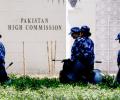
Pakistan has expressed condolences over the deaths of tourists in a terror attack in Pahalgam, Jammu and Kashmir, that killed 26 people. The Foreign Office spokesperson said Pakistan is concerned at the loss of tourists' lives and wished the injured a speedy recovery. The attack, claimed by The Resistance Front (TRF), a proxy of the banned Pakistan-based Lashkar-e-Taiba (LeT), is the deadliest in the Valley since the Pulwama strike in 2019.
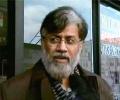
Pakistan has denied any connection to Tahawwur Rana, a key accused in the 2008 Mumbai terror attacks. Rana, a Canadian national, has not renewed his Pakistani documents for over two decades, according to the Foreign Office spokesperson.
Last week, Information Minister Atta Tarar had said that 24-36 hours were important, fearing a possible strike by India. However, the time passed and there was no action by India.
