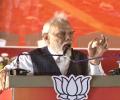
West Bengal Chief Minister Mamata Banerjee announced that the TMC will support the women's quota bill but opposes the delimitation bill introduced by the Modi government in the Lok Sabha. She also criticised the central government over central agency raids on TMC candidates.

The Indian government is reportedly developing new proposals to increase Lok Sabha seats by 50 per cent across all states. This initiative aims to address concerns from southern states regarding potential political power reduction due to population-based delimitation, while also facilitating the operationalisation of the women's quota law before the 2029 Lok Sabha elections.

As more opposition MPs are now aligning with the ruling NDA, sources in the government indicated that possibilities are being explored to give a fresh push to the delimitation legislation in Parliament.

Opposition members in the Lok Sabha have questioned the government's decision to move a bill to amend the 2023 women's quota law before bringing the principal Act into force.

Union Home Minister Amit Shah criticises the Congress and its allies for the defeat of the Constitution amendment bill aimed at implementing 33 per cent women's quota in legislative bodies before the 2029 Parliamentary polls.

In the first electoral battle since the new government under Chief Minister D K Shivakumar took charge in Karnataka, the ruling Congress on Thursday won five of the seven Legislative Council seats that went to polls, while the opposition Bhjaratiya Janata Party bagged two.

According to a bulletin issued on Wednesday, 'The Constitution (One Hundred and Thirty-First Amendment) Bill, 2026', 'The Delimitation Bill, 2026' and 'The Union Territories Laws (Amendment Bill), 2026' will be introduced and debated for passage in the Lower House.

The BJP has issued a three-line whip to its MPs, requiring their presence during the extended Budget session of Parliament, where amendments to the Women's Reservation Act are expected to be considered.

The ruling NDA coalition in India faces a significant challenge in passing the women's reservation bill in Parliament due to insufficient numbers. The bill requires a two-thirds majority in both houses, and the NDA needs to secure additional support or abstentions from other parties to achieve this.

The BJP and the Opposition have engaged in a war of words over the implementation of the women's reservation bill, which aims to reserve seats for women in legislatures. The bill was defeated in the Lower House, leading to accusations and counter-accusations between the parties.

The government has released a set of FAQs to address concerns and clarify the details surrounding the Women's Reservation Bill, which aims to provide 33 per cent quota for women in legislatures.
The BJP and opposition parties are engaged in a political battle over the implementation of the Women's Reservation Act, with the BJP defending it as historic and the opposition accusing the government of delaying its notification and using it to push an unconstitutional delimitation exercise.

NDA leaders have defended proposed amendments to the Women's Reservation Act and the Delimitation Bill, 2026, arguing women have waited long enough for reservation, while opposition parties allege the process could undermine India's federal and democratic structure, particularly impacting southern states.

In a swift political counter-offensive, the Bharatiya Janata Party and its National Democratic Alliance (NDA) partners have announced a massive, nationwide protest campaign targeting the Opposition.

Lok Sabha Speaker Om Birla announced that voting on three crucial bills, including amendments to the women's quota law and the establishment of a delimitation commission, will take place at 4 PM on Friday, following an anticipated 15-18 hour debate.
Parliamentary Affairs Minister Kiren Rijiju indicated that the government may bring a bill to increase seats in the Lok Sabha, potentially to implement reservation for women in the legislature. The Opposition has raised concerns about the timing and implications of the proposed bills.

The Women's Reservation Act 2023, mandating 33 per cent quota for women in legislatures, has been enacted, but its immediate implementation is unclear due to ongoing parliamentary debates and delimitation requirements.

The Centre has notified the implementation of the Women's Reservation Act 2023, providing a 33 per cent quota for women in legislatures, Jammu and Kashmir, and Union Territories, with the provisions set to come into force on April 17, 2026.

A bill to implement 33 per cent reservation for women in Lok Sabha and state assemblies by increasing the lower house's strength to 850 is slated for introduction in Parliament. The bill seeks to amend Article 81 of the Constitution and utilise 2011 Census data for redrawing constituencies.

The Lok Sabha is set to expand to 815 seats, with 272 seats reserved for women, according to Union Law Minister Arjun Ram Meghwal. The move aims to implement the women's quota without disadvantaging men or any state. The proposed legislations also include provisions for reservation for women from SC and ST categories within the women's quota.
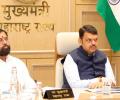
The previous Congress-NCP government had issued an ordinance to grant a 16 per cent quota to Marathas and five per cent to Muslims.

Several opposition parties on Wednesday decided to jointly oppose the delimitation provisions in the Constitution amendment bill in Parliament, even as they reiterated support for women's reservation, with Mallikarjun Kharge alleging the move is politically motivated.

Rahul Gandhi playfully remarked on his and PM Modi's lack of 'the wife issue' during a Lok Sabha debate, highlighting the influence of women in everyone's lives.

Prime Minister Narendra Modi has appealed to the opposition to support the government's bills for implementing the women's reservation law, cautioning against politicisation and assuring that delimitation will be fair to all states.

Priyanka Gandhi Vadra criticised the government's handling of the women's quota bill, accusing them of political maneuvering and neglecting the rights of OBCs.

Senior Congress leader Shashi Tharoor criticised the government's decision to link women's reservation with the expansion of Parliament, calling delimitation a 'political demonetisation'. He argued that women's reservation should be implemented immediately based on existing parliamentary strength.

The Indian government and opposition parties are set for a showdown in Parliament over a Constitution amendment bill concerning the implementation of the women's quota law and the delimitation exercise. The Opposition is concerned about the potential impact of delimitation on the political representation of southern states.

The Congress party has accused the government of scheduling a 'special session' to pass bills related to women's quota and delimitation with the intention of gaining political advantage in the upcoming West Bengal and Tamil Nadu elections, calling it a violation of the model code of conduct.

Prime Minister Narendra Modi announced that Parliament is on the verge of creating 'new history' by amending the Women's Reservation Act this week, ensuring its implementation by 2029. He highlighted the unanimous passage of the law in 2023 and the collective demand for its early enforcement.

West Bengal Chief Minister Mamata Banerjee criticised the BJP after the central government failed to pass a Constitution amendment bill for women's quota in legislatures, accusing the BJP of using the bill as a political ploy to divide the country and Bengal.

Union Home Minister Amit Shah has announced a significant increase in Lok Sabha seats for the five southern states following delimitation, countering misinformation and clarifying the timeline for women's reservation implementation.

The Congress party has announced its support for Nationalist Congress Party (SP) chief Sharad Pawar as the Maha Vikas Aghadi (MVA) candidate for the upcoming Rajya Sabha elections in Maharashtra.
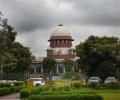
The Supreme Court has sought the Centre's response on a plea seeking the implementation of the 2023 Nari Shakti Vandan Act, which reserves one-third of seats for women in the Lok Sabha and state assemblies.

Speculation is growing that former Indian cricket captain Mohammad Azharuddin may be inducted into the Telangana Cabinet. The Telangana PCC President neither confirmed nor denied the possibility. If inducted, Azharuddin would be the first minority minister in the current cabinet.

Former Indian cricket captain Mohammad Azharuddin was sworn in as a minister in Telangana CM A Revanth Reddy's cabinet. His appointment is seen as significant ahead of the Jubilee Hills bypoll.

Maharashtra Chief Minister Devendra Fadnavis announced the state government's intention to introduce strong provisions to deal with religious conversions done using force or cheating. A panel has submitted recommendations, and the government will study and implement necessary changes. The move comes amid claims of misuse of religious freedom and concerns about conversions through coercion and deceit.

The activist urged his supporters not to block Mumbai's roads. "Clear the streets in two hours and ensure Mumbaikars are not troubled. Those who want to leave the city today can do so," he said.
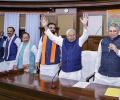
Call it political opportunism or sagacity, his moves, in effect, have not allowed the Bharatiya Janata Party to appoint its own chief minister to date, despite enjoying a near hegemonic status nationally and the best performance in recently held assembly polls where the saffron party bagged 89 seats, followed by the Janata Dal-United with 85.

The swearing-in ceremony was attended by Prime Minister Narendra Modi, Union Home Minister Amit Shah, BJP national president J P Nadda and several other top leaders of the NDA.
Electoral fortunes of 1,302 candidates, including over half a dozen ministers in the Nitish Kumar government, will be sealed on Tuesday with 3.70 crore voters eligible to exercise their franchise across 122 assembly segments in the second and final phase of the Bihar polls.
