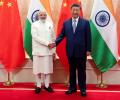
'China's basic purpose of taking the Shaksgam Valley was access to the Indian Ocean.'

Today's situation in the Shaksgam Valley is the consequence of what happened in Gilgit in 1947. But is India ready to militarily get back its territories? asks Claude Arpi.

Notably, Siachen is the highest battlefield of the world, which sits on the nuclear tri-junction of India, Pakistan and China.
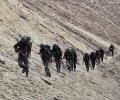
The government needs to answer the critical question of whether it has accepted any restrictions on its infrastructure creation activities, asserts Ajai Shukla.
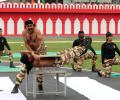
The 62nd Raising Day of the Indo-Tibetan Border Police Force was commemorated with great enthusiasm at the Seema Dwar in Dehradun.
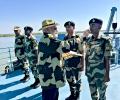
Keeping up his tradition of celebrating the festival with soldiers, Prime Minister Narendra Modi visited Sir Creek near the Indo-Pak border in Gujarat's Kutch district and offered sweets to jawans.

The Indian Army guards the Line of Actual Control -- India's border with China -- along with the ITBP.
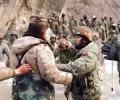
Some may see China's decision to antagonise India as strategically unwise. But China believes its prestige demands standing up to India, whatever the cost.
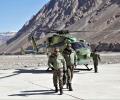
'This reluctance to respond forcefully to Chinese PLA provocations and outright aggression has as much to do with Prime Minister Modi personally, as with the institutional mindset of the MEA or even the Indian Army.' 'They are scarred by the 1962 War and are still cowed by China.'

Every week, we bring you fascinating videos, chosen by you, through your likes.
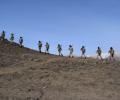
The ITBP guards the 3,488 km long Line of Actual Control between India and China, along with the Indian Army.

The paper suggests the strategy needs to be area-specific eg, border tourism can be promoted aggressively in the Turtuk or Siachen sector, and Daulat Beg Oldi or Depsang plains.
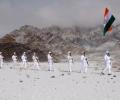
Video footage showed 'Himveers' dressed in white uniforms and chanting slogans of -- Bharat Mata ki Jai and Vande Mataram as the tricolour flies high. Two of the soldiers were seen holding the tricolour as they marched in the snow.

Twenty Indian Army personnel including a colonel were killed in a clash with Chinese troops in the Galwan Valley in eastern Ladakh on the night of June 15 in the biggest military confrontation between the two countries in over five decades.

Satellite images dated August 17, 2021, have revealed upgraded infrastructure near the Depsang plains along with the Western sector of the LAC between India and China.

16 Indian Army divisions face China, 20 face Pakistan and two divisions are reserves. This powerful signal can hardly be missed in China or Pakistan, notes Ajai Shukla.

With the two armies again in a face-off at multiple points, there is apprehension of renewed clashes.

Deployed at 15,632 feet, Captain Shiva Chauhan, 25, highlights the calibre of the Indian Army's women officers.

Every week, we bring you fascinating videos, chosen by you, through your likes.
'The Chinese -- up to the highest leadership -- will avoid a conflict because they know they will be badly licked.' 'The reputation they have painstakingly built over the last two-three decades of being a global power will be destroyed.'

If China's White Paper figures are authentic, the Indian Army, with 1.2 million soldiers, is 50 per cent larger than the PLAA.Ajai Shukla reports
'The Indian Army's surveillance had noticed the Chinese movements.' 'There was no intelligence failure.'

'The numbers of troops on both sides are enormous.' 'They are about 50,000-60,000 soldiers facing each other in that sector -- that's about the total number of troops that both sides had in the 1962 War in all sectors.'

'This was Indian land the PLA advanced on and occupied.' 'The Chinese then 'negotiated' a pullback of their troops a small distance on Indian territory even as Indian jawans draw back further into India from the forward position.' 'An apparently satisfied Indian government says this is a great move for peace! How great is that for China!'

'The MEA, hopefully, made it clear that the Indian PM can't be seen in Xi Jinping's company when China has, for all intents and purposes, annexed over 1,000 sq kms of Indian territory in eastern Ladakh, and essentially that the Wuhan spirit and the Mamallapuram spirit have turned into vinegar.'

In its first official account of the standoff between the two militaries, the ITBP revealed how its troops "not only effectively used shield to protect themselves but also responded fiercely to advancing PLA (Chinese People's Liberation Army) troops and brought the situation under control". "The ITBP has recommended the names of 21 men who faced the Chinese during the face-offs and skirmishes in May-June this year for gallantry," it said.
'The Chinese have been moving in step by step; inch by inch for the last 40 years.'

Indian Army officers, serving and retired, will tell you that the one thing that makes the Indian soldier singularly unique is his josh and jazba.
Since the June 15 clash, the PLA has inducted large numbers of troops, armoured vehicles and artillery along the LAC, from Depsang and Galwan in northern Ladakh to Hot Springs, Pangong Tso, and Chushul in central Ladakh, to Demchok and Chumar in southern Ladakh.
The military preparations underway show that the PLA may undertake operations this summer to achieve whatever objectives they could not achieve last May, asserts Jayadeva Ranade, the distinguished China expert and retired RA&W officer.

Sibal asked Modi to stop doing the politics of "illusion and delusion" and showing "red eyes" to China, and protect Indian territory.

The border guarding force is also moving its mechanised column assets like SUVs, all-terrain vehicles, snow scooters and trucks to forward locations in the midst of the projected increase in the number of troops at border units and fresh directives to undertake 'additional' patrols.
Within the army, there is growing concern that New Delhi will allow the Chinese to retain the territory they have occupied in the last month.
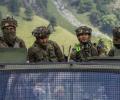
Today, the Ladakhis and Tibetans have been joined by the Sikhs, the Madrassis, the Garhwalis, the Rajputs, who are well trained psychologically and otherwise, to defend the nation, observes Claude Arpi.

'If our troops on the frontlines were sleeping for two hours, they can perhaps now sleep for 2.5 hours because when the adversary is right in front, then you can't even blink your eyes, you have to be absolutely alert.'

Sources said that even though India and China have been talking at the diplomatic and the military level for over six weeks now, there has been no thinning down in troop numbers or equipment by the Chinese side on this front.
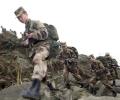
The Indian Army has been slow to react. Indian troops have deployed in the vicinity of PLA incursions, but there are no attempts to outflank Chinese positions.
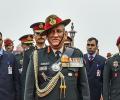
The creation of a CDS has got the head right. Issues that were not talked about for years are now being discussed, points out Ajai Shukla.

Until last month more than two-thirds of the Indian Army was deployed against Pakistan. Of 14 army corps, just four-and-a-half faced China, while more than twice that number was ranged against Pakistan.

'We are not going to be threatened by China neither are we going to threaten China.'
 © 2026 Rediff.com - Investor Information - Advertise with us - Disclaimer - Privacy Policy - Sitemap - Feedback - About us - Terms of use - Grievances