

Today's situation in the Shaksgam Valley is the consequence of what happened in Gilgit in 1947.
But is India ready to militarily get back its territories? asks Claude Arpi.

Shaksgam Valley, a territory formerly under the Shigar tehsil of the Baltistan region of Jammu and Kashmir state and illegally occupied by China, is in the news.
On January 9, Ministry of External Affairs Spokesperson Randhir Jaiswal reiterated that the Shaksgam Valley is part of India's territory, bluntly stating that the 1963 agreement between Pakistan and China relating to this area was 'illegal and invalid'.
'Shaksgam Valley is Indian territory,' asserted Jaiswal said. 'We have never recognised the so-called China-Pakistan 'Boundary Agreement' signed in 1963. We have consistently maintained that the agreement is illegal and invalid.
'...We have consistently protested with the Chinese side against attempts to alter the ground reality in the Shaksgam Valley. We further reserve the right to take necessary measures to safeguard our interests,' Jaiswal satted, without elaborating on the 'measures'.
Shaksgam Valley: The Facts
Since 2017, China started massive infrastructure development in the Shaksgam Calley.
Beijing's objective seems to be to connect the Shaksgam valley with Pakistan in the west, the Xinjiang Uyghur Autonomous Region (XUAR) in the north and the Tibetan Autonomous Region (TAR) in the south east.
China has already constructed a 129 kilometre Aghil-Shaksgam track connecting the Aghil Pass to the Shaksgam Pass.
Then the track moves eastward towards the Yarkand Valley connecting the Shaksgam Pass to G219 (the Western Highway also known as the Aksai Chin Road).
In the north, the Aghil-Shaksgam alignment is now linked with G-684 near Yilike, which further connects to the G-219 Highway at Mazar in Xinjiang.
Olivier Guillard, a researcher at CERIAS (Universite du Quebec, Canada) in an excellent paper published in 2024 by the Institut d'etudes de geopolitique appliquee, Paris, entitled China's unilateral attempt to alter status quo of South Asian Nations, explained: 'China has been illegally developing operational infrastructure, especially the Shaksgam Valley Road under three main tracks:
- Track 1 enters Shaksgam Valley from the northwestern side at Sokh Bulaq and [then] follows the Shaksgam river for 70 km.
- Track 2 from the Balti Brangsa towards the Shaksgam Pass.
- A third track is being developed since 2023 from Kul [Yilike] across the Aghil Pass presumably towards Skardu. It currently measures 117 km in length and 5 metres in width.

'Additionally,' Guillard added, 'China has established new construction camps in March 2024 that each have containerised housing modules, a concrete batch plant, rock grinding equipment, additional support facilities and a sizeable fleet of heavy construction equipment and light vehicles. By early May 2024, numerous flood control ditches were also noted to protect these new constructions.'
Considering that Shaksgam is Indian territory, this is extremely worrying, to say the least.
In the meanwhile, it is regrettable that certain government web sites still mention the length of the border with China as 3,488 km (and not 4,056 km), stopping at the Karakoram Pass instead of the trijunction with Afghanistan (External Affairs Minister Dr S Jaishankar rightly called Afghanistan India's 'contiguous neighbour').
One can only hope that it will be rectified.
Pakistan's wrong views
On December 11, 2023, India's Supreme Court upheld the August 2019 abrogation of Article 370 of the Constitution, which revoked Jammu and Kashmir's special status and bifurcated the state into two Union territories of Ladakh and Jammu and Kashmir.
Pakistan's politicians immediately started crying foul, saying that the Indian government's decision had 'no legal value'.
Jalil Abbas Jilani, a minister in the country's caretaker government, said that 'Kashmiris have an inalienable right to self-determination in accordance with the relevant UN Security Council resolutions.'
Jilani, like most of his colleagues, has probably never read the relevant UN resolutions; we shall soon come to that.
The Pakistani media too believed that this was a 'grave injustice' and an 'unjust verdict'. On December 12, Dawn newspaper said it was an attempt to rewrite history: 'The court's decision may strengthen India's stranglehold over Kashmir, but it cannot extinguish the Kashmiris' strong desire for freedom and dignity.'

'Pakistan, not content with assisting the invader, has itself become an invader'
While working on the Nehru papers a few years ago, I came across a 'Top Secret' note written in the early 1950s by Sir Girja Shankar Bajpai, then secretary-general of the ministry of external affairs and Commonwealth affairs.
It was entitled Background to the Kashmir Issue: Facts of the Case; it made fascinating reading.
It started with a historical dateline: 'Invasion of the state by tribesmen and Pakistan nationals through or from Pakistan territory on October 20, 1947; the ruler's offer of accession of the state to India supported by the National Conference, a predominantly Muslim though non-communal political organisation, on October 26, 1947; acceptance of the accession by the British Governor-General of India on October 27, 1947, under this accession, the state became an integral part of India; expression of a wish by Lord Mountbatten in a separate letter to the ruler the fulfilment of which was to take place at a future date when law and order had been restored and the soil of the state cleared of the invader, the people of the state were given the right to decide whether they should remain in India or not.'
The note also mentioned the invasion of the state by Pakistan regular forces on May 8, 1948; the conditions were clear and in two parts: First the Pakistani troops or irregulars should withdraw from the Indian territory that they occupied and later a plebiscite could be envisaged.
Commenting on the entry of Pakistanis on Indian territory, the note said: 'One of the grounds for this [Pakistani] military operation, as disclosed by Pakistan's foreign minister himself, was a recommendation of the commander-in-chief of Pakistan [a British national] that an easy victory for the Indian Army was almost certain to arouse the anger of the invading tribesmen [raiders] against Pakistan.'
The note also observed: 'Pakistan, not content with assisting the invader, has itself become an invader and its army is still occupying a large part of the soil of Kashmir, thus committing a continuing breach of international law.'
Pakistani politicians (and others) often quote the UN resolutions; very few have read them.
The UN resolutions of January 17, 1948, August 13, 1948, and January 5, 1949 (UNCIP Resolutions) made it amply clear that 'Pakistan cannot claim to exercise sovereignty in respect of J&K'.
The case of Gilgit-Baltistan
Today's situation in the Shaksgam Valley is the consequence of what happened in Gilgit in 1947.
An interesting announcement appeared in the 1948 London Gazette mentioning that the King 'has been graciously pleased... to give orders for... appointments to the Most Exalted Order of the British Empire...' The list included 'Brown, Major (acting) William Alexander, Special List (ex-Indian Army)'. Who was this officer?
Major Brown is infamous for illegally 'offering' Gilgit to Pakistan in 1947.
The British paramountcy had lapsed on August 1, 1947, and Gilgit reverted to the maharaja's control.
Lieutenant Colonel Roger Bacon, the British political agent, handed his charge to Brigadier Ghansara Singh, the new governor appointed by Maharaja Hari Singh. Major Brown remained in charge of the Gilgit Scouts.
Despite Hari Singh having signed the Instrument of Accession and joined India, Major Brown refused to acknowledge the orders of the maharaja under the pretext that some leaders of the Frontier Districts Province (Gilgit-Baltistan) wanted to join Pakistan.
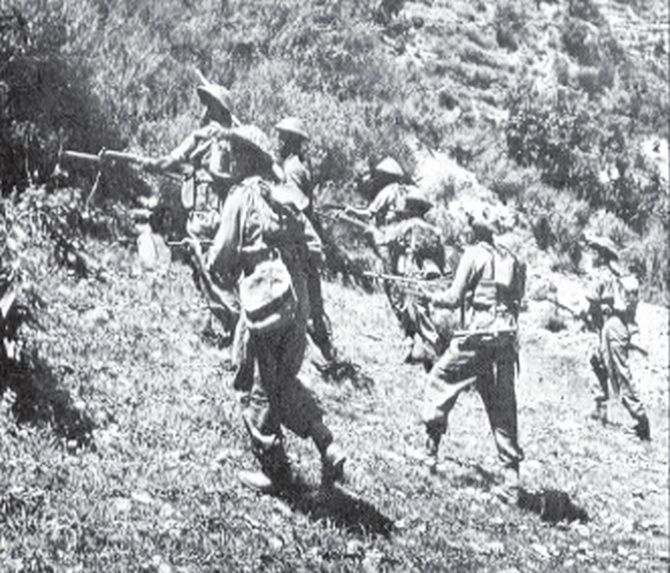
On November 1, 1947, probably under order from British generals, he handed over the entire area to Pakistan.
At the time, the entire hierarchy of the Indian and Pakistan army was still British.
In Pakistan, Sir Frank Messervy was commander-in-chief of the Pakistan army in 1947-1948 and Sir Douglas Gracey served in 1948-1951; while in India, the commander-in-chief was Sir Robert Lockhart (1947-1948) and later Sir Roy Bucher (1948).
It is only in June 1948 that General K M Cariappa took over.
Who can believe that all these senior generals were kept in the dark by a junior officer like Major Brown?
It is obvious that Major Brown's British bosses were aware of his 'gift' to Pakistan. The fact that he was given an OBE is further proof.
The king does not usually appoint 'deserters' or 'rebels' to the august order.
Amazingly, nine years ago, the British parliament passed a resolution that confirmed Gilgit-Baltistan was part of Jammu and Kashmir.
The motion was tabled on March 23, 2017 by Bob Blackman of the Conservative Party; it reads: 'Gilgit-Baltistan is a legal and constitutional part of the state of Jammu and Kashmir, India, which is illegally occupied by Pakistan since 1947, and where people are denied their fundamental rights, including the right of freedom of expression.'
It explains that the agreement signed on March 2, 1963 between Pakistan and China about the Shaksgam Valley (of the Gilgit Agency being transferred to China) is legally invalid.
Beijing should be told again and again ...and Pakistani politicians should learn their history.
But is India ready to militarily get back its territories? This columnist can't answer the question.
Claude Arpi is a long-time contributor to Rediff. You can read his earlier articles here.
Feature Presentation: Aslam Hunani/Rediff




 © 2026