
Airtel Business CEO Sharat Sinha stated that evolving architecture and methodologies for safely deploying Artificial Intelligence, coupled with adequate guardrails, are essential to unlock productivity gains. He welcomed the government's upcoming consultation paper on AI regulation, focusing on safety, deepfakes, and a human-first approach. Sinha also highlighted AI's role in driving demand for digital infrastructure and Airtel's growth in cybersecurity and fraud prevention.

Senior BJP leader R Ashoka has accused the Karnataka Congress government of a Rs 14.95 crore fraud in the Dr B R Ambedkar Development Corporation, following a previous alleged scam in the Maharshi Valmiki Scheduled Tribes Development Corporation. Ashoka cited an ED press release detailing the siphoning of funds through fake accounts and forged documents, demanding accountability from the Congress leadership.

'It's not about individuals operating the mule accounts being more or less skilled. Instead, 'lower-level' refers to the role the individual account plays in the broader mule network.'

The Central Information Commission (CIC) has directed the National Rifle Association of India (NRAI) to disclose the specific rules and policies behind its requirement for shooters to submit an affidavit on a non-judicial stamp paper for date of birth verification. The directive came after an RTI appeal sought clarity on the basis for this mandatory requirement, which the NRAI stated was part of its age fraud prevention measures.

The Jammu and Kashmir Crime Branch's Special Crime Wing has filed a chargesheet against three public servants, including a retired officer, for alleged fraud and corruption involving the manipulation of service records to obtain undue benefits. The case centres on a forged date-of-birth certificate and the facilitation of its incorporation into official records.

Jharkhand Chief Minister Hemant Soren has been formally charged by a special PMLA court in an alleged 8.86-acre land fraud and money laundering case. The Enforcement Directorate is investigating the illegal acquisition and transfer of land in Ranchi's Bargain area. Soren appeared via video conferencing and denied the allegations, stating they are baseless.

Prime Minister Narendra Modi has urged for a global framework to combat cross-border cyber frauds and deepfakes, highlighting the need for governments, tech companies, telecom operators, and financial institutions to collaborate. Speaking at the India Mobile Congress 2026, Modi stressed that technology thrives on trust and that India is ready to share its expertise in tackling cyber threats. He also noted the rapid expansion of 5G and the success of digital governance initiatives like Direct Benefit Transfer.
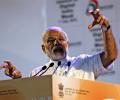
Prime Minister Narendra Modi, at the India Mobile Congress (IMC) 2026, articulated a vision for India's communications sector, emphasizing a global framework to combat cyber frauds and deepfakes. He called for India to become a hub for innovation and product development for the world. Industry leaders lauded his vision, highlighting India's robust digital infrastructure and its journey towards becoming a global technology leader, with a focus on trust, security, and responsible innovation.

An IIT Madras study reveals that financial cybercrime victims in India are often highly educated professionals, challenging the notion that only careless or financially unaware individuals are targeted. The research highlights that digital literacy doesn't guarantee protection, as fraudsters exploit stress and emotional vulnerabilities.
The Enforcement Directorate (ED) Director, Rahul Navin, has issued directives to intensify action against Insolvency and Bankruptcy Code (IBC) frauds involving "large haircuts" and to address delays in police registering FIRs based on ED's requests. The agency also aims to fast-track high-profile trials under the Prevention of Money Laundering Act (PMLA) and enhance internal coordination and efficiency.

Bank fraud is no longer just an external cyber threat -- insiders with legitimate access can exploit banking systems, trusted credentials and institutional blind spots to quietly siphon money.

The Indian government has challenged Congress leader Rahul Gandhi's criticism of levying fees on UPI payments above Rs 2,000 to merchants. The government highlighted that a parliamentary standing committee, which included Congress MPs, had previously backed a tiered Merchant Discount Rate (MDR) framework for UPI. This move aims to ensure the financial sustainability of the UPI ecosystem and reduce its dependence on government subsidies, a concern raised by the committee due to the significant funding gap between allocations and operational costs.

Financial Services Secretary M Nagaraju has urged banks to adopt the MuleHunter AI tool developed by RBI to identify and prevent mule accounts used in cyber financial frauds. The meeting also discussed 'Operation Octopus' by Hyderabad Police and emphasised coordinated efforts and intelligence sharing.

The Telecom Regulatory Authority of India (Trai) has expanded the 1600-number series to include utilities, courier, and logistics companies, introducing the new 1601 series to help consumers identify legitimate calls and prevent widespread fraud and impersonation.

Experts laud the decision to impose a 0.4 per cent Merchant Discount Rate (MDR) on UPI transactions exceeding Rs 2,000, effective October 15. This move, along with a dedicated fund for small merchants, is seen as crucial for creating a sustainable digital payments ecosystem, incentivising expansion in rural areas, and funding innovation while keeping most transactions free for users.

The Payments Council of India has confirmed that Unified Payments Interface (UPI) services will continue to be free for consumers and small merchants, despite a recent Lok Sabha Bill. This clarification addresses concerns about potential charges, emphasising that while a sustainable financial model for UPI infrastructure is being developed, transaction charges will not be passed on to users or small businesses.

Punjab's Finance, Excise and Taxation Minister Harpal Singh Cheema announced the unearthing of a Rs 429.30 crore GST fraud, leading to an FIR in Ludhiana. The investigation, initiated after intercepting a vehicle on September 30, revealed a syndicate of 62 interconnected firms across multiple states using non-genuine documents to evade taxes.

The Supreme Court has directed the Reserve Bank of India to prepare a standard operating procedure (SOP) within four weeks to deal with bank accounts linked to cyber frauds, including mule accounts. This directive is part of a broader effort to strengthen responses to cyber-enabled financial frauds, with the court also urging states and UTs to adopt and operationalise grievance redressal and money restoration modules.

The National Payments Corporation of India (NPCI) stated that the Merchant Discount Rate (MDR) "is distributed only amongst the UPI ecosystem, to further invest into infrastructure resilience, innovation, cybersecurity (protecting the UPI infrastructure with banks and non-banks) and customer service."

Prime Minister Narendra Modi emphasised the democratisation of technology to ensure no section of society is left behind, advocating for affordable and accessible digital services, especially for the Global South. He highlighted the potential of Digital Public Infrastructure (DPI) and called for solutions to cyber fraud, global standards for emerging tech, and mechanisms to identify AI-generated content during his interaction with GSMA board members.

Phishing sites mimicked SBI, ICICI Bank and Axis Bank to steal card details and OTPs.

The Vigilance and Anti-Corruption Bureau (VACB) in Idukki, Kerala, has registered a case against three individuals, including two former office-bearers of Adimaly Grama Panchayat, for allegedly misappropriating Rs 68.62 lakh in a goat distribution scheme meant for 2018 flood-affected people. The accused are alleged to have conspired to award a contract for goat supply to an unlicensed individual, leading to a significant financial loss to the government.

Police in Rajasthan have arrested 38 individuals involved in a nationwide cyber fraud network, unearthing scams worth over Rs 10 crore under 'Operation Mule Hunt'. The accused operated from various locations, including Dubai, and lured victims through investment, trading, and escort service schemes.
Congress leader Rahul Gandhi has accused the Modi government of quietly paving the way for imposing fees on UPI transactions, alleging it's a surrender to American pressure. The government's recent notification exempts charges only up to Rs 2,000, sparking concerns that higher value transactions and eventually all UPI payments could incur fees. Finance Minister Nirmala Sitharaman, however, clarified that Merchant Discount Rate (MDR) applies to merchants, not customers, and supports digital infrastructure.

The United States has announced new visa restrictions targeting individuals who engage in or facilitate "birth tourism." This move aims to prevent the exploitation of the US immigration system, which allows foreign nationals to travel to the US to give birth, thereby securing US citizenship for their children. The restrictions apply to facilitators, visa "fixers," and medical providers involved in these networks.

A two-day weekend would help employees recover physically and mentally. They would return better prepared for branch work that demands patience, judgment, and accuracy, asserts Tamal Bandyopadhyay.
The Indian government has mandated that banks and payment providers cannot levy charges on UPI transactions up to Rs 2,000 or on payments made via RuPay debit cards. This directive follows an amendment to the Payment and Settlement Systems Act, 2007, aiming to sustain and expand the digital payments ecosystem.
The Finance Ministry has clarified that the decision to impose a 0.4% Merchant Discount Rate (MDR) on UPI transactions above Rs 2,000 was made independently, refuting claims of foreign influence. The ministry stated the policy aims to build a self-sustaining digital payments ecosystem, with MDR funding infrastructure and supporting small merchants.

Thousands of young men and women, joined by prominent personalities, protested at Shivaji Park in Mumbai, demanding the resignation of Chief Election Commissioner Gyanesh Kumar despite police denial of permission. Organised by the Cockroach Janta Party (CJP), the agitation highlighted concerns over transparency in CEC appointments and alleged irregularities in electoral roll revisions.

The government is introducing a 0.4% Merchant Discount Rate (MDR) on UPI person-to-merchant payments above Rs 2,000, effective October 15. This move ends the zero-MDR regime, aiming to fund UPI infrastructure and sustainability, as the previous government subsidy was insufficient to cover operational costs. Payments between individuals and most everyday merchant transactions will remain free.

Industry experts advocate for India to develop its own artificial intelligence (AI) safety framework, distinct from US or EU models, to address unique challenges like deepfakes and cyberattacks. They call for a comprehensive commitment involving all stakeholders and a hybrid regulatory approach combining voluntary and binding measures, as the Indian government also considers new AI regulations.

A businessman from Vrindavan, Ratan Lal Agarwal, was defrauded of Rs 30 lakh in a "digital arrest" scam. A cyber fraudster, posing as an ATS officer, threatened Agarwal with a criminal case linked to his wife's mobile number and kept him under constant surveillance, coercing him into transferring the money. Police have registered a case and frozen part of the scammed amount.

A frozen phone screen, a fake customer-care call, a screen-sharing request or even a duplicate SIM can give cybercriminals a route into your bank account.

The Wrestling Federation of India (WFI) has formally requested the Unique Identification Authority of India (UIDAI) to permanently retain Aadhaar update histories related to date-of-birth changes and to restrict such modifications after a significant period. This move is part of WFI's intensified crackdown on age fraud in wrestling, which has seen numerous disqualifications and suspensions, aiming to ensure fair play and transparency in age-group competitions.

Buying a policy is only the beginning. Health insurance is a long-term commitment that needs regular review as your age, health needs and family circumstances change.
The Enforcement Directorate conducted two-day searches across Chandigarh, Punjab, and Maharashtra, seizing mobile phones, laptops, and cash. This action is part of a money laundering investigation into a "fake" call centre accused of defrauding US citizens through spam emails.

Over 700 doctors in Telangana have collectively lost nearly Rs 30 crore to various cyber frauds since September 2024, prompting the Telangana Cyber Security Bureau to hold an awareness meeting for healthcare professionals. Business and investment frauds accounted for the largest share of losses.

The Cockroach Janta Party (CJP) and student organisations have accused the government of attempting to influence electoral outcomes by allegedly deleting over 13 crore voters. They have demanded the resignation of Chief Election Commissioner Gyanesh Kumar, citing alleged irregularities in voter rolls and criticising the police crackdown on protesters. Leaders questioned the government's protection of the CEC and linked voter deletions to the narrow victory margin in the 2024 Lok Sabha elections.

The Bombay High Court has identified a worrying trend of foreign nationals infiltrating India, fraudulently acquiring documents like Aadhaar and PAN cards to claim Indian citizenship. The court highlighted serious gaps in inter-agency coordination and document verification, noting that some individuals have engaged in anti-national activities. It urged the Centre to amend the Aadhaar Act to facilitate tracing and deportation, and to establish procedures for dealing with human trafficking and border infiltration. The ruling came during a case involving an Afghan national who overstayed his visa and obtained fake documents to secure an Indian passport.
Police in Maharashtra's Latur district have registered a case against a man for allegedly cheating people by claiming to possess supernatural powers.
