
Indian markets on Dalal Street rallied sharply as easing tensions in the US-Iran conflict and stable oil prices boosted sentiment. Track Nifty 50 and BSE Sensex performance and key global triggers.

A new US intelligence report warns that India and Pakistan's relations remain at risk for nuclear conflict, fueled by terrorism and escalating tensions in the region.

Chaffing under public ridicule in the US as well as internationally for having 'lost' the war, Trump is under immense pressure to do something, cautions Ambassador M K Bhadrakumar.

Indian equity markets experienced a volatile session, with the Sensex and Nifty recovering some ground after a significant plunge the previous day. Gains were driven by PSU bank, IT, and metal stocks, but concerns over rising fuel prices and geopolitical tensions limited the recovery.

India's net oil import bill could rise by $56 billion to $64 billion annually assuming global crude averages $110 to $115 per barrel in FY27.

Trump has made it clear: the US will not lift its blockade of Iranian ports until a deal is signed.

The IRGC said the strikes were conducted in support of offensives by Hezbollah and residents of southern Lebanon, and described them as the beginning of a series of pre-announced operations against Israel.

The question is whether the clocks allow enough time for two deeply mistrustful sides to get there, and whether the surface calm holds long enough for the paddling to produce something before the ceasefire ends on April 22, notes Prem Panicker in his must read blog on the Iran War.

China has urged Pakistan and Afghanistan to engage in direct talks to resolve their ongoing conflict, offering to mediate and calling for a ceasefire.

Democratic Progressive Azad Party chairman Ghulam Nabi Azad expressed deep concern over the escalating conflict in the Middle East, urging restraint and diplomacy from all parties involved.

Pakistan's Prime Minister Shehbaz Sharif has offered to host talks between the US and Iran to help resolve the ongoing conflict in the Middle East, following reports of Pakistan's involvement in backchannel diplomacy.

Congress leader Rahul Gandhi has criticised Prime Minister Narendra Modi's foreign policy and his remarks referencing the COVID-19 pandemic in relation to the West Asia situation.

The US President clarified that these negotiations do not involve the new Supreme Leader, Mojtaba Khamenei.

Indian stock market benchmarks Sensex and Nifty rebounded strongly after a two-day decline, driven by falling crude oil prices and positive global cues amid hopes of de-escalation in the Middle East.

Foreign brokerages have started to cut their year-end targets for the Nifty 50 index amid the ongoing West Asia conflict.

'The entire US ecosystem built over decades at the bases in the Gulf region, especially the UAE, costing trillions of dollars have been decimated, dealing a mortal blow to the US Central Command's war capability,' points out Ambassador M K Bhadrakumar.

The big question is whether Trump is any longer in command of the situation. For all practical purposes, the war seems set to cascade as the US is preparing for a potential ground operation in Iran and threatens to destroy 'bridges next, then electric power plants', points out Ambassador M K Bhadrakumar.

Iran launched retaliatory military strikes targeting Israel and American military bases across the region, including in Qatar, the United Arab Emirates, Kuwait, Bahrain and Jordan.

Gold prices are expected to remain volatile next week as investors track geopolitical developments in the Middle East and key macroeconomic data releases that could shape the sentiment in the domestic market, analysts said.

"The US President's statements are within the framework of efforts to reduce energy prices and gain time to implement his military plans," the ministry stated.

A Palau-flagged oil tanker with 15 Indian crew members was attacked off the coast of Oman, resulting in injuries. The incident occurred amidst rising tensions in the Middle East following attacks between Iran, the US, and Israel.
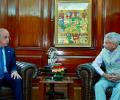
As tensions escalated between India and Pakistan following the deadly Pahalgam terror attack, Iran reached out to both countries, urging de-escalation. Saudi Arabia also expressed concern, with its foreign minister engaging in phone conversations with his Indian and Pakistani counterparts. Iran's foreign minister, Seyed Abbas Araghchi, emphasized the importance of bilateral relations, stating Tehran's willingness to "forge greater understanding" at this critical time. Saudi Arabia's foreign minister, Faisal bin Farhan Al Saud, spoke with both India's External Affairs Minister S Jaishankar and Pakistan's Foreign Minister Mohammad Ishaq Dar. Amidst heightened tensions, India has taken a series of punitive measures against Pakistan, including suspending the Indus Waters Treaty and downgrading diplomatic ties. Pakistan responded by shutting its airspace to Indian airliners and suspending all trade. Both countries exchanged warnings, with Pakistan emphasizing its commitment to "respond firmly to any aggression."

A senior Pakistani official has affirmed Pakistan's commitment to supporting Saudi Arabia, even before assistance is explicitly requested, amidst ongoing conflict in West Asia. This pledge underscores the close ties between the two nations and Pakistan's role in regional stability.
Pakistan's Foreign Minister Ishaq Dar has been actively involved in mediating between Saudi Arabia and Iran following the outbreak of war, ensuring the safety of Pakistani citizens in affected regions.

The core issues to be settled -- access to Hormuz, Israel's aggression in Lebanon, the question of Iran's nuclear programme, sanctions relief and compensation -- are thorny enough to require weeks of patient negotiation. The most likely outcome of the opening sessions is that both sides take the measure of each other, establish what is and is not negotiable, and return home without having broken anything. That would count as progress.

A fall in the Nifty 50 to around 19,000 is not impossible, but that would likely require nuclear options to be exercised.

China has denied reports of finalising a deal with Iran to sell CM-302 supersonic anti-ship missiles, amidst rising tensions in the Middle East and joint US-Israeli airstrikes.

'What we have yet to see on either the US or the Iranian side is willingness to compromise on their ultimate demands and the flexibility to reach an agreement to end the war.

Trump may strike. He may announce productive talks and extend again. He may do both at the same time. Iran will not open the Strait on someone else's terms, so no matter what happens, that problem will remain unsolved. And the IRGC will still be collecting its $2 million toll from every ship bold enough to ask permission to pass.

The Indian embassy in Tehran has earlier stated that it is facilitating the safe movement of nationals who wish to leave Iran.

This weekend, Donald Trump has begun to say the quiet part out loud -- that he wants to take control of Iran's oil, a formulation more in line with his robber-baron style of international relations.

Egypt, Pakistan, Saudi Arabia and Turkey met in Islamabad in what analysts say is the formal opening of a new diplomatic formation that could reshape the post-war regional order. Their immediate goal is a ceasefire; their larger ambition is to ensure that neither Iran nor Israel emerges from this war in a dominant position. Pakistan's foreign minister then flew directly to Beijing and mooted a Chinese role as guarantor of any eventual agreement. Prem Panicker continues his must read daily blog on the Gulf War.

The British government has called for a negotiated solution to prevent further escalation of conflict in the Middle East following joint strikes by the US and Israel on Iran, emphasizing the safety of UK nationals and the need to prevent Iran from developing nuclear weapons.

Taking Kharg would give the US control over virtually all of Iran's oil exports and thus provide significant leverage, notes Prem Panicker in his must read daily blog on the Gulf War. It would also put American troops within range of Iran's remaining missiles, drones, and artillery on a piece of real estate that is just eight square miles in size, and just 15 miles from the Iranian mainland.

The pause gives the US time to breathe, to regroup, to move its expeditionary force into position without risk of interception along the way. It gives Iran nothing -- on the ground, attacks against its infrastructure continue apace. Prem Panicker in his must read daily blog on the Gulf War.

Analysts predict a surge in gold and silver prices as investors seek safe-haven assets due to escalating tensions in the Middle East. The impact on domestic prices will depend on the conflict's duration, with geopolitical factors and macroeconomic data also playing a role.
'We are profoundly energy-dependent on the Gulf. That dependency must now be redirected towards the United States, because we require American permission to procure oil.' 'We additionally require Iranian permission to acquire oil from that source. So India now has to seek two separate permissions merely to secure its energy supply.' 'Should we be compelled to source from America, or from Venezuela -- which is, in effect, American-controlled supply -- that will inevitably carry a price premium, an elevated shipping cost, and a considerably extended delivery timeline, given the distances involved.'
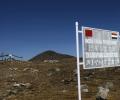
A Delhi court has reserved its order on the bail plea of a couple accused of hurling racial slurs at their neighbours from Arunachal Pradesh and Manipur. The arguments were presented by both parties, with the court set to deliver its decision on Tuesday.

Amidst ongoing conflict, Iranian President Masoud Pezeshkian signals a potential de-escalation by apologising to neighbouring countries while firmly rejecting US President Donald Trump's demand for unconditional surrender.

For weeks, the war skirted the edge of catastrophe without tipping over. Missiles flew, there was much destruction, commanders were assassinated, cities across the Gulf and even in Israel struggled to absorb the shock. But one line held: Energy infrastructure, the arteries of the global economy, remained largely untouched. That is no longer true. Prem Panicker continues his must read daily blog on the Gulf War.
