
China on Tuesday confirmed that it has reached an agreement with India to end the standoff between the two armies in eastern Ladakh.

Sources had earlier said that the areas and patrolling status were expected to be moved back to pre-April 2020 level.

China on Thursday said the meeting between Prime Minister Narendra Modi and Chinese President Xi Jinping in Russia's Kazan on Wednesday carries a "great significance" as they reached an "important common understandings" to improve the bilateral ties.

The Indian Army began patrolling at Demchok on Friday, days after Indian and Chinese troops completed disengagement at the two friction points in eastern Ladakh, Army sources said.

India and China have held their first diplomatic talks since withdrawing troops from two face-off points in eastern Ladakh, reflecting on the lessons learned from the border row to prevent future incidents. The two sides agreed to maintain peace and tranquillity in border areas, prepare for the next meeting of Special Representatives on the boundary question, and highlighted the importance of regular exchanges and contacts at diplomatic and military levels. The talks come after the completion of the disengagement process from the last two friction points, following an agreement finalized in October 2022.
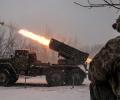
A peace keeping role for India is a distinct possibility. Indian military has both the numbers and experience to carry out this job, observes Colonel Anil A Athale (Retd).

The Indian Army has commenced a verification patrolling at Depsang, the second friction point in eastern Ladakh, the government said on Saturday.

China does not have to give up what it took in 2020, it will never give up its claim to Arunachal Pradesh, Ladakh and other areas, and it has all the time now to plan its next surprise, points out Lieutenant General Prakash Katoch (retd).
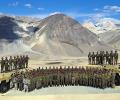
China has said that the disengagement of troops in eastern Ladakh by the Chinese and Indian armies is going on "smoothly" following a recent agreement between the two nations.
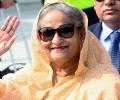
Bangladesh's interim government has requested India to extradite deposed Prime Minister Sheikh Hasina, who has been living in exile in India since August. The request comes after the Bangladesh-based International Crimes Tribunal issued arrest warrants for Hasina and several others for "crimes against humanity and genocide." The interim government has cited an existing extradition treaty between the two countries as grounds for the request. Hasina has accused the interim government of perpetrating "genocide" and failing to protect minorities since her ouster.
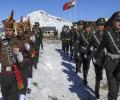
India on Monday announced it has reached an agreement with China on patrolling along the Line of Actual Control (LAC) in eastern Ladakh, in a major breakthrough in ending the over four-year-long military standoff ahead of a likely meeting between Prime Minister Narendra Modi and Chinese President Xi Jinping in Russia this week.

The sources have said that patrolling will begin at these points once the disengagement that began last week is completed and both sides will move their respective troops and dismantle temporary structures.

Union minister Kiren Rijiju on Friday said he interacted with soldiers of China's People's Liberation Army along the Sino-Indian border near Tawang during a visit to an Indian Army post on Diwali.

The exchange took place at five Border Personnel Meeting points along the LAC, the sources added.
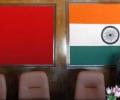
India and China have agreed to take measures to further ease the situation at the borders while continuing to implement the October agreement to resolve the standoff in eastern Ladakh comprehensively. The two sides held the 32nd meeting of the Working Mechanism for Consultation & Coordination on China-India Border Affairs (WMCC) in New Delhi, agreeing to maintain communication through diplomatic and military channels and safeguard sustainable peace and stability in the border areas. This meeting follows the October 21 agreement between the two countries to resolve the over four-year-long military standoff in eastern Ladakh.

Ukrainian President Volodymyr Zelenskyy told the United Nations Security Council that 'we have to prepare' the second peace summit to end the Russia-Ukraine war 'altogether' and he has invited India and other countries to join the peace process.

Bangladesh's ousted Prime Minister Sheikh Hasina has launched a scathing attack on the interim administration, accusing Chief Adviser Muhammad Yunus of running a "fascist regime" that persecutes minorities and allows terrorists to operate freely. Hasina, who is currently in India, made the remarks in a virtual address to overseas Awami League supporters, vowing to bring Yunus and his allies to justice for alleged atrocities. Her comments come ahead of a visit by India's Foreign Secretary to Dhaka, where he is expected to raise concerns about the safety of minorities in Bangladesh.

Glimpses of the At Home reception hosted by President Droupadi Murmu on Independence Day at Rashtrapati Bhavan.

Following the disengagement, both sides will soon start the coordinated patrolling in their respective areas, sources added.

India will look at disengagement and de-escalation of the situation along the Line of Actual Control (LAC) in eastern Ladakh after restoration of the status quo of April 2020, Army Chief General Upendra Dwivedi said on Tuesday, a day after New Delhi announced striking an agreement with Beijing to end the over four-year border row in the region.

India and China have made "some progress" in disengagement, External Affairs Minister S Jaishankar said on Sunday, describing it as a "welcome" move which opens up the possibility that other steps could happen.
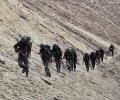
The government needs to answer the critical question of whether it has accepted any restrictions on its infrastructure creation activities, asserts Ajai Shukla.
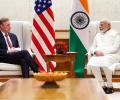
Prime Minister Narendra Modi on Monday met US National Security Advisor Jake Sullivan in New Delhi.

The war and Modi's recent visit to Ukraine is expected to figure prominently in the bilateral meeting, according to US National Security Adviser Jake Sullivan.

India and China on Wednesday held 'constructive' and 'forward-looking' diplomatic talks to resolve the over four-year border standoff along the Line of Actual Control (LAC) in eastern Ladakh but there was clear no indication of any breakthrough.

As Finer wrapped up his high-profile visit to India, the White House said Finer 'acknowledged' India's establishment of a committee of enquiry to investigate the 'lethal plotting' and underlined the need for holding accountable those responsible.
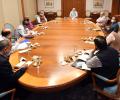
Stressing that while framing any policy, there is a need to look at it from India's strategic point of view, Modi said there were instances when notes from the national security council were not given due importance.
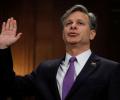
It is expected that FBI chief Wray will hold talks with senior Indian security officials.

India received consular access on at least three occasions to Nikhil Gupta, who is detained in a Czech prison following charges by the United States relating to a foiled assassination attempt on a Sikh extremist.

Swiss foreign minister Ignazio Cassis said Russia would be asked to join the peace plan discussions at some point in time but to bring Russia on the table would require mediation by some countries.

Ukraine's First Deputy Foreign Minister Emine Dzhaparova will pay a four-day visit to India from Sunday, the first official visit from the East European country since the Russian invasion began last year.

The Central Military Commission, which is the overall high command of the Chinese military, is headed by Chinese President Xi Jinping.

As its factories resumed operations after over two-month of grim battle against coronavirus, China is busy tapping into the vast business opportunities of export of key medical goods, specially ventilators and personal protection equipment (PPE), across the world, including India, where both private and government bodies are placing orders for the import of these products.
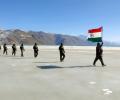
India has told China not to "shift goalposts" and "confuse" managing the border affairs and restoring peace at the frontiers with the larger issue of the resolution of the boundary question, which is dealt with by different designated mechanisms.

The disengagement process from both the north and south banks of Pangong Lake was completed by the two nations and further disengagement is underway at other friction points.
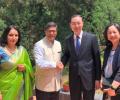
Sun Weidong is an expert on South Asia who worked closely with external affairs minister S Jaishankar.
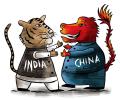
India and China achieved a major milestone this year when their bilateral trade crossed the landmark figure of $100 billion but it did not generate any fanfare in both capitals as the two Asian giants are going through a "particularly bad patch" in their relations due to a set of actions by Beijing in violation of agreements that led to the military standoff in eastern Ladakh. Starting with a modest $1.83 billion in 2001, the bilateral trade crossed $100 billion-mark in the first 11 months this year, a significant milestone for which the two countries carried out campaigns to boost trade and build it as a major stakeholder to improve the relations between two nations, whose ties otherwise remained frosty over the festering boundary dispute and strategic rivalry. According to last month's data from China's General Administration of Customs (GAC), the India-China bilateral trade totalled $114.263 billion, up 46.4 per cent year-on-year from January to November 2021.
In a tweet, India's Ambassador to China, Vikram Misri said the medical kits were dispatched early on Thursday from Guangzhou Airport in southern China. Over two million test kits being procured from China will be sent to India in the next 15 days, Misri told PTI in Beijing.
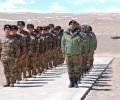
Chinese Foreign Ministry spokesman Wang Wenbin said this at his media briefing as he parried questions on India's assertion that consensus reached by the leaders on maintaining peace along the border cannot be swept under the carpet.
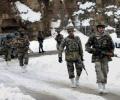
China has alleged that the Indian troops twice crossed the border line on June 15 for "illegal activities and provoked and attacked Chinese personnel" which led to serious physical conflict between the two sides, hours after the Indian Army said the violent face-off took place between the troops during the "de-escalation process" in the Galwan Valley.
 © 2026 Rediff.com - Advertise with us - Disclaimer - Privacy Policy - Sitemap - Feedback - About us - Terms of use - Grievances