
Former Union minister Dinesh Trivedi has been appointed as India's next High Commissioner to Bangladesh, signalling efforts to strengthen bilateral relations between the two countries.

External Affairs Minister S Jaishankar defends India's purchase of Russian oil, stating it is not the largest purchaser and that the US had previously supported such actions to stabilize energy markets. He also addresses concerns about tariffs and trade relations with the US.

The BRICS foreign ministers' meeting in New Delhi concluded without a joint statement due to disagreements over the West Asia conflict, with Iran blaming the UAE for the lack of consensus. India, as the host, issued a chair's statement highlighting the differing views.
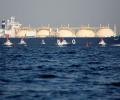
Iranian Deputy Foreign Minister Kazem Gharibabadi has urged India to take the lead in bringing peace to West Asia, highlighting the UAE's role in stalling BRICS consensus on the conflict. Gharibabadi also discussed a new framework with Oman for merchant vessels passing through the Strait of Hormuz.

A court in Ballia, Uttar Pradesh, sentenced six individuals to 10 years in jail for culpable homicide related to a 2014 land dispute that resulted in the death of one man.

Delhi should keep all its options open in what is essentially a transitional period in the geopolitics of energy rather than remain a gatekeeper serving Trump's 'America First', suggests Ambasssador M K Bhadrakumar.

The Vishva Hindu Parishad (VHP) has appealed to the United Nations to intervene on behalf of religious minorities in Pakistan and Bangladesh, citing human rights violations.
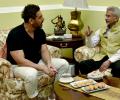
Dr Jaishankar meets up with movie star John Abraham, who plays J P Singh, currently India's ambassador to Israel, in The Diplomat.

The Indian government has revised the application fee for the Overseas Citizen of India (OCI) card and introduced changes to the application process, including abolishing the six-month continuous stay requirement.

"My interview was on March 21, 1977. That was the day the Emergency was revoked. Revoked! So, I go in for an interview at Shahjahan Road... First person that morning," recalls Jaishankar, now 70.
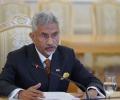
The relations between New Delhi and Washington are on a downturn after Trump doubled tariffs on Indian goods to a whopping 50 per cent, including 25 per cent additional duties for India's purchase of Russian crude oil.
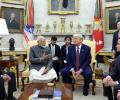
Prime Minister Narendra Modi and US President Donald Trump discussed the Middle East crisis, with a focus on the Strait of Hormuz.

External Affairs Minister S Jaishankar addresses Parliament on Operation Sindoor, denying any US trade linkage and highlighting Pakistan's request for a ceasefire through the DGMO channel.
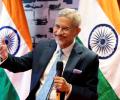
'The logic every one of our neighbours must realise is that working with India will give you benefits, and not working with India has a cost.'

External Affairs Minister S Jaishankar discusses India's approach to cross-border terrorism following the Pahalgam attack, emphasizing a firm response and no compromise on nuclear blackmail.
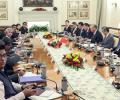
Chinese Foreign Minister Wang Yi's visit to India focuses on border talks with NSA Ajit Doval, amidst efforts to rebuild relations after the Galwan Valley clashes and rising India-US tensions.
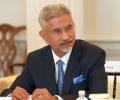
External Affairs Minister S Jaishankar says Operation Sindoor conveyed India's resolve to act against terrorism, following UN Security Council's call to bring Pahalgam attackers to justice.

Union ministers paid tribute to the victims of the Pahalgam terror attack on its first anniversary, reaffirming India's commitment to combating terrorism with a firm and zero-tolerance policy.

Opposition parties are demanding a full Parliament discussion on the West Asia conflict, criticising the government's silence and calling for a contingency plan to protect India's energy security and citizens.

JD(U) MP Sanjay Kumar Jha has appealed to the External Affairs Minister S Jaishankar to ensure the safety and well-being of the Bihari diaspora in West Asia, following escalating tensions in the region.
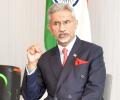
When asked whether both armies talked to each other, initiated by the Pakistani army, Jaishankar said, "Yes, we have a mechanism to talk to each other as a hotline. So, on the 10th of May, it was the Pakistani army which sent a message that they were ready to stop firing, and we responded accordingly."
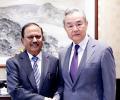
Wang is travelling to India days ahead of Prime Minister Narendra Modi's planned trip to the Chinese city of Tianjin to attend the annual summit of the Shanghai Cooperation Organisation.

The security cover of External Affairs Minister S Jaishankar has been strengthened with the addition of two bullet-resistant vehicles following a review of his Z category armed central protection recently, official sources said on Wednesday.

Congress leader Rahul Gandhi on Friday accused External Affairs Minister S Jaishankar of "collapsing" India's foreign policy and questioned the government's handling of the recent tensions with Pakistan, particularly the US President Donald Trump's role as a mediator. Gandhi's remarks come amidst a war of words between the Congress and the ruling BJP over their leaders' statements on the Indo-Pak conflict.

India has voiced its deep concern over reports of increasing civilian casualties in Lebanon due to Israeli strikes, emphasising the protection of civilians and the importance of international law.
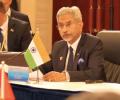
Jaishankar said the UN Security Council condemned the attack and underlined the need to hold perpetrators, organisers, financiers and sponsors of the reprehensible act and bring them to justice.

India expects partners to understand its policy of 'zero tolerance' against terrorism, and it will never countenance 'perpetrators of evil' being put on par with its victims, External Affairs Minister S Jaishankar said on Saturday during extensive talks with his British counterpart David Lammy.

External Affairs Minister S Jaishankar has informed a parliamentary panel that Pakistan was notified about Indian strikes on terror camps in their territory only after they were carried out. He also clarified that the decision to halt the military operation was taken bilaterally following a request from Pakistan, and there was no US mediation involved. Jaishankar emphasized India's zero-tolerance policy against terrorism and the importance of conveying a united message against it globally.

The Indian embassy in Tehran has earlier stated that it is facilitating the safe movement of nationals who wish to leave Iran.

Both Houses of Parliament were adjourned sine die, concluding a Budget session marked by the passage of key legislations and the defeat of a Constitution amendment bill on women's reservation. The session saw frequent opposition protests and discussions on various issues, including the West Asia conflict.

Congress leader Shashi Tharoor is urging the Indian government to take a more proactive role in mediating the escalating conflict between the US-Israel alliance and Iran, emphasising the impact on India's energy security and regional stability.
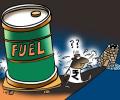
India is sending a shipment of diesel and petrol to Sri Lanka to help alleviate the country's energy crisis amidst regional instability.
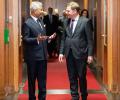
External Affairs Minister S Jaishankar has asserted that India has zero tolerance for terrorism and will never give in to nuclear blackmail, emphasizing that New Delhi will deal with Pakistan purely bilaterally. He made these remarks during a joint press conference with his German counterpart in Berlin, where he also highlighted the importance of the strategic partnership between India and Germany, emphasizing the need for a free trade agreement between the two nations.

"India has consistently maintained a firm and uncompromising stance against terrorism in all its forms and manifestations. It will continue to do so," he said.

The Indian government has addressed Parliament regarding a case of an Indian national seeking repatriation from Russia due to the situation in West Asia and the Gulf region. The government also responded to queries about Indian nationals denied entry to South Korea and seafarers detained in foreign countries.

India observed the first anniversary of the Pahalgam terror attack, with leaders paying homage to the victims and asserting the country's commitment to fighting terrorism.
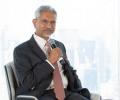
External Affairs Minister S Jaishankar is scheduled to visit China for an SCO conclave, marking a significant step in easing tensions after the 2020 border standoff. Discussions on the boundary dispute are also anticipated.
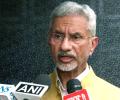
India on Thursday welcomed Kabul's firm rejection of attempts to create distrust between India and Afghanistan during a phone conversation between External Affairs Minister S Jaishankar and acting Afghan Foreign Minister Amir Khan Muttaqi.
Jaishankar said that the Pahalgam attack "was an act of economic warfare. It was meant to destroy tourism in Kashmir, which was the mainstay of the economy. It was also meant to provoke religious violence because people were asked to identify their faith before they were killed."

After the war erupted between Russia and Ukraine, the US and Western nations imposed sanctions on Moscow. However, India has continued to purchase Russian oil.
