
Delhi's air quality slipped into the 'very poor' category for the first time this season on Monday, with an AQI of 312. This triggers Stage 2 of the Graded Response Action Plan (GRAP), leading to stricter measures to control pollution. Minimum temperatures were also noted.

We are not acting at scale, by taking tough and time-bound action to bend the pollution curve, assets Sunita Narain.

The Commission for Air Quality Management (CAQM) has implemented Stage 1 of the Graded Response Action Plan (GRAP) in Delhi-NCR after the Air Quality Index (AQI) deteriorated to the 'poor' category. Forecasts indicate the AQI will remain poor in the coming days, triggering restrictions like banning coal and firewood in eateries and limiting diesel generator use.

Delhi's air quality plunged into the 'severe' category for the first time this season on Friday morning, with the average Air Quality Index (AQI) hitting 403. Several monitoring stations reported even higher levels, prompting the invocation of Stage III of the Graded Response Action Plan (GRAP) to curb pollution.

The Commission for Air Quality Management (CAQM) has implemented stage one measures in Delhi-NCR under the Graded Response Action Plan (GRAP) as air quality declined to the 'poor' category.

The Delhi Traffic Police has intensified its enforcement drive under GRAP anti-pollution measures, issuing 433 challans for no-entry violations, checking 7,657 vehicles at city borders, and turning back 609 vehicles for not meeting prescribed emission standards, leading to massive traffic snarls.

New Delhi experienced its worst air quality in 287 days on Tuesday, with the Air Quality Index (AQI) reaching 350 and several monitoring stations reporting 'severe' pollution levels. PM2.5 was identified as the dominant pollutant, posing significant health risks. The city has been placed under Stage II of the Graded Response Action Plan, with stubble burning and transport emissions being major contributors to the deteriorating air quality.

A new analysis by the Centre for Science and Environment (CSE) reveals that Delhi-NCR's early-winter air pollution has reached a three-year high in the week preceding Diwali. The average PM2.5 concentration significantly increased compared to previous years, driven primarily by vehicular emissions and regional pollution inflow. The report highlights the failure of year-round pollution control measures, with Diwali firecrackers exacerbating an already deteriorating situation, and notes the emergence of new pollution hotspots and the ineffectiveness of emergency traffic restrictions.

Delhi Chief Minister Rekha Gupta announced a complete ban on construction activities from December 10 to January 20 to combat severe winter air pollution. The government will use its AI-powered Dust Portal 2.0 and AI-enabled cameras to monitor construction sites over 500 square metres in real-time, issuing alerts and fines for violations. Citizens are encouraged to report non-compliance.

Young Mumbai batter Ayush Mhatre has sustained a grade 4 tear in his right hamstring, sidelining him for an estimated four to six weeks, potentially longer. This injury is a significant blow to Mumbai's Ranji Trophy campaign, especially as Mhatre was named vice-captain for the season.

Measures under the GRAP's 'very poor' and 'severe' categories came into effect on Tuesday.
Delhi Chief Minister Arvind Kejriwal on Friday said pollution levels declined in the national capital due to government initiatives as he announced a 15-point winter action plan to curb pollution.

A recent survey reveals that a significant number of households in Delhi-NCR are experiencing health problems due to the worsening air quality, with residents reporting symptoms like sore throat, cough, and burning eyes.

The Supreme Court on Wednesday asked the Commission for Air Quality Management (CAQM) to consider directing schools in Delhi-NCR to postpone open air sports competitions planned in November and December to 'safer months' keeping in mind air pollution levels.
In December 2016, the Supreme Court directed the central government to have a graded action plan to tackle the menace of air pollution. There are two plans - Comprehensive Action Plan and Graded Response Action Plan.

Delhi's air quality deteriorated to the 'severe' category, prompting the implementation of Stage-IV GRAP measures and hybrid classes for schools.

As the air pollution in Delhi-NCR ameliorated over the last two days, the Centre's air quality panel Sunday directed authorities to lift the ban on plying of non-BS VI diesel light motor vehicles in the region and the entry of trucks into the capital imposed under the final stage of the Graded Response Action Plan.

A thick layer of toxic smog enveloped the national capital on Saturday as air quality deteriorated sharply, prompting the Commission for Air Quality Management (CAQM) to invoke the strictest curbs under Stage IV of the Graded Response Action Plan (GRAP) across Delhi-NCR.
Bomb threats were received by a few schools in Delhi on Tuesday, making it the second such incident this week and the fifth in nine days in the national capital, officials said.
Delhi government mandates 50% work from home for offices and private establishments under GRAP stage three due to severe air pollution. Essential services are exempted.
This deterioration in air quality led to prompting enforcement of Stage II of the Graded Response Action Plan (GRAP) in the national capital.

The Delhi Pollution Control Committee (DPCC) reports improved air quality in Delhi compared to the same period last year, attributing it to coordinated efforts by government departments. Officials aim to avoid implementing GRAP Stage III restrictions through proactive measures and public participation.

The stage of alert will be based on positivity rate (on two consecutive days), cumulative number of new cases (over a week) and average oxygenated-bed occupancy (for a week).

Preventive measures are in place and the forecast suggests further improvement, said the statutory body responsible for forming air pollution reduction strategies for the region and their implementation.
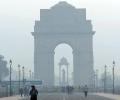
'Most pollution boards across the country have unused funds. There is practically no reason why pollution should not be a political priority.'
Delhi's 24-hour average air quality index (AQI) stood at 248 on Saturday.

The Delhi government has ordered half of its staff to work from home, urging private organizations to follow suit as the national capital faces an alarmingly high level of air pollution. The move comes as Delhi recorded an Air Quality Index (AQI) of 426 in the "severe" category, with residents reporting health issues. Essential services will continue to operate at full capacity. The government has also advised companies to provide shuttle bus services for employees and suggested that private entities consider shifting office hours to reduce traffic congestion.

Delhi's 24-hour average air quality index (AQI) stood at 407 at 4 pm.
The SC questioned the Delhi government over delay in implementation of stricter anti-pollution measures under GRAP-4, and said it will not allow scaling down of the preventive measures without its prior permission.
The overall AQI deteriorated further and touched the 268 mark, which falls in the poor category.

The Bandra Kurla Complex area of Mumbai recorded an AQI of 300 and in the Chembur area, AQI of 319 was recorded as 'very poor'.
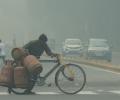
'These measures should be in place throughout the year in order to bring down AQI levels to 100 or below'

By all available indications, the White House drafted a face-saving note and handed it, ready-made, to Islamabad. Pakistani Prime Minister Shehbaz Sharif was supposed to then post it in the guise of a plea urging Trump to extend the deadline by two weeks 'to allow diplomacy to run its course'. Trump would then graciously accept Pakistan's 'request' and declare a ceasefire. Sharif dutifully posted the message on X. Except that he, or whoever was handling the account, forgot to delete the tell-tale first line visible in the edit history: 'Draft - Pakistan's PM Message on X'. Prem Panicker's must read blog on the Iran War.
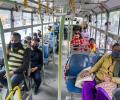
He said stringent curbs have been put in place as part of the Graded Response Action Plan for COVID-19 to check the spread of the infection and the Delhi Disaster Management Authority (DDMA) will decide on implementing more restrictions.
'Some success has been achieved in raising the costs of terrorism for Pakistan.'

Air quality index (AQI) soared past 350 level in parts of Delhi on Thursday and experts cautioned that as weather turns colder it may breach the 400-mark ceiling and enter the 'severe' zone soon, notwithstanding the incidents of stubble burnings which have nosedived from 17,529 in 2020 to 4,262 this year.

Some residents have already taken this step to relocate, either temporarily or permanently, some to their native places and others to clean-air destinations like Goa and Himachal Pradesh.
Delhi CM Arvind Kejriwal said Covid cases are mild and there is no increase in the consumption of oxygen or the use of ventilators despite the rise in numbers.

Delhi's air quality plummeted to alarming levels on Tuesday after 24 days, with many areas witnessing a significant spike in pollution despite the strictest measures, including a ban on construction activities and the entry of trucks into the city, coming into force.

Areas in the National Capital Region -- Noida and Gurugram -- recorded an AQI of 529 and 478 respectively both in the highly toxic 'severe'.
