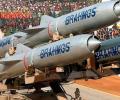
Army Chief Gen Upendra Dwivedi announced that India is considering raising a 'rocket-cum-missile' force in response to the evolving regional security situation and similar units in China and Pakistan. The move aims to enhance India's combat capabilities and long-range strike potential.

In appointing Lt Gen Dwivedi, the government followed the seniority principle.

Army Chief Gen Upendra Dwivedi shared his vision for a cafe named 'Ahista Zindagi' in Madhya Pradesh, designed as a retreat for reflection and conversation in today's fast-paced world, during an interaction with youths in Delhi.

Lt Gen Dhiraj Seth, currently the Vice Chief of Army, has been appointed as the next Chief of the Army Staff, taking over from Gen Upendra Dwivedi on June 30. He brings nearly four decades of distinguished military experience, having commanded various formations and held key strategic appointments.

Gen Dwivedi, who has vast operational experience along the frontiers with China and Pakistan, was serving as the Vice Chief of the Army.
Army Chief Gen Upendra Dwivedi issued a stern warning to Pakistan, stating that if it continues to harbour terrorists and operate against India, it risks becoming 'history'. The remarks were made during an interactive session, days after the anniversary of Operation Sindoor, which involved precision strikes on terror infrastructure in Pakistan and PoK.

India's Army Chief, General Upendra Dwivedi, emphasized the Indian Army's role as a "melting pot" and cited the harmony between Kuki and Meitei soldiers in the same units as an example of the force's unifying nature. He made the remarks during a lecture in Pune, highlighting the Army's efforts to promote unity and integration within its ranks. General Dwivedi also touched upon the Army's role in internal security in Jammu and Kashmir, the Northeast, and the upcoming Olympics.

The Army chief said the situation along the Line of Actual Control with China has been stable, but it needs constant vigil.

The BJP has announced its new national organisational team, with eight leaders from Uttar Pradesh receiving key appointments. These include two national vice-presidents, two general secretaries, two secretaries, and the chiefs of the OBC and Minority Morchas. The appointments reflect a strategic focus on youth, social diversity, and experienced campaigners, particularly after the party's recent electoral setbacks in the state.

General Dhiraj Seth has been appointed as the new Chief of the Army Staff, taking command of the 1.3 million-strong Indian Army. He brings nearly four decades of extensive experience, including commanding two operational Army commands along the western front, and will lead the force in its pursuit of self-reliance and readiness amidst dynamic global geo-strategic challenges.

Gen Dwivedi, who also addressed a gathering at his alma mater, Rewa Sainik School, said that during Operation Sindoor, Indian forces ensured that no action was taken while prayers or namaz were underway.

The Army Chief said India's political brass has the will to strengthen the country's deterrence capabilities.

Equipped with torpedoes and anti-submarine rockets, the first of the Mahe-class anti-submarine warfare shallow water craft (ASW SWC) was delivered to the Navy on October 23.

So, when to start, when to stop, how much to apply in terms of time, space and resources, and how much, what is the definition of calibrated action, all these things were something "we kept discussing at every time," Gen Dwivedi recalled.

Gen Pande was to retire from service on May 31.

India's armed forces, including the Army, Navy, and Air Force, extensively participated in yoga sessions across the country to commemorate International Day of Yoga. From high-altitude regions to parade grounds, thousands of personnel, their families, and cadets engaged in various asanas, highlighting yoga's role in promoting physical fitness, mental resilience, and holistic well-being.

The Indian Army has brought a change in its social media guidelines under which its personnel can now sign up on Instagram, but with a rider that they can use it only as 'passive observers' without putting up posts or comments on the platform, sources said on Thursday.

Army Chief General Upendra Dwivedi asserted that Operation Sindoor was unlike any conventional mission and that it was akin to playing a game of chess as 'we did not know' what would be the enemy's next move.
Indian army chief General Upendra Dwivedi on Saturday said that the surgical strikes carried out during Operation Sindoor were a clear message to Pakistan that supporters of terrorism will not be spared.
Army Chief General Upendra Dwivedi Monday said there is still a 'degree' of standoff between the Indian and Chinese militaries along the Line of Actual Control in eastern Ladakh and both sides need to sit down and firm up a broader understanding on how to calm down the situation.
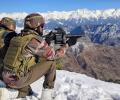
Army Chief Gen Upendra Dwivedi visited Dehradun on Monday and reviewed operational preparedness, interacted with troops, and received briefings on security initiatives and infrastructure development in the region. He emphasized the importance of maintaining peak operational efficiency and adaptability in a complex security environment. The visit highlights the Army's proactive approach to ensuring mission readiness and boosting troop morale.
In a stern warning to Pakistan, Army chief General Upendra Dwivedi said on Friday that the neighbouring country should stop sponsoring terrorism on its soil if wants to retain its place on the world map.
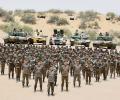
He also reviewed the joint actions undertaken in coordination with the Indian Air Force and the Border Security Force, they said.
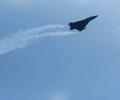
Defence experts discuss the objectives and strategic pause of Operation Sindoor, emphasizing the avoidance of a prolonged conflict and its potential impact on the Indian economy.
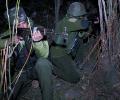
Indian Army troops fired upon and took down multiple suspected Pakistani drones that entered Indian territory from across the Line of Control (LoC) in the Rajouri district of Jammu and Kashmir. This is the second such incident in three days.

Singh reached Udhampur on a two-day visit on Friday, his second trip to Jammu and Kashmir post-Operation Sindoor. He visited Kashmir on May 15, days after India and Pakistan reached an understanding to stop military actions against each other.
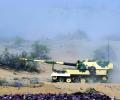
Defence Minister Rajnath Singh witnessed the spectacular Thar Shakti capability demonstration at the historic Longewala battlefield, showcasing the Indian Army's integrated prowess in Jaisalmer on Friday, October 24, 2025.

The situation along the Line of Actual Control (LAC) in eastern Ladakh is stable but sensitive and not normal, Chief of Army Staff General Upendra Dwivedi said on Tuesday on the dragging military standoff between China and India in the region.

The aircraft was allowed to move inside India as the air defence personnel knew who was inside the plane, they said.

Defence Minister Rajnath Singh has assured the nation that India will respond strongly to the recent terror attack in Kashmir's Pahalgam, which killed 26 people. He stated that India will not be intimidated by such acts and will take every necessary step to trace those responsible and those who conspired behind the scenes. Singh described the attack as "extremely inhuman" and reiterated India's zero-tolerance policy against terrorism.
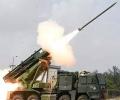
The Army is also looking at strengthening the existing Pinaka regiments and had recently placed orders for buying the area denial ammunition for these rocket regiments.
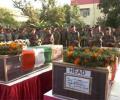
Speaking to media-persons after paying his last tributes to five soldiers, including two Army captains, who lost their lives in the Rajouri firefight, Lt Gen Dwivedi said, "While we lost five of our brave soldiers in the encounter, we also eliminated two dreaded terrorists. Our boys went after the well-trained and equipped foreign terrorists without giving any thought to their personal safety. This (taking out the dreaded terrorists) has dealt a major blow to the terror ecosystem and Pakistan. As per our estimation, 20-25 terrorists could still be operating in the area. We should be able to control the situation in a year's time with the help of locals."

Defence Minister Rajnath Singh said Operation Sindoor gave Pakistan a "good dose" of caution and warned against any future "misadventure" against India. He also highlighted the role of the armed forces in nation-building and the government's commitment to border infrastructure development.
The eastern Ladakh military standoff between India and China began in May 2020 and a deadly clash at the Galwan Valley in June that year resulted in a severe strain in ties between the two neighbours.

Defence Minister Rajnath Singh held a comprehensive review of the national security scenario with top military leadership in India. The meeting comes after Pakistan's recent attempts to target Indian military installations using drones and missiles were thwarted. The meeting discussed the evolving security situation and the Indian military's response to the Pakistani attacks.

The role of the space sector in armed conflicts came into sharp focus during Operation Sindoor, which saw extensive use of drones and loitering munitions and tested the capabilities of air defence systems such as indigenously developed Akash Teer.
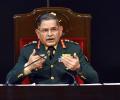
The General said it was "too early" to take a call on the role of Bangladesh, where a change in government may bring about a change in the relationship between it and India.

Security forces are using drones and helicopters for surveillance of the dense forest area where terrorists are believed to be holed up since Wednesday after killing two Army officers and a deputy superintendent of police in the initial exchange of fire, the officials said.

Army Chief General Upendra Dwivedi visited Kashmir to review the security situation following the Pahalgam attack earlier this week that left 26 people dead, mostly tourists. The visit comes less than 24 hours after Pakistan resorted to small arms firing along the Line of Control (LoC) in Jammu and Kashmir.

President Droupadi Murmu and Prime Minister Narendra Modi on Saturday led the nation in paying tributes to military personnel who fought valiantly in harsh conditions to hand Pakistan a crushing defeat in the 1999 Kargil conflict.
