
Indian benchmark indices Sensex and Nifty experienced a sharp decline in early trading due to escalating tensions in the Middle East, driving crude oil prices higher. Global market bearishness and foreign fund outflows further contributed to investor unease.

Paris Saint-Germain president Nasser Al-Khelaifi has been stranded in Qatar for over a week due to the ongoing conflict in the Middle East, impacting flights and travel across the region.

The Finalissima match between Spain and Argentina in Doha is in doubt after the Qatar Football Association suspended soccer tournaments indefinitely following U.S. and Israeli attacks on Iran and retaliatory missiles fired at the Arabian Peninsula.

Arsenal secured a 1-0 victory over Atletico Madrid, winning 2-1 on aggregate, to reach the Champions League final for the second time in their history. Bukayo Saka's goal proved decisive in a tense semi-final clash.
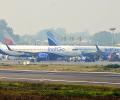
An IndiGo flight from Delhi to Manchester was forced to return to its origin due to last-minute airspace restrictions related to the ongoing situation in West Asia. The flight was using a leased Boeing 787 aircraft.

If the oil infrastructure is attacked by the United States, the whole area could be flooded with oil, spilling into the Persian Gulf.

'Even if the war ends tomorrow, which is unlikely, and we go back to the pre-war status quo, the world will still need some time to get over the sudden shock of oil price increases.'

Games open in Verona with calls for unity amid wars and athlete absences

The broader conflict in West Asia, the largest international market for Indian carriers, has forced a sharp reduction in daily flights relative to the summer schedule.

IT major HCLTech reported a 4.20 per cent year-on-year rise in consolidated net profit to Rs 4,488 crore for the January-March quarter of FY26, but projected a modest 1-4 per cent revenue growth for FY27, citing market volatility and reduced discretionary spending.

The intriguing bit is that Trump is likely to attend the talks in Islamabad this weekend -- if he does, it will be the clearest signal yet that the US is ready to exit the war with some sort of win to show, since he cannot afford to go for the talks and return empty-handed, notes Prem Panicker in his must read blog on the Iran War

Far from it; the country's resistance to the US, its nuclear ambitions, and its pursuit of influence and proxies across the Middle East are driven by a constant search for independence and security. Thus, Iran will never capitulate. Trump will learn this home truth ultimately, and it is going to be a humbling personal experience that may even destroy his presidency, predicts Ambassador M K Bhadrakumar.

The question is whether the clocks allow enough time for two deeply mistrustful sides to get there, and whether the surface calm holds long enough for the paddling to produce something before the ceasefire ends on April 22, notes Prem Panicker in his must read blog on the Iran War.

'It was diminishing even before Trump came to power.' 'The US was at the centre of the global economy. That position is going to become less and less important and less central.'

Amidst rising Middle East tensions, External Affairs Minister S Jaishankar highlights India's strategic dialogue with Iran to safeguard maritime traffic through the Strait of Hormuz, ensuring India's energy security and continued oil trade.

For India, much is at stake: Crucial energy supplies traversing the Strait of Hormuz, the fate of its 10 million citizens living and working in West Asia -- who send generous remittances home -- and its major trade links with the region.

Karex, the Malaysian company that makes roughly one in five of the world's condoms -- about five billion a year, supplying Durex and Trojan among others -- announced this week that it is raising prices by up to 30 percent. The reason is the Strait of Hormuz.

Indian companies, however, are now paying a premium of $6-$7 a barrel for Russian oil, compared with discounts of $8-$10 a barrel before the start of the conflict.

'What we have yet to see on either the US or the Iranian side is willingness to compromise on their ultimate demands and the flexibility to reach an agreement to end the war.

West Asia conflict triggers sharp sell-off in Indian markets, with realty, banking and auto stocks leading losses amid energy shock fears.

Donald Trump's inconsistent statements and actions regarding the conflict with Iran have drawn criticism and confusion, raising questions about American credibility and the direction of US foreign policy.

The big question is whether Trump is any longer in command of the situation. For all practical purposes, the war seems set to cascade as the US is preparing for a potential ground operation in Iran and threatens to destroy 'bridges next, then electric power plants', points out Ambassador M K Bhadrakumar.

The cost of the war is being counted not in the corridors of power in Washington or Tehran, but in Firozabad's darkened furnace rooms, Howrah's idle casting sheds, and a barbershop in Kochi where the wait is suddenly, inexplicably, an hour long, notes Prem Panicker in his must read blog on the Iran War.

Analysts predict that the ongoing conflict in West Asia, crude oil price fluctuations, and the US Federal Reserve's interest rate decision will significantly influence the Indian equity market this week.

President Trump asserts the US military has decimated Iran's forces and no longer requires assistance from NATO allies to secure the Strait of Hormuz, despite earlier requests for support.

The core issues to be settled -- access to Hormuz, Israel's aggression in Lebanon, the question of Iran's nuclear programme, sanctions relief and compensation -- are thorny enough to require weeks of patient negotiation. The most likely outcome of the opening sessions is that both sides take the measure of each other, establish what is and is not negotiable, and return home without having broken anything. That would count as progress.

Analysts predict a surge in gold and silver prices as investors seek safe-haven assets due to escalating tensions in the Middle East. The impact on domestic prices will depend on the conflict's duration, with geopolitical factors and macroeconomic data also playing a role.

Pakistan's Prime Minister Shehbaz Sharif has engaged in extensive diplomatic efforts to de-escalate the conflict in West Asia, offering to host talks between the US and Iran and engaging with leaders from Saudi Arabia, Qatar, Malaysia, the UK, China, and the European Union.

The ceasefire is still technically holding, to the extent that no overt hostilities have been reported yet, but the rhetoric has hardened dangerously. The week ahead will also clarify whether the Islamabad failure was a negotiating tactic or whether Washington has genuinely locked itself into a position from which the only exits are climb-down, escalation, or the slow bleed of a new status quo that nobody chose and nobody controls. Prem Panicker continues his must read blog on the Iran War.

Iran is fighting a different war: Older, slower, and in some ways more dangerous. Iran doesn't need to shoot down an F/A-18. It only needs to make the Strait of Hormuz feel dangerous long enough for insurance markets, shipping companies, and oil futures traders to do the rest. Prem Panicker continues his must-read daily blog on the war in the Middle East.

External Affairs Minister S Jaishankar discussed the West Asia conflict and its impact on energy supplies with his Russian counterpart Sergey Lavrov and EU's Foreign Policy chief Kaja Kallas.

The 'Finalissima' match between Spain and Argentina that was scheduled to be held in Qatar has been cancelled due to the conflict in the Middle East while the South American side rejected multiple alternatives, UEFA said on Sunday.

The International Cricket Council (ICC) is developing alternate flight plans for players and officials returning from the T20 World Cup following US strikes on Iran.

The 'rescue' operation occurred within kilometres of Iran's underground tunnel complex at Isfahan, assessed by the IAEA and US intelligence as holding a substantial portion of the country's 60 per cent enriched uranium stockpile. Retired senior US military officers have highlighted that the mission's footprint -- hundreds of special operators, multiple heavy-lift aircraft deep inside Iran -- appears outsized for recovering a single airman. Prem Panicker continues his must read blog on the Iran War.

Indian stock market benchmark indices Sensex and Nifty experienced a significant decline, driven by escalating tensions in the Middle East and rising crude oil prices.

US President Donald Trump and Russian President Vladimir Putin discussed the Iran conflict and its impact on global energy supplies during a phone call.

Fight on toward goals that keep receding, or exit with most objectives unmet. Trump is agitated, his poll numbers falling below the Plimsoll line, his base fractured between those who back the war and those who remember that he campaigned on ending them.

Israel and the United States had a plan. Iran punched back. And now the Gulf is reeling, the world is beginning to feel the pain and, as on date, no one in Washington or Tel Aviv appears willing to admit that the punch has landed, notes Prem Panicker, continuing his must-read blog on the war in the Middle East.

The United States, which entered this war in expectation of a short, sharp win along the Venezuela model, is now preparing for deeper involvement in a conflict it does not fully control, without the allies it typically relies on, against an adversary that is not behaving as expected, in a global environment that is already absorbing economic shock. Prem Panicker continues his must read daily blog on the Gulf War.

Prime Minister Narendra Modi addressed the Israeli Parliament, reaffirming India's support for Israel in the face of terrorism and expressing support for the Gaza peace initiative.
 © 2026 Rediff.com - Advertise with us - Disclaimer - Privacy Policy - Sitemap - Feedback - About us - Terms of use - Grievances