
The visas were granted to the five Iranian players after US President Donald Trump spoke to Australian Prime Minister Anthony Albanese following reports that the players had requested asylum.

'On behalf of the Islamic Republic of Iran, I express gratitude and appreciation for my dear brothers HE Prime Minister of Pakistan Sharif and HE Field Marshal Munir for their tireless efforts to end the war in the region.'

Gold prices experienced a significant decline in futures trading due to uncertainty surrounding geopolitical tensions in West Asia and conflicting statements regarding the conflict. Investors are also awaiting key macroeconomic data for further direction on interest rate cuts.

The official also advised all the trade partners to abide by the trade deals. The new 10 percent global tariff is part of Trump's protectionist trade agenda, aimed at addressing balance-of-payments issues and unfair trade practices.
The ruling is expected to have wide-ranging consequences for global trade, businesses, consumers, inflation trends and household finances across the country.

US President Donald Trump and Russian President Vladimir Putin discussed the Iran conflict and its impact on global energy supplies during a phone call.

Prime Minister Narendra Modi has called on Indian citizens to unite and overcome the challenges posed by the ongoing conflict in West Asia, cautioning against politicisation and rumour-mongering.
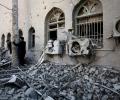
The logic of war plus the gathering storms in US politics as the midterms loom large leave him with no real alternative but to negotiate, points out Ambassador M K Bhadrakumar.
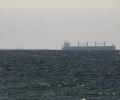
The UK Maritime Trade Operations issued a warning noting that the incident took place approximately 15 nautical miles north of Sharjah.

Prime Minister Narendra Modi will review the impact of the West Asia conflict on India's food, energy, and fuel security with senior cabinet ministers. The meeting follows previous discussions and concerns raised about global energy crises and supply chain disruptions.
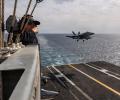
While Trump has been examining the possibility of stationing ground forces in the Middle East, CBS News reported that he has yet to define the exact conditions under which he would approve their use.
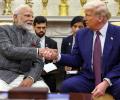
Amidst escalating tensions with Iran, the US has granted India a temporary 30-day waiver to continue purchasing Russian oil, aiming to stabilise global energy markets and encourage future US oil imports by India.

He also criticised the possible succession of the son of the late supreme leader of the Islamic Republic, Mojtaba Khamenei, who is widely viewed as a leading contender for the position.

Iranian Foreign Minister Seyed Abbas Araghchi on Saturday criticised the United States over its stance on Russian oil, claiming Washington was now "begging" countries across the globe, including India, to purchase Russian crude.

External Affairs Minister S Jaishankar discussed the West Asia conflict's impact on the global economy, particularly energy security, with US Secretary of State Marco Rubio. He also engaged with GCC ambassadors and his Sri Lankan and German counterparts on the same issue.

The verdict marks a notable shift from a series of recent wins for Trump at the Supreme Court.

For weeks, the war skirted the edge of catastrophe without tipping over. Missiles flew, there was much destruction, commanders were assassinated, cities across the Gulf and even in Israel struggled to absorb the shock. But one line held: Energy infrastructure, the arteries of the global economy, remained largely untouched. That is no longer true. Prem Panicker continues his must read daily blog on the Gulf War.

'What we have yet to see on either the US or the Iranian side is willingness to compromise on their ultimate demands and the flexibility to reach an agreement to end the war.

Amid an escalating regional war, questions deepen over whether Iran's soccer team will compete at this year's FIFA World Cup to be jointly hosted by the United States, Mexico and Canada.

Iran has not closed the Strait. It remains open; however, due to current conditions and circumstances, ships are unable to pass through the Hormuz. Otherwise, Iran never wanted the Strait to be closed or blocked, the supreme leader's representative said.

Indian markets on Dalal Street rallied sharply as easing tensions in the US-Iran conflict and stable oil prices boosted sentiment. Track Nifty 50 and BSE Sensex performance and key global triggers.

Donald Trump claims his use of tariffs prevented a nuclear war between India and Pakistan, a claim India has repeatedly refuted.
He accused the firm of trying to interfere with how the US military operates and threatened further action if it does not cooperate during a six-month phase-out period.

A new poll indicates that President Donald Trump's approval rating is suffering as economic anxieties and the rising cost of living weigh heavily on US voters, revealing deep political divides and widespread dissatisfaction with the government.

Trump said that the strait will be "open very soon" if ongoing negotiations with Tehran continue successfully.
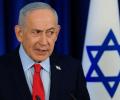
Benjamin Netanyahu declares that the joint Israel-US campaign is successfully 'crushing' Iran, eliminating existential threats and weakening the regime's regional influence.

Brace yourself for Sunny Deol's roaring patriotism and more on OTT this week, as Sukanya Verma lists your choices.

Trump further reiterated his claim that he ended 'eight wars in 10 months', and said the Russia-Ukraine conflict was the toughest of all.

The 'rescue' operation occurred within kilometres of Iran's underground tunnel complex at Isfahan, assessed by the IAEA and US intelligence as holding a substantial portion of the country's 60 per cent enriched uranium stockpile. Retired senior US military officers have highlighted that the mission's footprint -- hundreds of special operators, multiple heavy-lift aircraft deep inside Iran -- appears outsized for recovering a single airman. Prem Panicker continues his must read blog on the Iran War.

By all available indications, the White House drafted a face-saving note and handed it, ready-made, to Islamabad. Pakistani Prime Minister Shehbaz Sharif was supposed to then post it in the guise of a plea urging Trump to extend the deadline by two weeks 'to allow diplomacy to run its course'. Trump would then graciously accept Pakistan's 'request' and declare a ceasefire. Sharif dutifully posted the message on X. Except that he, or whoever was handling the account, forgot to delete the tell-tale first line visible in the edit history: 'Draft - Pakistan's PM Message on X'. Prem Panicker's must read blog on the Iran War.

The ongoing conflict involving the United States, Israel, and Iran intensified sharply with attacks on critical energy infrastructure across the Gulf, even as US President Donald Trump said he had cautioned Israeli Prime Minister Benjamin Netanyahu against targeting Iran's key South Pars Gas Field.

The United States Trade Representative (USTR) office on Wednesday launched a sweeping investigation into manufacturing and industrial practices in 16 economies, including India, citing concerns over what it calls 'structural excess capacity' that could distort global trade. Announcing the move on a White House press call, Jamieson Greer said the probe would be conducted under Section 301 of the Trade Act of 1974, one of Washington, DC's most powerful trade enforcement tools.

Prime Minister Narendra Modi convened the Cabinet Committee on Security to address the impact of the West Asia conflict on Indian citizens, focusing on safeguarding them from the conflict's effects and ensuring the smooth flow of essential supplies.

Pakistani Prime Minister Shehbaz Sharif has briefed Saudi Crown Prince Mohammad bin Salman on Pakistan's diplomatic efforts to de-escalate the situation in West Asia. This follows Pakistan's offer to host talks between the US and Iran to resolve the ongoing conflict.
A US lawmaker has criticized President Donald Trump's tariff policy on India for purchasing Russian oil, urging him to reverse it immediately.

A Pakistani man with ties to Iran has been convicted in a US court for plotting to assassinate former US President Donald Trump and other American politicians.

During his State of the Union address, President Trump honored Dalilah Coleman, a young crash victim, and urged Congress to pass 'Dalilah Law' to prevent undocumented immigrants from obtaining commercial driver's licenses, sparking debate on immigration and road safety.

For years, these two powers operated as "frenemies" in the shadow of Iran's regional influence. The frame here is "The Enemy of My Enemy."

His remarks come after Trump warned Iran of severe consequences if it fails to reopen the strategically vital Strait of Hormuz, a key global energy transit route.

Trump may strike. He may announce productive talks and extend again. He may do both at the same time. Iran will not open the Strait on someone else's terms, so no matter what happens, that problem will remain unsolved. And the IRGC will still be collecting its $2 million toll from every ship bold enough to ask permission to pass.
