
India too can rise to the top if the 1.4 billion Indians back home are given better opportunities to use their innate talent and capacity to work hard, with right incentives in a more meritocratic rules-based system, asserts Ajay Chhibber.

Foreign investors have largely been exiting one part of the market while domestic investors have been enthusiastically accumulating another, points out Debashis Basu.

Gwadar is viewed as a critical pearl in China's maritime strategy as it would give a permanent logistical footprint near an important choke point - the Strait of Hormuz and the oil rich Persian Gulf, explains Commodore Venugopal Menon (retd).

As India awaits Vaibhav Sooryavanshi's senior debut, experts urge cricket to remember the 15-year-old is still a child, highlighting the challenges of balancing extraordinary talent, growing fame and emotional well-being.

Streaming has globalised the entertainment industry, enabling artists like Diljit Dosanjh and Arijit Singh to reach diverse international audiences.

Although the front seat in my car will miss his presence, the echoes he left behind will remain for long. K R Nayar mourns legendary cricket writer Qamar Ahmed.

The Union Health Ministry has amended drug rules, making it mandatory to have a doctor's prescription for the sale of all syrups, including cough syrups. This move aims to enhance regulatory oversight and patient safety following concerns over drug quality and contamination-linked deaths.

The NCERT has included in the class 9 social science textbook a section on Emergency, which it described as "one of the major challenges to democracy in India" with Education Minister Dharmendra Pradhan hailing the move saying future generations should know about the "dark deeds".

The umbrella of 'inexperience' or 'reset' is merely an excuse. Team India's think-tank will have to admit that this is experimentation without a roadmap, points out K R Nayar.

Have a blast with Vvan: Force of the Forrest, one puzzling piece at a time!

Cyril Radcliffe drew India's border without ever visiting it. Turns out our environmental clearance system learned the same trick -- and the Western Ghats are paying for it, points out Binu Alex.

India is navigating a complex diplomatic landscape, attempting to balance its 'forever honeymoon' with the Israel-UAE-Bahrain axis against its historical ties with Iran, as evidenced by recent high-level visits and evolving geopolitical realignments in the Middle East, observes Ambassador M K Bhadrakumar.

The monsoon session of Parliament will set the tone for how the Hindu community feels about what happened at the Ram Mandir. Whether emotions will be stirred within the voters of India lies solely at the oratory skills of the Congressis and Samajwadis, notes Zainab Sikander.
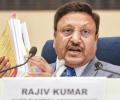
It is because dealing with a regulatory system that is largely headed by retired IAS officers then becomes relatively easy, points out A K Bhattacharya.

Sanju Samson's biggest opponent isn't the opposition, it's the selection committee. Samson has never been given a long rope; all he receives is a thin thread.

Many students who do well in the NEET exams miss out on a medical seat because they didn't get their documentation in order. You don't want to be that student, says Ashok Hegde.

Not a single retail outlet ran dry. Every household that wanted a cylinder got one. India faced neither a 1991 moment nor a 2013 one. Macroeconomic stability held. This was not an accident, and it was not luck alone. It was the work of a government that chose to act as it had during the pandemic -- deliberately and gradually, building one measure upon another rather than reaching for a single dramatic lever, explains V Anantha Nageswaran, chief economic advisor to the Government of India.

I had gone to Baramati to ask about loans. I came back having done a small, accidental good.

Notwithstanding the economic complementarities and the host of agreements for deepening economic relation on a host of areas, both sides share common viewpoints on the foreign policy domain and seek common grounds to serve as a counterweight to China, notes Dr Rajaram Panda.

If we really want to curb the further depreciation of the rupee and make the rupee appreciate, we want to come out of the mindset that the exchange rate is merely a number, bring policy corrections to help reduce the outflow of foreign exchange by imposing suitable tariffs to discourage imports and bring self reliance, discipline FPIs, and correcting rules governing royalty outflows, suggests Dr Ashwani Mahajan, National Co-Convenor, Swadeshi Jagaran Manch.

It is an unusual choice to depute a retired general for the funeral of a revered religious figure but a thoughtful one in an attempt to inject verve into the bilateral relationship and restore the equilibrium in India's West Asian policies, notes Ambassador M K Bhadrakumar.

Have a blast with Welcome to the Jungle, one puzzling piece at a time!

History may remember Takaichi Sanae not as the leader who simply accelerated Japanese rearmament, but as one who governed during Japan's transition from an industrial-age security model to a post-industrial strategic member of the global order, points out Varun Arya.

Omar Abdullah has so far laboured hard to make best of a bad bargain. Even so, the ground reality is anything but reassuring. The Opposition parties, including notably the PDP, appear to be gaining ground, though more by default. Public patience with Omar's government has nearly run out, notes Mohammad Sayeed Malik, the distinguished commentator on Kashmir affairs.

One of the world's gentleman cricketers has quietly walked away from the game, just as he played it: With grace, dignity, and zero fuss.

The boundary mess between India and Nepal needs a solution in a manner as mentioned by Nepal's Foreign Minister Shishir Khanal: 'On evidence not emotions', counsels Lieutenant General Shakti Gurung (retd).

'Though he said a lot of things, he never once asked me to stay.' Aarti David explores love and betrayal in this short story.

Ramesh is not in our class group photo. He had already vanished from school by the time it was taken. We didn't know why then. A few weeks later, we did, recalls Binu Alex.

For the foreseeable future, the most likely outcome remains continuation of the status quo. Taiwan will remain self-governing without formally declaring independence, while China continues to apply sustained pressure short of war, predict Krishnan Srinivasan and Manoj Mohanka.

Pacer Gurnoor Brar impressed on his international debut before captain Shubman Gill played a regal knock to set up India's seven-wicket win over Afghanistan in the rain-hit series opener.

Three BJP candidates have been declared elected unopposed in the biennial Rajya Sabha elections in Madhya Pradesh, while the Congress party has moved the Supreme Court against the rejection of its candidate Meenakshi Natarajan's nomination.

The RBI seems to be acknowledging that all deposits are not equal -- a deposit with a lower run-off assumption is inherently more valuable than one that could disappear overnight, points out Tamal Bandyopadhyay.

The remarkable rise of smallcaps reflects the emergence of a broad set of specialised businesses operating in industries where the sectoral tailwinds remain considerably stronger than macroeconomic headwinds, points out Debashis Basu.

We have built an economy that can deliver everything -- from iPhones to biryani -- to a doorstep in 10 minutes, but it cannot deliver a fire engine through a lane in 20, points out Amit Kapoor.
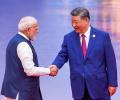
India's dual pursuit of a robust strategic partnership with Washington and a pragmatic, tension-management policy with Beijing represents the essence of modern multi-alignment. By embracing economic pragmatism, learning to compartmentalize political differences, and engaging in continuous dialogue, India can secure its borders, grow its economy, and contribute to a stable, multipolar Asian century, points out Ambassador Rajasekhar.

Cristiano Ronaldo, playing his 6th FIFA World Cup, headlines the Portugal squad that has a glittering supporting cast that includes Vitinha, Joao Neves, Bruno Fernandes and Nuno Mendes.

Have a blast with Pati Patni Aur Woh Do, one puzzling piece at a time!

Maharana Pratap became a hero not because he won a battle, but because he continued fighting after he lost one, asserts Harishchandra.

We have Yoga Day. We have Hindi Day. We have, I am fairly certain, so many days, though I have never met anyone enjoying these days, notes Binu Alex.

Ideology is dead; long live the numbers game that is being played with the sole intention of securing a two-third majority in the Lok Sabha for the NDA, observes Nilanjan Mukhopadhyay.
