
Specialised range taking shape in Andhra Pradesh, while West Bengal clears way for DRDO's new testing facility.

Congress candidate Milan Pradhan for the Nandigram assembly bypoll was arrested for alleged involvement in the 2007 anti-land acquisition movement. Another party leader, Subhasish Bhattacharya, was also arrested. The Congress alleges political vendetta by the BJP, especially as Pradhan had successfully filed his nomination. The party has questioned the timing and legality of the arrest, particularly during the model code of conduct, and plans demonstrations.

AICC general secretary K C Venugopal announced that the Congress would not withdraw its candidate Milan Pradhan from the Nandigram Assembly bypoll in West Bengal, despite his recent arrest. Pradhan was apprehended in connection with a 2007 anti-land acquisition movement case, shortly after the Trinamool Congress extended its support to him. Venugopal alleged political pressure and questioned the Election Commission's silence, vowing to elevate the issue to a national level.

Six forest personnel, including a range officer, were injured in an attack by suspected timber smugglers in North Tripura. Two Forest Department vehicles were also damaged in the incident.

The Defence Research and Development Organisation (DRDO) and the Indian Air Force (IAF) have successfully conducted flight tests of the RudraM-II air-to-surface missile, marking a significant milestone in indigenous defence technology.

West Bengal Chief Minister Mamata Banerjee has declared that the TMC will proceed with its planned sit-in protest against alleged attacks on party leaders and workers, as well as the Railways' hawker eviction drive, despite the police denying permission for the event.
A man and his sister-in-law were found dead inside his house in Odisha's Balasore district. Police suspect suicide linked to an alleged illicit relationship, pending post-mortem and investigation.

India has successfully conducted the maiden salvo launch of the indigenously developed Naval Anti-Ship Missile-Short Range.

The family of the driver injured in the shooting that killed a BJP leader's aide in West Bengal has demanded justice and urged the government to prevent future incidents.

Loitering munitions, often described as 'suicide drones' or 'kamikaze drones', are becoming central to modern warfare because of their ability to hover over target areas, identify threats and strike with high precision.

A man in Rajasthan's Jhalawar district has been arrested for allegedly murdering his wife and attempting to pass it off as an accidental fall. Forensic investigation and crime scene reconstruction revealed the truth, leading to the husband's arrest.

India successfully test-fired two Pralay missiles in quick succession off the coast of Odisha, paving the way for its induction into the military. The missile is indigenously developed and features a state-of-the-art navigation system.

India successfully test-fired the 'Agni 5' intermediate range ballistic missile, capable of reaching targets up to 5,000 km, validating its operational and technical parameters.

"The fire which broke out in the underground magazine store of the Proof and Experimental Establishment (PXE) in the early hours has been fully controlled by fire-fighters," said Director of PXE, R Appavuraj.

India successfully test-fired nuclear-capable short range ballistic missiles Prithvi-II and Agni-I from an integrated test range off the Odisha coast, demonstrating its strategic deterrence capability. The test-firing of the missiles, conducted by the elite Strategic Forces Command, validated all operational and technical parameters.

The missile showcased its precision and capability to neutralise targets, the statement said.

DRDO conducted the maiden flight test of the Long Range Land Attack Cruise Missile from a mobile articulated launcher.

The flight test fully met all the trial objectives validating complete network centric warfare weapon system, the defence ministry said.

The system performance was also validated through the data captured by a number of radars, telemetry and electro-optical tracking system deployed by ITR, Chandipur.

By the time the enemy aircraft is 50 km away, the Akash-NG's computers have calculated the launch trajectory and impact point and launched the missile.

It said the tests were carried out against high-speed unmanned aerial targets under different interception scenarios.

The VSHORADS missile is meant for neutralising low altitude aerial threats at short ranges.

The National Security Strategy document should flag all major issues concerning security strategy and provide guidelines to concerned departments to work out suitable action plans. Since the global and regional geopolitical canvas is dynamic, the NSS document should be deliberated at length before formulation and should be reviewed periodically, recommends Commodore Venugopal Menon (retd).

This MRSAM version is a surface-to-air missile developed jointly by DRDO and Israel Aerospace Industries for use by the Indian Army.

A peek into the life of a public-sector banker who did well professionally, but paid a price for it, points out Tamal Bandyopadhyay.

The MRSAMs were test-fired from the Integrated Test Range launch pad-III at Chandipur near here before noon
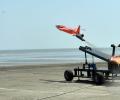
Developed by the Defence Research and Development Organisation, the High-speed Expendable Aerial Target (HEAT), ABHYAS, successfully flighttested from the Integrated Test Range in Chandipur, Odisha, October 22, 2021.

The Defence Research and Development Organisation successfully tested a new version of the Akash Missile --Akash Prime' -- from the Integrated Test Range in Chandipur, Odisha.

This firing is a significant step towards achieving self-reliance in niche missile technology. Navy said.

The test was carried out by DRDO against a high-speed unmanned aerial target which was successfully intercepted by the missile.

The vehicle can be used as an aerial target for evaluation of various missile systems.

On both the occasions, the missiles intercepted the simulated targets with pinpoint accuracy. The missiles were tested for minimum and maximum range.
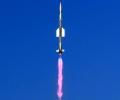
The quick reaction surface-to-air-missile missile developed by DRDO was test launched from the Integrated Test Range at Chandipur near here at about 3.08 pm from a vertical launcher against an electronic target at a very low altitude.
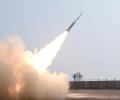
The Integrated Test Range of Defence Research and Development Organisation (DRDO) has taken various measures to protect its facilities at Chandipur and Abdul Kalam Island in Odisha, which are likely to be affected by cyclone 'Yaas', an official said.

The QRSAM system is unique in its ability to operate on the move, searching for and tracking enemy targets; and then fire on a short halt.
The Defence Research and Development Organisation on Friday successfully conducted a flight test of Solid Fuel Ducted Ramjet (SFDR) technology in Odisha, official sources said.
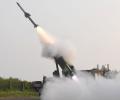
The successful test-firing of the QRSAM, having a range of around 30 km, paves the way for its commercial production

The Defence Research and Development Organisation on Friday successfully flight-tested a propulsion system that enables a missile to intercept aerial threats at very long range at supersonic speeds.

With new added technologies, including the control system, the missile was test-fired from the Integrated Test Range (ITR) launch pad-III at Chandipur around 10.45 am, said a source at the Defence Research and Development Organisation.

Describing the mission as a "major milestone" in the development of BrahMos, the sources said that the air version of the missile was test-fired from supersonic fighter aircraft Sukhoi 30 MK-I at 10.30 am.
