
The Pinaka rockets have a range of around 37 km.

The missile is capable of carrying 500/100 kg of warheads and is powered by liquid propulsion twin engines.

There was no casualty or damage to property, Superintendent of Police Niti Sekhar said.

The conversion facilitated range enhancement and improvement in Pinaka's accuracy.

The VL-SRSAM, which DRDO developed for the Indian Navy, was fired from a warship at a high-speed aerial target mimicking incoming enemy aircraft.
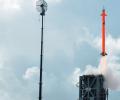
In a bid to galvanise its air defence capabilities, India on Tuesday successfully test fired a new, long range surface-to-air missile jointly developed with Israel from a defence base off Odisha coast.

A land-attack version of the missile was test-launched from Launch Pad-3 of the Integrated Test Range (ITR). An air force variant was fired from an IAF fighter jet over Bay of Bengal.
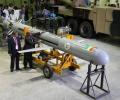
This was the fifth experimental test of the homegrown missile system.

The state-of-the-art advanced missile, a product of joint venture between India and Israel.

India on Saturday successfully test-fired indigenously developed ballistic missiles 'Prithvi-II' and 'Dhanush' from different locations off the Orissa coast, adding more firepower to the armed forces.

"Two flight trials were conducted at Integrated Test Range, Chandipur, to test the effectiveness of the guidance and control systems of the LGBs," a Defence Ministry release said in New Delhi.

This the second time that the missile has been test-fired in less than a month and is part of an effort to put in place a multi-layer missile defence system.

Like the Shourya and Prahar missiles, the Pralay is powered by conventional solid fuel, and its payload is designed to carry only a conventional warhead.

A salvo from a Pinaka battery brings down on the enemy more than seven tonnes of high explosive in just 44 seconds.
The trails were conducted without a helicopter in direct and top attack mode.
This was the 14th launch of the missile, which has a range of 290 km. It has also been tested from a naval destroyer in the past.
Lakshya was flown as a support system to gauge the precision control of the short range missile.

SAAW, an indigenously designed and developed 120 kg class smart weapon, has been developed by the Defence Research and Development Organisation.

Prithvi-2 is capable of carrying 500-1,000 kg of warheads and is powered by liquid propulsion twin engines, the sources said.

India's indigenously developed Pinaka rockets were on Thursday successfully test-fired thrice from a multi-barrel rocket launcher at an armament base in Chandipur-on-sea, about 15 km from Balasore in Odisha.

India on Friday successfully test-fired the new surface-to-air missile, developed jointly with Israel, with a strike range upto 70 km, from a defence base off Odisha coast, a day after two similar trials were conducted.

The condition of the youth, who had slapped West Bengal Chief Minister Mamata Banerjee's nephew Abhishek Banerjee at a rally on Sunday, was stated to be critical after he suffered multiple head injuries.

For the first time, India on Tuesday test-fired its indigenously developed medium range sub-sonic cruise missile 'Nirbhay' from the Integrated Test Range at Chandipur.
India successfully conducted the third developmental trial in four days of its indigenously developed beyond visual range air-to-air missile 'Astra' on Monday from the integrated test range at Chandipur, 15 km from Balasore in Odisha.

The missile positioned at launch pad-3 of the ITR swung in to action after getting signal from the radars to intercept a moving aerial target supported by an unmanned air vehicle (UAV) 'Banshee' over the Bay of Bengal, officials said.
Boosting its air defence shield and re-validating operational efficacy, India on Thursday test fired successfully its indigenously-developed surface-to-air 'Akash' missile from the Integrated Test Range at Chandipur, nearly 15 km from Balasore. "The user-specific trial, which formed part of the country's routine air defence exercises, was successful," said a Defence Research Development Organisation official associated with the Akash missile project.
Two days after its successful trial, India on Saturday again test-fired the indigenously developed surface-to-air Akash missile from the test range at Chandipur near Balasore. "The user specific trial, which formed part of the country's routine air defence exercises, was conducted from the ITR," said a Defence Research Development Organisation official associated with the Akash missile project.
"The sophisticated surface-to-surface missile was flight tested at around 1100 hours from a mobile launcher at ITR's launch complex-3 as part of an operational exercise," defence sources said.
India's indigenously developed, micro-light pilot-less target aircraft 'Lakshya-1' was successfully test flown from the Integrated Test Range at Chandipur in Odisha on Thursday.

India on Thursday test-fired its nuclear-capable Prithvi-II ballistic missile with a strike range of 350 km from a test range near Balasore as part of a user trial by the army.
India on Wednesday successfully test fired its indigenously developed surface-to-air 'Akash' missile of the Air Force version from the integrated test range at Chandipur near Balasore in Odisha, the fifth trial of the anti-aircraft system in the last fortnight.
India on Friday successfully test fired its two indigenously-developed surface-to-air 'Akash' missiles of Air Force version with a strike range of 25 km from the Integrated Test Range at Chandipur near Balasore in Odisha.

The double test-fire came after trials of the missile, with a range of 25 km and capable of carrying a warhead of 60 kg to neutralise aerial targets, on May 24 and 26.
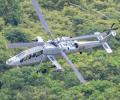
All of India welcomes the Light Combat Helicopter into the Armed Forces arsenal and wishes it a safe tenure and happy shooting. May it rule the skies and ensure that the enemies are given a fitting reply when the need arises.
India on Friday test-fired the Brahmos supersonic cruise missile with certain new systems from the Integrated Test Range at Chandipur off Odisha coast. The test comes two days after defence scientists conducted a similar trial from the same site. "The missile was test-fired from a ground mobile launcher from launch complex-3 of the ITR at about 10 am," a senior official said.
India on Wednesday successfully test fired Brahmos supersonic cruise missile as part of a user trial by the Army from the test range at Chandipur off Odisha coast.
"It was a direct hit and grand success," defence sources said after the test launch.
India on Monday successfully test-fired its nuclear capable 'Prithvi-II' ballistic missile, with a range of 350 kms, as pa rt of user trial by the armed forces from Chandipur off Orissa coast.
The surface-to-surface missile took off from an underground silo at the launch complex-3 in the ITR at about 1428 hours, defence sources said.
Two indigenously developed surface-to surface missiles were planned to be fired from a mobile launcher in salvo mode from the launch complex-3 of ITR as part of user trial by the Army, defence sources said.
