
Novak Djokovic returns at the China Open encouraged by his fitness, aiming to revive momentum against Nuno Borges at a venue where he remains unbeaten across 29 matches.

Coco Gauff exited the China Open after a draining few days, then withdrew from Wuhan as fatigue, online racial abuse and a gruelling season took their toll.

China emphasises proper handling of differences and a long-term perspective for bilateral ties ahead of President Xi Jinping's visit to India for the BRICS summit and talks with Prime Minister Narendra Modi. The visit aims to stabilise relations following the 2020 Ladakh standoff and strengthen BRICS cooperation.

National security advisor Ajit Doval arrived in Beijing on Monday for a two-day visit to take part in the Special Representatives talks on the India-China boundary question with his Chinese counterpart and Foreign Minister Wang Yi.

China has cancelled drone shows and suspended drone flights across several provinces following a small plane crash in Beijing that raised significant security concerns, especially near top leadership compounds. This move signals a tightening of low-altitude aviation regulations, impacting the burgeoning "low-altitude economy" and civilian drone use, with new laws classifying illegal drone use as a public security threat.
National Security Advisor Ajit Doval is in Beijing for the 25th round of Special Representatives talks on the India-China boundary issue with his Chinese counterpart Wang Yi. These crucial discussions precede Chinese President Xi Jinping's anticipated visit to India for the BRICS summit, offering a potential opportunity for a meeting with Prime Minister Narendra Modi. The talks aim to address the long-standing border dispute and recurring tensions, with both sides emphasising the importance of peace and tranquillity for bilateral relations amidst recent reports of aggressive Chinese posturing in Arunachal Pradesh.

Mirra Andreeva crushed Nikola Bartunkova 6-2, 6-2 to reach the China Open final, setting up a title showdown with home favourite and Olympic champion Zheng Qinwen.

Foreign Secretary Vikram Misri held extensive discussions with China's Vice Foreign Minister Hua Chunying and other senior officials in Beijing, reviewing bilateral relations, trade, cultural exchanges, and emphasising peace and tranquillity in border areas. His visit aims to advance the vision of both nations as development partners.

Mirra Andreeva survived Ekaterina Alexandrova in two tight tiebreaks to reach her first China Open semi-final, where rising Czech star Nikola Bartunkova awaits after crushing Karolina Muchova in Beijing showdown.

India has rejected China's objection to New Delhi's standardisation of names for 28 places and features in Ladakh, reiterating that Ladakh is an "integral and inalienable" part of India. China had strongly opposed the move, calling India's establishment of the Union Territory and the naming "illegal and void".

Star Indian long jumper Murali Sreeshankar underwent minor ligament reconstruction surgery on his right ankle in London following an injury sustained at the Asian Games last month. This marks his second major surgery, having previously missed the Paris Olympics due to a left knee injury in 2024. Sreeshankar is now targeting a return to competition next season, with his sights set on the 2027 World Championships and the LA 2028 Olympics.

A light sport aircraft crashed into Beijing's Citic Tower, the city's tallest skyscraper, prompting immediate evacuations. The incident occurred despite stringent airspace regulations in the Chinese capital, with details on casualties and the aircraft's origin still unclear.

Investigators have revealed that the pilot of a small plane that crashed into Beijing's tallest skyscraper, the CITIC Tower, suffered from long-term anxiety and had expressed suicidal thoughts in his diaries. The incident, which killed the pilot and injured 13 others, has raised significant security concerns in the highly sensitive Chinese capital, especially given strict airspace regulations.

India's Manav Thakkar and Manush Shah suffered a straight-game defeat against South Korea's Lim Jonghoon and Oh Junsung in the men's doubles semifinals at the WTT China Smash.

World number two Aryna Sabalenka exited the China Open in the third round after a straight-sets loss to Nikola Bartunkova, marking another setback in a challenging season where she has not won a trophy since the 'Sunshine Double' earlier this year.

Novak Djokovic began his China Open comeback with a 6-3, 7-6(2) win over Nuno Borges, extending his perfect Beijing record to 30 victories as he targets a seventh title.

A light sport aircraft crashed into Beijing's Citic Tower, the city's tallest skyscraper, causing an immediate evacuation and scattering debris. The incident, which occurred in the prominent business district, has raised concerns, with authorities yet to comment and the origin and circumstances of the crash remaining unknown. The aircraft was identified as a Sunward SA60L Aurora, and the crash highlights recent stringent regulations on recreational flying in Beijing's airspace.

Novak Djokovic staged a remarkable comeback to defeat top seed Alexander Zverev 4-6 6-4 6-4 in the China Open semi-finals, maintaining his undefeated streak at the tournament. Despite Zverev's strong start, Djokovic's resilience and clutch play secured his spot in the final, moving him closer to a seventh China Open title and his first trophy of the year.
Investigators have revealed that the pilot of a small plane that crashed into Beijing's tallest skyscraper, the CITIC Tower, suffered from long-term anxiety and had expressed suicidal thoughts in his diaries. The incident, which killed the pilot and injured 13 others, has raised significant security concerns in the highly sensitive Chinese capital, especially given strict airspace regulations.

China has voiced strong opposition to India's recent decision to standardise names for 28 strategic locations and geographical features in Ladakh.

Olympic champion Zheng Qinwen defeated French Open winner Mirra Andreeva 7-5 6-4 on Sunday to become the first Chinese player to win the China Open. This victory marks Zheng's first WTA 1000 title and her first trophy of the year, following a recovery from an elbow injury.

Hubert Hurkacz secured his first-ever victory over Novak Djokovic, eliminating the four-time champion from the Shanghai Masters with a dominant 6-4, 6-3 win. Meanwhile, Alexander Zverev advanced, continuing his pursuit of the year-end world number one ranking.

Russian tennis player Daniil Medvedev was disqualified from his China Open semi-final match against Novak Djokovic after accidentally hitting a spectator with a ball. Djokovic, who was leading at the time, advanced to the final, extending his unbeaten record at the tournament. Another semi-final also saw a retirement due to injury.

Donald Trump has ruled out using nuclear weapons or ground troops against Iran, despite the US military developing strike options including the "mother of all bombs" (MOAB) for Iranian energy and nuclear facilities. Trump clarified the MOAB is not nuclear and expressed confidence in non-nuclear options. He also discussed nuclear disarmament talks with Russia and China and his determination to prevent Iran from acquiring nuclear weapons, even as questions arise about MOAB's effectiveness against deeply buried targets.

World number one Elena Rybakina has withdrawn from the upcoming Wuhan Open due to a foot injury, following a recent defeat at the China Open. Despite ongoing struggles with a lower leg and foot problem, Rybakina had a successful season, securing her third Grand Slam title and qualifying for the WTA Finals. She plans to rest and recover before her next scheduled competition in Ningbo.

'Therefore, Beijing comes to wrong conclusions.'

China has strongly rejected a US bill that would impose tariffs on countries, including India, for purchasing Russian oil and gas. Beijing views the "Lindsey O Graham Sanctioning Russia and Iran Act 2026" as an act of "long-arm jurisdiction" and interference in its sovereign trade relations, asserting that its economic cooperation with other nations is based on equality and mutual benefit.

Glimpses from Donald Trump and Xi Jinping's ceremonial Beijing engagement capture diplomacy, symbolism and statecraft at historic Chinese landmarks.

Novak Djokovic won his seventh China Open title after Alex de Minaur retired injured, extending his unbeaten Beijing streak to 34 matches and securing a 21st consecutive season with a singles title.

Global indoor fitness race organisation Hyrox has changed its rules after women's World record holder Joanna Wietrzyk soiled herself during an event in Beijing but was allowed to continue and win the race, prompting an apology from co-founder Moritz Fuerste.

American tennis star Coco Gauff has revealed she received an "insane" amount of racial abuse on social media following her controversial win over Chinese teenager Sun Xinran at the China Open, where a replayed point sparked an online backlash.

An urban map of the largest cities in the world, by population, in the early 1700s looked almost empty by today's standards.

United States President Donald Trump boards Air Force One for his return home following diplomatic engagements in Beijing.

Xi brought in asymmetrical power play by stating that India should have 'strategic cognition' and 'strategic judgement made on the basis of the stage of development the two countries are at'. This is a very nuanced way of asserting China's coercive diplomatic posture and reflects Beijing's penchant to unleash border instability at will, restrict rare earth metal exports, exert pressure on India at global and regional orders, asserts China expert Srikanth Kondapalli.

Chinese President Xi Jinping is set to visit the United States from September 23 to 25 for summit talks with US President Donald Trump, with discussions expected to cover critical economic and trade issues, including AI, and the recently signed US sanctions law targeting countries buying Russian oil and gas.

Novak Djokovic, the 24-time Grand Slam champion, has announced his return to the China Open after an 11-year absence, seeking to regain form after a surprising first-round exit at the US Open.

Filipino tennis star Alex Eala's quest for an Asian Games gold medal and 2028 Los Angeles Olympics qualification was thwarted by China's Wang Xiyu, who rallied to a 3-6, 6-3, 6-2 victory, consigning Eala to a second singles bronze.
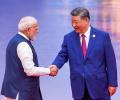
Ahead of Xi Jinping's visit, National Security Advisor Ajit Doval and Chinese Foreign Minister Wang Yi held extensive talks in Beijing on August 25 on the boundary issue and reached an eight-point consensus.

Members of the Tibetan community in exile held a symbolic protest march in Delhi's Majnu Ka Tila ahead of Chinese President Xi Jinping's visit to India for the BRICS 2026 Summit, voicing opposition to Beijing's policies in Tibet.

'It really sucks': Filipino fans were left frustrated by rain as Alex Eala's Asian Games opener was moved indoors in Nagoya.
