
Sukanya Verma quizzes you to find out just how much you know about the movies.

Maharashtra Deputy Chief Minister Ajit Pawar and four others were killed after their aircraft crashed in Baramati on January 28, 2026. Here are 11 other prominent Indians who died in air crashes.

Former India cricketer Jacob Martin rammed into three parked cars while driving his luxury SUV allegedly under the influence of alcohol in Vadodara.

With the Union Budget 2026, India's 74th, fast approaching, all eyes are once again on New Delhi's North Block as Finance Minister Nirmala Sitharaman is preparing to table it on February 1, 2026, marking her ninth Budget presentation in a row.

The first 25 years in this century has seen some amazing films and blockbusters in Hollywood. Girish Wankhede lists the top-grossing Hollywood movies from 2001 to 2025, focusing on the key qualities that resonated with Indian audiences and contributed to its appeal.

Border 2 saw the best opening ever for Bollywood since last year's Chhaava.

rediffGURU Vipul Bhavsar answers readers' personal income tax queries.

'The body is holding together, and it's a great group to be a part of.'

Elena Rybakina put on a brilliant performance to defeat favourite Aryna Sabalenka 64, 46, 64 and lift her first Australian Open trophy.

A car from Akshay Kumar's security entourage was hit by an autorickshaw after the three-wheeler was struck by another vehicle in Juhu area, northwest Mumbai, leaving one person injured, police said.

Former Haryana Police chief Shatrujeet Singh Kapoor has been appointed as the director general of the Indo-Tibetan Border Police (ITBP). He succeeds Praveen Kumar, who has been named the new head of the Border Security Force (BSF).

Given Modi's track record from the time he became Gujarat chief minister in October 2001, it is highly improbable that Nabin will get opportunities to display his individual capacity. Even the team of organisational leaders that he will 'appoint' in a few weeks or months, will unlikely to be his choice, predicts Nilanjan Mukhopadhyay.

Mark Tully, the renowned journalist, author, and Indophile, has passed away at the age of 90. He spent a lifetime in India as a journalist, mingling with its people and telling their stories.

Sixteen Maoists, including top leader Anal, were killed in a gunfight with security forces in Jharkhand's West Singhbhum district on Thursday, Union home minister Amit Shah said.

Homebound missed an Oscar nomination; Sinners broke the record by getting the most nominations ever, at 16 counts.

Shrikant Pangarkar is in the fray from ward 13. His opponents are candidates from the BJP and several other parties, though the Eknath Shinde-led Shiv Sena has not fielded a contestant.

This is also the time when South Indian films started doing well, commercially and critically, on a Pan-India scale.

Suresh Kalmadi brought several top-class events to India including the 2003 Afro Asian Games, the 2008 Commonwealth Youth Games, the 2010 Commonwealth Games.

The BSE Sensex has been one of the top-performing areas of investment in the past 40 years, consistently delivering double-digit returns in rupee terms, beating assets such as global equities, precious metals, and fixed income.
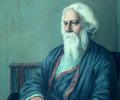
Who have been India's Laureates, winners from India or of Indian-origin?

Telangana Intelligence sources reveal that Sajid Akram, a suspect in the Bondi Beach mass shooting and native of Hyderabad, renewed his Indian passport in 2022. Investigations reveal his family's shock and previous visits to India.

Nestled in the mountain ranges of Kabirdham district, Bhoramdeo has an ancient temple dedicated to Lord Shiva, about 125 km from Raipur.

Newly declassified documents from the United States National Security Archive have revealed that Pakistan's nuclear proliferation was a significant concern for both the US and Russia, with leaders expressing 'nervous' fears about the country's atomic stability.

Trade analyst Girish Wankhede puts together a curated list of the 25 biggest hits in the first 25 years of the century.

Well-known inmates of the notorious Metropolitan Detention Center, Brooklyn, New York.
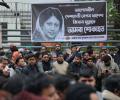
Former Indian envoys reflect on the life and legacy of Bangladesh's former Prime Minister Khaleda Zia, highlighting her role in restoring democracy and the complex relationship between India and Bangladesh during her tenures.
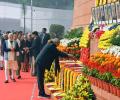
Vice President C P Radhakrishnan and Prime Minister Narendra Modi led Parliamentarians in paying floral tributes to those who died fending off terrorists who attacked the Parliament House in 2001 on the 24th anniversary of the attack.

rediffGURU Vipul Bhavsar answers readers' personal income tax queries.
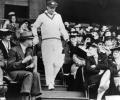
Bradman wore that cap during the 1947/48 series against the first Indian team to tour Australia. The series saw Bradman amassing 715 runs from six innings.

Khaleda Zia, the former Prime Minister of Bangladesh and a dominant figure in the country's politics, has died at the age of 80 after a prolonged illness. Her career spanned decades and included periods of both power and controversy.
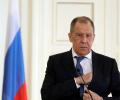
Russian Foreign Minister Sergei Lavrov stated that Russia does not intend to attack Europe, but any attack on Russia would face a devastating response. He also accused the EU's 'war party' of hindering Ukraine peace efforts and pledged support for China on Taiwan.
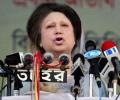
Khaleda Zia, Bangladesh's former first female prime minister and chairperson of the Bangladesh Nationalist Party, has died at the age of 80 after a prolonged illness.

Net direct tax collection grew 8 per cent to over Rs 17.04 lakh crore this fiscal till December 17 on slower refunds and higher advance taxes from corporates, the income tax department data showed on Friday.

Where Dhurandhar leaned into aggressive bloodlust through its acerbic storytelling, Ikkis moves in the opposite direction, asking us to see people beyond uniforms, slogans, or sides, observes Mayur Sanap.
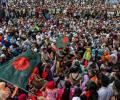
A key leader of Bangladesh's National Citizen Party (NCP), Mahfuz Alam, has distanced himself from the party's alliance with Jamaat-e-Islami, citing ideological differences and concerns over Jamaat's controversial history.

'The emphasis is on execution, not identification.'
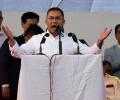
Bangladesh Nationalist Party (BNP) acting chairman Tarique Rahman on Thursday urged people to maintain peace as he presented a vision of an inclusive society, saying the country belongs to people of all faiths, including Muslims, Hindus, Buddhists and Christians.

In the mid-1990s, when the shares of listed companies first began to be held in electronic form, they accounted for less than 1 per cent of the stocks bought and sold on the stock exchanges. This climbed to 99.5 per cent by 2001.
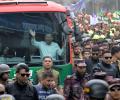
Bangladesh Nationalist Party (BNP) acting chairman Tarique Rahman has returned to Dhaka after 17 years in self-exile in the UK, amid political instability following the killing of a youth leader. His return is significant as BNP emerges as a forerunner in the changed political landscape.

Ask rediffGURU and tax expert Mihir Tanna your income tax-related questions.
 © 2026 Rediff.com - Investor Information - Advertise with us - Disclaimer - Privacy Policy - Sitemap - Feedback - About us - Terms of use - Grievances