
Russian Foreign Minister Sergey Lavrov has publicly supported India's bid for a permanent seat on the United Nations Security Council. He stated that any reform of the UNSC should not grant additional seats to Western countries like Germany and Japan, citing their "militarism and revanchism." Instead, Russia advocates for increased representation from Asia, Africa, and Latin America, specifically backing India and Brazil, while also emphasizing the need to address African interests.

Former US National Security Adviser John Bolton has stated that China is not prepared to back India's bid for a permanent seat on the UN Security Council. He highlighted that any expansion of permanent membership would require a UN Charter amendment, which China could veto. Bolton also discussed the broader institutional challenges facing the UN and suggested that regime change in Iran is crucial for long-term stability in West Asia, linking Houthi attacks to Iran's "ring of fire" strategy.

China has strongly rejected a US bill that would impose tariffs on countries, including India, for purchasing Russian oil and gas. Beijing views the "Lindsey O Graham Sanctioning Russia and Iran Act 2026" as an act of "long-arm jurisdiction" and interference in its sovereign trade relations, asserting that its economic cooperation with other nations is based on equality and mutual benefit.

Anthropic has formally warned investors that its technology may pose "existential risks to humanity" in a long-awaited initial public offering prospectus circulated with a small group of partners in recent days.
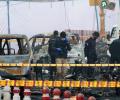
A new UN Security Council report has 'officially attributed' the November 2025 Red Fort terror attack in New Delhi, which killed about 15 people, to Al-Qaeda in the Indian Subcontinent (AQIS). The report highlights AQIS's evolution into a regional terrorist entity and its efforts to establish networks.

The US rejected Iran's proposal to reopen the Strait of Hormuz, citing Tehran's demands for sanctions relief and access to frozen assets before nuclear program negotiations. US Ambassador Mike Waltz called the offer a "cynical attempt," while Iranian Foreign Minister Seyyed Abbas Araghchi disputed Waltz's account and reiterated Iran's readiness for both diplomacy and renewed hostilities. President Trump expressed confidence in winning the conflict soon and keeping all options, including military strikes, on the table, with denying Iran a nuclear weapon as the primary objective.

Chinese President Xi Jinping is set to visit the United States from September 23 to 25 for summit talks with US President Donald Trump, with discussions expected to cover critical economic and trade issues, including AI, and the recently signed US sanctions law targeting countries buying Russian oil and gas.
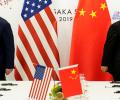
Top US and Chinese officials, including Vice Premier He Lifeng and Treasury Secretary Scott Bessent, held "candid, in-depth and constructive" talks in New York on economic and trade issues, with a specific focus on artificial intelligence. These discussions precede Chinese President Xi Jinping's anticipated visit to Washington and occur amidst new US sanctions targeting countries purchasing Russian oil and gas, and the US unveiling an "AI Force."

India has dismissed Pakistan's recent announcement of a seven million rupees bounty on Jaish-e-Mohammed chief Masood Azhar as a "gimmick," demanding concrete action against terrorism. India highlighted Pakistan's history of similar "phoney announcements" and its alleged sheltering of Azhar, while Pakistan faces international pressure from the FATF to crack down on terror financing.

Prime Minister Narendra Modi, addressing the BRICS summit, called for a fundamental shift in global governance, advocating for the replacement of the current 'pyramid of privilege' with a 'platform of partnership' where the Global South becomes a 'rule shaper' rather than a 'rule follower'.

Xi's bilateral meeting with Modi was substantial and readouts from both sides gave indications of rapprochement, if not a reset of bilateral relations between India and China, notes Ambassador T P Sreenivasan.

India and China are in what experts call 'a cooperation-versus-competition situation'.
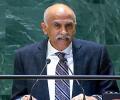
India has strongly condemned an attack on UN peacekeepers in Lebanon that resulted in the death of a Serbian Blue Helmet and injuries to two others. The nation has called for an immediate and thorough investigation to ensure accountability for the perpetrators. This incident follows a series of attacks on UNIFIL personnel amidst escalating hostilities in the region, prompting global calls for peacekeeper safety.

India has urged the United Nations to update its sanctions regime against Afghanistan, arguing that it must reflect the changed political reality and focus on incentivising positive actions rather than solely relying on punitive measures. India highlighted its ongoing humanitarian and development support for the Afghan people.

Prime Minister Narendra Modi addressed the Indonesian parliament, emphasising India's commitment to development over expansionism and advocating for a free, open, and inclusive Indo-Pacific. He highlighted the strong historical ties between India and Indonesia, calling for enhanced cooperation in various sectors, including defence, technology, and counter-terrorism, amidst growing concerns over regional security.

External Affairs Minister S Jaishankar has affirmed India's commitment to ensuring issues like a free, open, and rule-based maritime order, seafarer safety, and countering terror financing receive due attention at the UN Security Council during its 2028-29 term.

The failure of the State when it directly affects our lives, through a corrupt exam system, has produced this current anger, points out Aakar Patel.

India has condemned the killing of a French soldier serving with the UN peacekeeping mission in South Lebanon and called on all parties to ensure the safety of peacekeepers.

India has expressed firm opposition to attacks on merchant shipping amidst the ongoing Iran conflict, revealing that several Indian nationals have died or are missing due to these incidents. The nation also called for restraint, de-escalation, and prioritising civilian safety in the region.
India has strongly criticised Pakistan at a UN Security Council meeting, asserting its right to defend itself against cross-border terrorism and warning of consequences for Pakistan's support of such activities.

'Actual implementation of the 14-point agreement is proving hard to achieve let alone striking and sustaining a long-term treaty or deal.'

US Secretary of State Marco Rubio met with Pakistan's Foreign Minister Ishaq Dar amid American demand that countries mediating the peace talks with Iran join the Abraham Accords and establish diplomatic and economic ties with Israel.

The UN Security Council will vote on a Bahrain-proposed resolution regarding the Strait of Hormuz, aiming to ensure freedom of navigation amid concerns and opposition from some members.
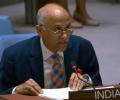
India has strongly criticised Pakistan at the UN Security Council, highlighting civilian deaths and injuries in Afghanistan caused by cross-border violence by Pakistani military forces, accusing Pakistan of 'heinous acts' and 'systematic genocide'.

The United States and Iran have reached an agreement in principle to immediately and permanently halt all military operations, lift sanctions, and work towards a comprehensive final agreement within 60 days, including a significant reconstruction package for Iran.
India has strongly criticised Pakistan at a UN Security Council meeting, asserting its right to defend itself against cross-border terrorism and warning of consequences for Pakistan's support of such activities.

India has expressed strong concerns over attacks on commercial ships in the Strait of Hormuz, citing its importance to India's energy and economic security. Ambassador Yojna Patel highlighted the need to respect international law and ensure the safety of seafarers, while also addressing broader Middle East issues including the situation in Gaza and Lebanon.

Russian President Vladimir Putin and Chinese President Xi Jinping have reaffirmed their commitment to dismantling global hegemonism and building a 'multipolar world' during high-level talks in Beijing.

India has strongly condemned Pakistan's military airstrikes against Afghanistan, citing significant civilian casualties, and criticised its 'trade and transit terrorism' against Afghan traders, calling these actions blatant violations of international law and UN norms.
As tensions in the Middle East approach a critical juncture, reports have surfaced regarding a draft memorandum of understanding between the United States and Iran aimed at de-escalating the ongoing conflict, Iranian state media reported on Wednesday.
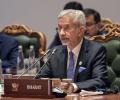
India has expressed serious concerns about the West Asia crisis and its potential impact on energy supplies and maritime stability, urging BRICS nations to find practical solutions to geopolitical challenges and unilateral sanctions.

Tensions escalate at the UN Security Council as the US and Israel defend their military actions against Iran, while Iran condemns the strikes as war crimes, raising fears of a wider Middle East conflict.

UN Secretary-General Antonio Guterres has expressed deep concern over US President Donald Trump's warning to Iran and appealed for the re-establishment of freedom of navigation in the Strait of Hormuz.

The US-China rapprochement, however tenuous, is not without implications for India. Both China and Pakistan have become closer to the US, notes Ambassador T P Sreenivasan.

The BRICS foreign ministers' meeting in New Delhi concluded without a joint statement due to disagreements over the West Asia conflict, with Iran blaming the UAE for the lack of consensus. India, as the host, issued a chair's statement highlighting the differing views.
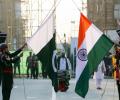
The UN Security Council will hold closed consultations on Monday on the situation between India and Pakistan after Islamabad sought an emergency meeting on the issue. Pakistan, which currently sits as a non-permanent member of the council, requested the meeting in light of rising tensions between the two countries following a terror attack in India. The meeting comes after India's foreign minister spoke with all council members except China and Pakistan, emphasizing the need to bring perpetrators of the attack to justice. The Pakistani envoy has argued that the situation in Jammu and Kashmir poses a threat to regional and international peace and security, justifying the need for a council discussion.

India has expressed strong concern over the targeting of commercial shipping in the Strait of Hormuz during the West Asia conflict, urging for the restoration of unimpeded navigation and global commerce.

Iran on Thursday spelled out three conditions to end the war with Israel and the United States, which entered its thirteenth day today. Taking to X, Iran's President Masoud Pezeshkian said he reaffirmed the country's commitment to peace during talks with leaders of Russia and Pakistan.
India has condemned recent attacks on UN peacekeepers in Lebanon, following the death of an Indonesian peacekeeper. India urged all parties to ensure the safety and security of the Blue Helmets and called for accountability for crimes against peacekeepers.

The UN Security Council, with India's support, has adopted a resolution condemning Iran's attacks on Gulf Cooperation Council countries and Jordan, demanding an immediate cessation of hostilities and denouncing threats to the Strait of Hormuz.
