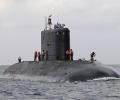
The Bay of Bengal base will house nuclear submarines and aircraft carrier

Once again an Indian prime minister has realised that with Pakistan and China, things will not move as he wishes.

'When Modi was having his maiden meeting with Donald Trump, China is up to its old tricks again, by causing a distraction on the Doklam plateau,' says B S Raghavan, the distinguished civil servant.

'Does it mean that we are witnessing the end of an era?' 'Probably not, but the post-Trump trade war has certainly brought a lot of instability in China,' notes Claude Arpi.
'Modi and Abe are working seriously for India-Japan bonhomie to grow stronger.' 'It is a win-win situation for both countries and the future look promising,' says Rajaram Panda, the Indian Council for Cultural Relations India Chair Visiting Professor at Reitaku University, Japan.

UAVs are an intrinsic part of today's technology driven battlefield. Indians don't seem to be taking the challenge with the degree of urgency that is required, says Brigadier S K Chatterji (retd).

'The Modi government will do well to thrash out a national consensus before taking the leap and put itself in America's pouch,' says Rajeev Sharma.

'The American fear of the Chinese military is overblown. The countries that should be concerned are China's neighbours,' Jeffrey Wasserstrom tells Rahul Jacob.

Chinese President Xi Jinping has announced that the 2.3 million strong People's Liberation Army, the world's largest, will be trimmed by three lakh.

The Chinese leader will display his grip on the Communist party and chart his plans for his country's future.

How will the Modi Sarkar's likely return affect other nations?


The PM's vision of a lean, agile, mobile and technology driven force requires more than 1.7 percent of GDP that it now gets.
Even as Barack Obama administration officials believe that the India-US relationship has now "emerged at the world stage" and is no longer a "restricted to narrow" South Asia or subcontinental set of issues, they also concede that America's security partnership with Pakistan over the years still poses challenge to India-US relationship.
China continues to hold out on fingering Pakistan as the 'mothership of terror,' declaring Masood Azhar a terrorist at the UN, and India's membership of the NSG, says China expert Srikanth Kondapalli.

'Chinese leaders rarely receive their foreign guests in cities other than Beijing. Such respect for India!' 'Does it mean that Modi could replicate "the warmth and unconventional way" by sending Indian troops into Tibet, as Xi did in Chumur (Ladakh) when he arrived in India? Of course, Indians are far too polite to do so,' says Claude Arpi.
Against the backdrop of growing Chinese assertion in the Asia-Pacific region, India on Thursday said it supports the "freedom of navigation" in international waters noting that any disputes or differences in the region must be resolved diplomatically.

Australian Prime Minister Tony Abbott on Monday said it was now "highly unlikely" that any debris of the missing Malaysia Airlines plane will be found on the ocean surface, as he announced a more intensive underwater search

'There is no Buddha or Gandhi among countries, existing for the service of others; they all exist for the good of themselves.' 'For each country, its own interests should be paramount, and it is futile and churlish to expect China to be an exception to this rule,' says B S Raghavan, the distinguished civil servant and long-time China-watcher.

Rajaram Panda explains why the US president needs to restrain himself and build a relationship with China to put any credible pressure on North Korea.
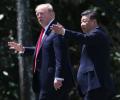
Trump aides, who participated in the two-day talks held at the US President's Mar-a-Lago resort in Florida, described the meetings as productive and said the two leaders exhibited "positive" chemistry.

'While visits and personal meetings are useful, changes of strategic significance have occurred recently, with Beijing trying to take the lead which Modi must take note of.'

ADB has often expressed its interest in promoting sub-regional integration in South Asia and perhaps could be involved as a facilitator.
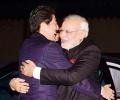
'The regional context and the personal ties between Modi and Japanese Prime Minister Shinzo Abe to a large extent contributed to this dawn of a new era in bilateral relations,' says Srikanth Kondapalli.

'When sensitive territory goes into the hands of your enemy. he becomes more powerful in military terms.' 'Assuming the Chinese take over the Doklam Plateau they will not stop at that.' 'They will keep ingressing, and it will be easier for them to further expand their territory.' 'I feel the Chinese will vacate that area in two months after it begins to snow.'

'His secretary of defence nominee, General James Mattis, says he expects Pakistan to take action against terrorists operating from its soil.' 'Any pressure the US can bring on the Pakistani regime terror-wise would pay dividends for India.'
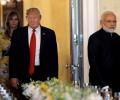
'China was the elephant in the Oval Office and Trump would have sensed that Modi's foreign policy architecture has become disoriented sans the US' pivot to Asia,' points out Ambassador M K Bhadrakumar.

''There is the perennial worry in the Indian mind regarding the US 'hyphenating' India and Pakistan. Frankly, this is a completely nonsensical hypothesis. The US has always 'hyphenated' India and Pakistan and it couldn't have been otherwise,' says Ambassador M K Bhadrakumar.
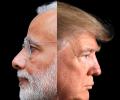
Here's why Rajeev Srinivasan believes there will be nothing particularly positive about the prime minister's US visit.
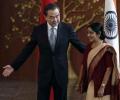
The entire gamut of bilateral ties including the contentious boundary issue was discussed during a "cordial and substantive" engagement between the foreign ministers of India and China in New Delhi who met within two weeks of installation of the Narendra Modi government.

The United States and China have agreed to expand military exchanges and exercises as part of efforts to build more stable bilateral ties amid tensions over cyber security.

President Pranab Mukherjee's recent visit to the Pacific Island nation is path-breaking, but much more needs to be done, says Dr Rahul Mishra.

The readouts by the Indian and Chinese sides on the meeting on Monday between External Affairs Minister Sushma Swaraj and her Chinese counterpart Wang Yi in Moscow bring out that divergences are crowding into the centrestage of their relationship, says Ambassador M K Bhadrakumar.

Boosting trade and simplifying visa regime, apart from security and defence cooperation, were among the key bilateral issues. The two leaders also discussed regional and international matters of mutual interest.

'Difficult issues should not be brushed under the carpet, but should be raised upfront, particularly by India. While engagement and dialogue are always welcome and desirable, there should be some tangible results. Mere signing of agreements, MoUs, joint declarations are not enough.'

Confronting a slowdown in growth, China says it will only increase its defence budget by 7.6% this year, against the anticipated rise of between 20% and 30%. 'It is difficult to explain the reduction in the Chinese defence budget,' says Claude Arpi. 'Is there a hidden budget? Possibly!'

'If India and China come together, 40 per cent of the world's people are going to be prosperous'

'By the time he came out after nearly five hours, he had a one-to-one conversation with the President, a delegation-level meeting, a reception, a dinner, a tour of the White House and a joint statement of a kind none of his predecessors ever had,' says Ambassador T P Sreenivasan.

Tillerson said China's behaviour and action is "posing a challenge to the rules-based international order".

"India will succeed if it's not splintered on religious lines."
 © 2026 Rediff.com - Investor Information - Advertise with us - Disclaimer - Privacy Policy - Sitemap - Feedback - About us - Terms of use - Grievances