
The search for missing Malaysia Airlines flight MH370 has come to an end with passengers' families being informed that the effort to find the plane has been suspended.

In the case of India, there are no specific references in China's white paper. However, there are several takeaways for India, says Srikanth Kondapalli.

'Ensuring through diplomatic means and in conjunction with strategic partners that India will not be required to fight a simultaneous two-front war with China and Pakistan.' Brigadier Gurmeet Kanwal (retd) lists what India must have in its national security strategy.

The search for the crashed Malaysian jet on Friday dramatically shifted to a new area 1,100 km further northeast in the Indian Ocean after authorities received "the most credible lead" of radar data suggesting the plane flew faster and ran out of fuel more quickly than estimated.

Kuala Lumpur's delay in roping in India to help track the missing aircraft is an indicator that New Delhi must redouble its diplomacy and capacity demonstration in East Asia, feels Nitin Pai

'Europe can be discussed on a golf course...' 'North Korea? What do I care what the man with the bad haircut does?'

'Extending the range of the DF-21D could challenge Indian aircraft carriers if the missiles are launched from southwest China. Also, if Pakistan acquires these systems, these missiles could directly challenge India's aircraft carriers.'

'A bit of marketing, a bit of positioning, and a lot of strategic thinking is required, and all this should be in aid of India's strategic intent: Becoming the third pole in a global G3 and aiming for Numero Uno,' says Rajeev Srinivasan.

The 2 countries signed 15 agreements including one on defence cooperation after Prime Minister Narendra Modi held 'productive discussions' with President Joko Widodo.

It seems China is ready to cooperate with India in the central Asian region through the SCO framework, the reasons for which are manifold, says Sana Hashmi.

The US wants to split Sino-India ties, says the Chinese media.

India has some ability to influence what the world order will look like, but it needs to make structural changes to the ministries of external affairs and commerce, and evolve formal coordination mechanisms with the ministries of finance and home, says Nitin Pai

One thing Beijing must understand is that India is not obsessed with being a threat to China but only wants a rightful place for itself in the world, says Sanjeev Nayyar.

The 'Missing link in India's Act East Policy', as India's former foreign secretary Shyam Saran calls it, needs to be filled sooner rather than later, says Dr Rahul Mishra.
Seeking to boost the strategic ties, India and the US finalised the text of the Logistics Exchange Memorandum of Agreement.

'How can a State, which claims to be a responsible power, unilaterally grab a "disputed" area to build a road on it?' asks Claude Arpi.

Stating that India is new bright spot of hope and opportunity for the world, the prime minister said India among other things is igniting the engines of its manufacturing sector and making its farms more productive and more resilient.

There's still little indication of forward movement in Indo-US defence relations.

'China might soon have to seriously consider whether it prefers an Indo-US hyphenation to a Sino-Indian one.'

'This is the first time the US has formally recognised the threat India faces from terrorist organisations based in Pakistan.'
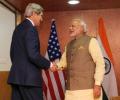
Elaborating on America and India's scope of engagement, Kerry said he has seen first-hand the transformation in Indo-US relationship as well as the ups and downs in the relationship. Kerry says the world's oldest and largest democracy were "finally beginning to captalise on our connections to each other." Sheela Bhatt/Rediff.com reports after the media interaction with the US secretary of state.

'This is the first time that the Americans have agreed to refer to "cross-border terrorist attacks" in a joint statement.' 'No wonder Pakistan has called the joint statement "singularly unhelpful" and has blasted it, and its all-weather friend China has applauded Pakistan's frontline role in combating terrorism,' points out former foreign secretary Ambassador Kanwal Sibal.
'Both India and Pakistan are now, for the first time in history, very closely allied and connected with the US -- economically and politically.'
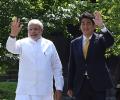
Although the India-Japan relationship has its own driving forces in terms of robust economic ties and shared values, China is the elephant in the room in the strategic parleys between the two countries, says Rup Narayan Das.
China wants a code of conduct for troops on the India-China border areas. While the Indian side has reacted cautiously, it is not clear what effective additional protocols that the current proposed code will bring forth to usher stability in the border areas, says Srikanth Kondapalli.
In all the noise surrounding the Dok La confrontation, Claude Arpi focuses on a crucial issue that has hardly been covered -- the construction of roads for the armed forces and the local population to reach the most remote border posts.

Dr Manmohan Singh would be faced with very few choices in Beijing given the Chinese conceived notions of the world today and India's low place in their calculus, says Srikanth Kondapalli.

'Modi and Obama both had agendas that went beyond the nuclear deal. The threat from the chilly Himalayas had to be tackled in the warm waters of the Indian Ocean.'

'The Modi-Xi and Modi-Obama meetings, with an interval of just 12 days, are juxtaposed superbly at a crucial point in the prime minister's life. Can Modi carve out a win-win situation with the superpower and the emerging superpower at the same time?'

Continued uncertainty or confrontation in the Asia-Pacific is clearly in no one's interest as it will affect major powers' attempts to restructure their economies and revive growth. Conflict would roll back the gains to each of our countries of 40 years of stability and peace, says Shivshankar Menon.

Will China's new military reforms endanger Xi Jinping's rule?

As Japan beefs up its defences against China, both New Delhi and Tokyo seem to have decided to re-energise their relationship to ensure a strategic balance in Asia. It is a clear signal that they may be ready to work together in containing if not confronting China, says Nitin Gokhale.
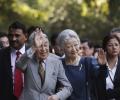
In the media frenzy over inconsequential issues, the visit of the Emperor of Japan to India has been pushed to the margins of public discourse. Colonel (retd) Anil Athale explains the great historical and political significance of the visit.

'Obama probably thinks, "He is quite a guy!" Americans on Capitol Hill think, "He has guts. He is a big player".' An Indian official explains the importance of the Modi visit to Sheela Bhatt/Rediff.com

'China made it evident that neither the swing-ride at Ahmedabad nor the red carpet at New Delhi worked, by timing its muscle-flexing in Ladakh to coincide with Xi's visit.'

President Xi Jinping's visit may put relations between India and China on a new trajectory

The prime minister's outreach to Japan is a recognition of the civilisational potential that the two nations hold and can wield in evolving an era of 'Asianism' in global politics, says Anirban Ganguly.

'We should hit Pakistan, continue to prepare for surgical strikes, continue to punish Pakistani posts in the proximity of the LoC and we should start adopting counter terrorist measures.' 'That should be India's action without escalating it to a full-fledged war.'

After Pyongyang tests a missile potentially capable of reaching the US, Dr Rajaram Panda explores the realistic -- and peaceful -- options before Donald Trump and the international community at large.

'The question remains: Was the Obama visit truly a success? Only the future will tell us if the "breakthrough" in the nuclear liability issue will concretise into electricity.' 'As importantly, it will be interesting to watch how India's relations with China will evolve in the months to come.'
 © 2026 Rediff.com - Investor Information - Advertise with us - Disclaimer - Privacy Policy - Sitemap - Feedback - About us - Terms of use - Grievances