
Delhi Police have arrested Raju Mukhiya, the alleged kingpin of a gang involved in house burglaries across multiple states. The gang used domestic workers to gain access to affluent homes and steal valuables.

Delhi Police have dismantled a honey-trap and extortion racket where gang members impersonated police officers to extort money from victims met through dating apps.
Jammu and Kashmir police have attached immovable property belonging to a Pakistan-based terror handler in the Manjakote area of Rajouri district.
'We won not (only) because we were able to carry out long-range precision strikes.' 'That is, of course, one of the reasons but we had better situational awareness about what's happening than Pakistan.'

The Jammu and Kashmir government reports that over 3,000 schools have experienced low or zero enrolment since 2022, prompting school closures and mergers. The report details the financial implications and district-wise breakdown of the affected schools.
Delhi Police have arrested three long-absconding proclaimed offenders, including two wanted under the POCSO Act and one in an attempted murder case, following a multi-state operation across Bihar and Jharkhand.
The Jammu and Kashmir government has achieved significant progress in digitising revenue records, reaching 93.39 per cent completion with over 64 lakh records approved across the Union Territory.
Police in Jammu and Kashmir have arrested three alleged drug peddlers in separate operations, including one who had been evading arrest for over two years. The arrests were made in Udhampur and Rajouri districts, with heroin and poppy straw recovered.
Delhi Police arrested 482 alleged gangsters and associates, including nine operatives linked to Pakistan-based gangster Shahzad Bhatti, during a 48-hour pan-Delhi operation.
Jammu and Kashmir police arrested eleven drug peddlers and seized heroin in separate operations across Udhampur, Poonch, Doda, and Kathua districts.

A 32-year-old Nigerian national died after being apprehended by Delhi Police during an operation. An investigation is underway to determine the circumstances surrounding his death.

The cancellation of NEET-UG 2026 due to alleged paper leaks has led to widespread outrage among aspirants, who are questioning the competence of the National Testing Agency (NTA) and demanding that AIIMS-Delhi conduct the medical entrance exam.
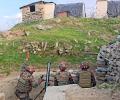
Army troops opened fire after noticing suspicious movement in a forward area near the Line of Control (LoC) in Rajouri district, while security forces conducted searches at more than a dozen places in Poonch, Samba, and Kathua districts of Jammu and Kashmir on Tuesday, officials said.

The Army paid a solemn tribute to Fazal, who died on Thursday after a brief illness. They remembered him as a "valiant son of the soil" who stood shoulder to shoulder with troops during Operation Sarp Vinash, which successfully dismantled terrorists' operational hub in Hill Kaka.
An armed guard of Qatal was also killed in the attack that took place on Saturday night.
Over 200 individuals in Rajouri, Jammu and Kashmir, have been quarantined after 17 people, including 13 children, died from a mysterious illness. The deaths have sparked concerns about the spread of the illness, and a medical emergency has been demanded by local officials. A central team is investigating the cause of the deaths, with over 230 samples sent for testing. Officials have identified a common factor among the deceased: brain involvement and damage to the nervous system. Three patients have been airlifted to a hospital in Jammu, and one patient has been airlifted to PGI Chandigarh for further treatment.

Many places across northern states including Delhi recorded above-normal temperatures crossing 40 degrees Celsius, while the India Meteorological Department warned of heatwave conditions in parts of Uttar Pradesh in the coming days. Jammu and Kashmir saw a dip in temperatures with fresh snowfall in the higher reaches and rainfall in the plains.
Security forces reported suspected drone activity in forward areas along the International Border (IB) and Line of Control (LoC) in Samba, Rajouri, and Poonch districts of Jammu and Kashmir. A search operation has been launched.

The contingent marched on the tune of CRPF song 'desh ke hum hai rakshak' played by the force band on the Kartavya Path.
A 48-year-old man has been arrested for allegedly orchestrating a fake police arrest in west Delhi, leading to the kidnapping and robbery of two brothers who were relieved of Rs 40 lakh in cash and valuables.

A villager was killed and three others were injured in shelling by Pakistan in forward areas of Jammu and Kashmir's Poonch and Rajouri districts early Friday morning, prompting Army troops to retaliate. The shelling also caused significant damage to property, with many houses and hundreds of vehicles affected. The firing and shelling were directed at areas in Rajouri, Poonch, and Jammu districts, apart from Kashmir's Kupwara and Baramulla districts, overnight.
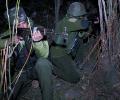
Indian Army troops fired upon and took down multiple suspected Pakistani drones that entered Indian territory from across the Line of Control (LoC) in the Rajouri district of Jammu and Kashmir. This is the second such incident in three days.

Protests erupted in Kashmir following the killing of Iran's Supreme Leader Ayatollah Ali Khamenei, leading to restrictions on movement and mobile internet speeds.

The Border Roads Organisation (BRO) rescued 60 people, including 40 soldiers, stranded in a snowbound area of Doda district, Jammu and Kashmir. The BRO also restored connectivity to strategic roads in the Rajouri district after heavy snowfall.

Protests erupted in Jammu and Kashmir following events in Iran, leading to heightened security measures and appeals for peace.

A remote village in Jammu and Kashmir's Rajouri district has been declared a containment zone after 17 people from three families died under suspicious circumstances. Prohibitory orders have been imposed on all public and private gatherings in the area. The village has been divided into three containment zones with varying levels of restrictions. The incident follows a visit by Chief Minister Omar Abdullah to the village on Tuesday.

The Municipal Corporation of Delhi (MCD) demolished a portion of a house belonging to the family of an accused in the Uttam Nagar killing, citing encroachment on a drain. The demolition is part of an ongoing anti-encroachment drive in the area.
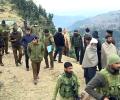
A mysterious illness has claimed 17 lives in Jammu and Kashmir's Rajouri district, with the latest victim being a young girl named Yasmeen Kousar. The deaths have sparked concern and an inter-ministerial team has been sent to investigate the cause. The patients experienced symptoms such as fever, pain, nausea, and loss of consciousness before dying within days of hospitalization. The J&K government has ruled out a communicable disease of bacterial or viral origin.

The farmers in Kashmir's border areas are now growing organic vegetables and that decision is changing their lives for the better.
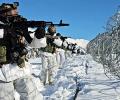
Pakistani forces allegedly violated the ceasefire along the Line of Control (LoC) in the Nowgam sector of Kupwara district, Jammu and Kashmir, on Friday, according to officials.

Heavy snowfall in the Kashmir Valley and Jammu region disrupted traffic and air services, leading to the closure of the Jammu-Srinagar highway and cancellation of flights. Rescue and road clearing operations are underway.

BCCI president Mithun Manhas announced plans to construct new cricket stadiums in Jammu and Kashmir to further develop cricket in the region after their maiden Ranji Trophy title win.

Pakistani drones were spotted hovering along the Indo-Pak border in the Poonch and Samba districts of Jammu and Kashmir, prompting security forces to activate their anti-drone measures. The drones were seen along the Line of Control (LoC) and the International Border.
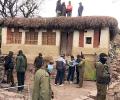
A high-level inter-ministerial team conducted a six-hour investigation in Badhaal village, Rajouri district, Jammu and Kashmir, to ascertain the causes of death of 17 members of three families under mysterious circumstances. The team, led by a director-rank officer in the Union Ministry of Home Affairs, collected samples and briefed by senior district, health and police officers. The team's visit follows the deaths of 16 people between December 7 and January 19. The investigation is ongoing, with authorities focusing on potential neurotoxins and a spring that tested positive for pesticides.

Simran Bala, a 26-year-old Assistant Commandant from a border village in Rajouri, Jammu and Kashmir, will lead an all-male CRPF contingent on Kartavya Path in New Delhi on Republic Day. Her achievement is a source of immense pride for her family and the entire district.
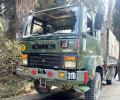
The troops returned fire and reinforcements were rushed to neutralise the terrorists, the officials said, adding that a search operation is underway in the area.
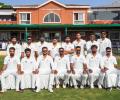
Pace spearhead Auqib Nabi was the standout performer for Jammu and Kashmir but the triumphant Ranji Trophy campaign was a team effort.
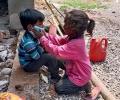
A series of deaths in a remote village in Rajouri district, Jammu and Kashmir, are not due to any disease, according to the Health Minister. Tests conducted by various institutions, including the ICMR, NCDC, and DRDE, have returned negative results. However, the minister has ordered an investigation into the deaths to determine the cause.

Army troops thwarted a terrorist attack on a security post and house of a village defence guard (VDG) in Jammu and Kashmir's Rajouri district early Monday morning, officials said.

A fresh exchange of fire took place on Thursday between terrorists and security personnel in Jammu and Kashmir's Rajouri district, where four Army personnel were killed and two others were injured in an encounter, officials said.
