
India has commissioned its new indigenously-built nuclear-powered ballistic missile submarine INS Aridaman into service, further strengthening the naval component of its nuclear triad. Defence Minister Rajnath Singh also highlighted the Indian Navy's role in securing maritime trade routes.

India is strengthening the naval component of its nuclear triad with Navy Chief Admiral Dinesh K Tripathi on Tuesday saying that the third indigenous nuclear-powered submarine 'Aridaman' will be commissioned soon and that his force is focusing on boosting its overall combat prowess.

China on Monday successfully test-fired a long-range strategic missile from one of its nuclear-powered submarines in the Pacific Ocean, drawing sharp reactions from Japan and Australia.

Experts' worries intensified after Pakistan commissioned its first Chinese-built Hangor-class submarine, PNS Hangor, last month.

Saran delivered the second annual Raja Ramanna lecture at NIAS on Wednesday night.
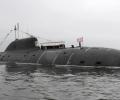
The second SSN that India is negotiating to lease from Russia will only replace the Chakra, when its 10-year lease expires, reports Ajai Shukla.
Russia has handed over a new nuclear powered submarine armed with torpedos and cruise missiles to India and the vessel has set sail for home with a mixed crew of Indian and Russian sailors. The Akula class nuclear attack submarine, which is on a ten-year lease to the Indian Navy, left its base on the Pacific coast earlier this week, bound for India, RIA Novosti and Interfax news agencies reported.

Gwadar is viewed as a critical pearl in China's maritime strategy as it would give a permanent logistical footprint near an important choke point - the Strait of Hormuz and the oil rich Persian Gulf, explains Commodore Venugopal Menon (retd).
British Navy is all set to launch its biggest-ever nuclear submarine that can fire guided-missiles to pulverise an enemy more than 1,600 km away.

India is increasingly focusing on long-range weapons capable of reaching targets across China.
India is considering a proposal to induct another nuclear submarine built in Russia and has plans of indigenously building two more Arihant Class underwater vessels to guard its maritime boundaries, Defence Minister A K Antony said.

'Torpedoes travel at more than 100 kilometres per hour, about 50-60 knots.' 'It must have been a matter of a few minutes before it detonated under the Iranian ship.' 'The Iranian ship would have probably got three, four minutes and wouldn't have known till they actually heard the whirr of the torpedo.'

With this India joins the select group of countries which have a nuclear triad -- capable of delivering nuclear weapons by aircraft, ballistic missiles and submarine launched missiles.
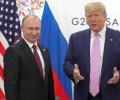
Russia announces its withdrawal from a self-imposed moratorium on deploying intermediate-range missiles, citing escalating tensions with the US and the repositioning of American nuclear submarines.
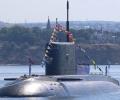
Russia has launched its latest nuclear submarine to be armed with a 'Poseidon' nuclear drone, also known as 'doomsday missile' capable of 'wiping out' coastal nations, according to media reports.

'We were in a heavily nuclearised environment. China had tested for Pakistan in the 1980s and helped their missile programme stay just one step behind us.'
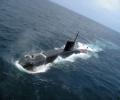
In what would be a major boost for the submarine building capability within the country, the first three nuclear attack submarines to be built indigenously would be having 95 per cent 'Made in India' content in them and it would further go up in the next three.
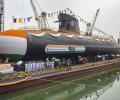
The status of the current submarine force level is alarming and we need to address the threat perceptions expeditiously. Critical decisions pertaining to national security cannot be delayed any further due to the rapidly changing maritime threat perceptions and growing strategic importance of the Indian Ocean region, asserts Commodore Venugopal Menon (retd).

Equipped with advanced weaponry, the HMS Anson is fitted with "Tomahawk Block IV land-attack missiles" with a range of 1,600 km and "Spearfish heavyweight torpedoes," providing formidable offensive capabilities.

A new report from the Stockholm International Peace Research Institute (SIPRI) indicates that India has expanded its nuclear arsenal and is developing long-range weapons capable of reaching targets across China, while also maintaining focus on its rivalry with Pakistan.

According to a report by France 24, the US President did not say whether he meant nuclear-powered or nuclear-armed submarines. He also did not elaborate on the locations.

'Pakistan's is the only military-controlled nuclear weapons programme in the world.' 'As people get radicalised, the risk of a brigadier or pilot taking matters into their own hands is a real concern.'
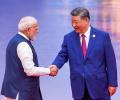
For India, China's Indian Ocean power projection, maritime domain awareness, dual-use ports, underwater surveillance, antisubmarinewarfare, naval exercises with Pakistan, pose considerable pressure, depleted India's strategic depth and marginalises Indian role, points out Srikanth Kondapalli.

A lesson for India is to clearly define objectives beforehand, so that the adversary or other parties do not attempt to mitigate them midway.

Russian President Vladimir Putin, in his address to the Federal Assembly (Russia's bicameral parliament) on Sunday, stated that Moscow had developed a small-sized nuclear power unit that could be used in a cruise missile to extend its range practically indefinitely.

President Vladimir Putin announced that Russia has successfully tested the Poseidon, a nuclear-powered submersible drone with unlimited range, along with updates on the Sarmat missile and Burevestnik cruise missile.

If Iran and Oman choose to charge a fee for rendering services to vessels using their territorial waters, so be it. The US is indulging in an irrationally self-destructive act, notes Ambassador M K Bhadrakumar.

Following the seizure, Moscow issued a strong condemnation asserting that no country has the right to use force against vessels lawfully registered under another state's jurisdiction, particularly on the high seas.
The submarine, capable of remaining underwater for months, will be rechristened as 'INS Chakra' and it would be for the first time in more than two decades that the Indian Navy would have a nuclear attack submarine

A Russian Parliament member claims Russia has enough nuclear submarines to counter US deployments, following statements by Donald Trump and Dmitry Medvedev.
According to Russian journal Vedomosti, the agreement was made when Prime Minister Narendra Modi met Russian President Vladimir Putin in Goa BRICS summit.

Deputy Chairman of Russia's National Security Council Dmitry Medvedev claims military victory in Ukraine is visible and emphasizes the need to plan for the aftermath. He also comments on Donald Trump's desire to be seen as a peacemaker.

Amid rising tensions, Iran threatens retaliation after the United States confirms sinking its warship, IRIS Dena, in international waters, escalating conflict in the region.
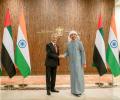
Frankly, was it really necessary in the middle of a fratricidal war for External Affairs Minister S Jaishankar to travel to Abu Dhabi for a one-on-one with the sheikh on April 12?Or, for National Security Advisor Ajit Doval to follow up on April 26? Or, for PM Narendra Modi to follow through today? There are no easy answers, notes Ambassador M K Bhadrakumar.

Hydrography (underwater geography) prevents the Indian Navy for opting for an all-conventional, or all-nuclear submarine fleet.

This is the time for India to plan forward fully, with the goal of Atmanirbharata, and energy security. The Persian Gulf is no longer a reliable source, points out Rajeev Srinivasan.

In a post on Truth Social, Trump outlined key goals of the campaign, including degrading Iran's missile capabilities, dismantling its defence industrial base, eliminating naval and air power, preventing Tehran from acquiring nuclear capability, and protecting United States allies such as Israel, Saudi Arabia and the United Arab Emirates.

India's second nuclear-powered ballistic missile submarine was commissioned into the Navy on Thursday in the presence of Defence Minister Rajnath Singh who said this will further strengthen the country's nuclear triad and enhance nuclear deterrence.

The question is no longer whether the war will expand. It has. The next few days will tell us whether the war stabilises around Hormuz or whether the Strait itself becomes the trigger for a far larger rupture. What to watch for over the next 48 hours is simple: Any move by the US toward direct naval control of the Strait; any credible Iranian attempt to disrupt or mine shipping lanes and, critically, whether energy infrastructure in the Gulf continues to be targeted.If those lines are crossed in tandem, the war will no longer be containable within the region.
