
Vaikhari Sonawane tells us how she went from writing blogs about her therapy sessions to creating a nationwide student-led mental health network.
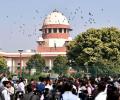
The Supreme Court has begun hearing petitions challenging the Election Commission's decision to conduct a special intensive revision exercise in Bihar ahead of elections, raising concerns about voter exclusion.
At Ahmedabad's Civil Hospital, DNA samples from over 190 relatives are being matched with victims of the Air India crash, a process expected to take up to 72 hours.
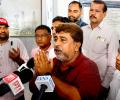
Expressing surprise over political parties not coming forward in filing objections related to 65 lakh excluded voters, the top court directed the chief electoral officer of Bihar to implead them in the court proceedings.

Glimpses from around the world that will make you smile and cry.

A two-judge bench of the top court had on August 11 directed authorities in Delhi-National Capital Region (NCR) to start picking up stray dogs from all localities "at the earliest" and relocate the animals to dog shelters.
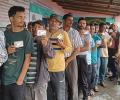
The Election Commission has assured the Supreme Court that no voter's name will be deleted from the draft electoral roll in Bihar without prior notice and a fair hearing. The EC also clarified that it is not required to share separate lists of those not included in the draft rolls.

Soldiers, cops, detectives, K-Pop idols, here's everything you can catch on OTT this week.

The development follows a joint operation by Madhya Pradesh's State Tiger Strike Force, Rajasthan forest department, and Sawai Madhopur-based NGO Tiger Watch last month that led to the arrest of six poachers, including three from Rajasthan.

The Supreme Court has stated it will intervene if there is mass exclusion in the special intensive revision of electoral rolls in Bihar, emphasizing the Election Commission's role as a constitutional authority.

The government rejected the Opposition's demand for a discussion on electoral roll revision in Bihar, citing that the matter is sub judice and pending before the judiciary.
The Supreme Court has directed the Election Commission of India (ECI) to publish details of deleted names from the voters list in Bihar, along with reasons for non-inclusion, to enhance transparency in the special intensive revision (SIR) of the electoral roll.
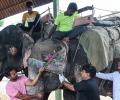
Thousands of people participated in a 'silent march' in Kolhapur on Sunday, demanding that 36-year-old female elephant Mahadevi (also called Madhuri), be brought back from Vantara wildlife rescue, treatment, and rehabilitation centre in Gujarat's Jamnagar district.

An NGO claimed that its documentary cast a slur on the reputation of India, its judiciary and Prime Minister Narendra Modi.
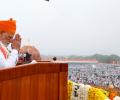
Prime Minister Narendra Modi addressed the nation on Independence Day, focusing on economic growth, self-reliance, and national security. He emphasized manufacturing quality products at affordable prices, supporting farmers, and combating terrorism and infiltration.
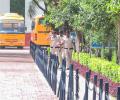
Delhi Police are investigating a series of bomb threats targeting schools and colleges, sent via encrypted networks. The threats have caused panic and disruption, prompting increased security measures and a police investigation into the source and motives behind the emails.

FCRA registration will also be cancelled if any NGO is not utilising foreign funding as per the aims and objectives of the NGO or if it has not uploaded the annual returns, the ministry said.

'Day by day we expose how soulless we have become as a society. Every day is a disappointment.'

'Grief united all of us as Ahmedabadis.'
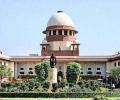
The Supreme Court of India has scheduled a hearing on February 19 for pleas challenging the appointment of the Chief Election Commissioner and Election Commissioners under the 2023 law. The court emphasized the potential consequences if any action is taken before the hearing. The pleas argue that the 2023 law, which excludes the Chief Justice of India from the selection panel, undermines the independence of the Election Commission and allows for undue influence from the executive branch. The court's earlier verdict in March 2023 called for an independent selection panel comprising the Prime Minister, Leader of the Opposition, and the Chief Justice of India to ensure the integrity of the Election Commission. The case highlights concerns about the independence of India's electoral process and the potential for political influence in the appointment of key election officials.
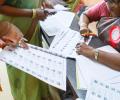
The Supreme Court has agreed to hear petitions challenging the Election Commission's decision to revise electoral rolls in Bihar. The hearing is scheduled for July 10.

The couple got married on February 7 in Ahmedabad.
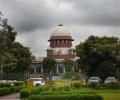
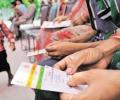
A bench of Justices Sudhanshu Dhulia and Joymalya Bagchi, however, questioned the timing of the exercise, besides offering its prima facie view that Aadhaar card, voter ID card and ration cards could be considered during the SIR in Bihar.
The Delhi high court has slapped Rs 10 lakh costs on an NGO which had filed a Public Interest Litigation (PIL) alleging unauthorised construction in New Delhi, saying it was unfortunate that the noble forum of PIL was being used for blackmailing citizens.
'The speed at which an aircraft lands or takes off, even a single object can work as a bullet.'

Alleging that the NGO allows its name to be used "at the behest of some selected political interest", the Union of India told the top court that it is guilty of collecting huge funds by exploiting the agonies of riot-affected people.
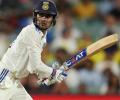
India's young guns have the talent to achieve something special in the upcoming England Test series, provided they back themselves, said former South Africa skipper AB de Villiers in Mumbai on Saturday.
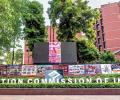
The Supreme Court will hear on February 19 pleas challenging the appointments of the Chief Election Commissioner and Election Commissioners under the 2023 law. The court will take up the matter on a priority basis, after some urgent listed matters. The government has appointed a new CEC and ECs under the new law, which excludes the Chief Justice of India from the selection panel, despite a 2023 Supreme Court verdict directing the inclusion of the CJI in the panel. The petitioners argue that the exclusion of the CJI undermines the independence of the election commission.
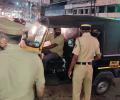
A 26-year-old man, Anandu Krishnan, has been arrested for allegedly defrauding people across Kerala by promising them scooters, sewing machines, and home appliances at half price. The accused claimed to use Corporate Social Responsibility (CSR) funds from big companies. The case has taken a political turn with the involvement of Congress leader Lali Vincent, who served as a legal advisor to an NGO involved in the transactions. Vincent defended Krishnan and said he was not a fraudster, claiming he was made a scapegoat after those who promised CSR funds backed away. The case is being investigated by the Kerala police, who are also looking into the role of certain political leaders in the fraud.
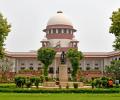
The Supreme Court will hear a plea seeking an independent selection process for the Comptroller and Auditor General of India (CAG) on March 17. The PIL, filed by the Centre for Public Interest Litigation, argues that the current system of appointment solely by the executive and the prime minister violates the Constitution and undermines the CAG's independence. The petition calls for a transparent process involving the prime minister, Leader of the Opposition, and Chief Justice of India. The PIL contends that the CAG's role as a watchdog over government finances requires a fair and non-arbitrary appointment procedure.

"We don't want people going after Muslims and Kashmiris," Himanshi Narwal said on Thursday, stoic and firm as she mourned her husband, Naval officer Lieutenant Vinay Narwal, who was gunned down in Pahalgam just 10 days ago. He would have been 27 on Thursday.
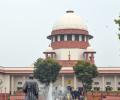
The Supreme Court is scheduled to hear on March 18 a plea seeking to debar from polls, candidates charged with serious offences. The plea, filed by advocate Ashwini Kumar Upadhyay, seeks directions to the Centre and the Election Commission of India (ECI) to restrain such candidates put on trial for serious offences. The plea alleges that despite recommendations of the Law Commission of India and court's previous directions, the Centre and the ECI did not act. The plea also highlights the increasing number of MPs with declared serious criminal cases since 2009, with one MP declaring 204 criminal cases against him, including culpable homicide, house trespass, robbery, criminal intimidation, etc. It claims that political parties are competing with each other in a race to the bottom as they couldn't afford to leave their competitors free to recruit persons with criminal antecedents.

Several petitions were filed in the apex court challenging the Act, contending that it was discriminatory towards the Muslim community and violated their fundamental rights.
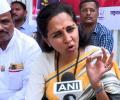
NCP (SP) leader Supriya Sule has criticized the Maharashtra government's decision to make Hindi a mandatory third language in schools, stating that it will not tolerate any undermining of the Marathi language. Sule also criticized the state's implementation of the National Education Policy (NEP) 2020, expressing concerns about its potential impact on students and teachers. She also questioned the appointment of a retired bureaucrat as the chief economic advisor to the chief minister and criticized the state's performance in areas like fiscal deficit management and the Jal Jeevan Mission.
The Supreme Court of India has sought the government's response on a Public Interest Litigation (PIL) that challenges the appointment process of the Comptroller and Auditor General of India (CAG), arguing it's unconstitutional. The PIL, filed by the Centre for Public Interest Litigation, claims the current process, solely through executive appointment by the Prime Minister, undermines the CAG's independence and violates constitutional principles. The court, while acknowledging the importance of institutional trust, questioned the extent to which it should intervene in the appointment process and whether this would constitute rewriting constitutional provisions. The PIL suggests the CAG's appointment should be similar to other independent bodies, with a selection committee comprising the Prime Minister, Leader of the Opposition, and Chief Justice of India. The case has implications for the independence and transparency of India's audit system.

For 100 low-income families near Lonavala, around 80 km from Mumbai, Jimmy Carter was a godsend as he had helped build their houses in 2006.

The Inlaks-Ravi Sankaran Internship for field biology, ecology and conservation is inviting applications from young applicants with bold and unconventional ideas for tackling conservation problems.
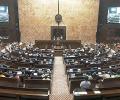
President Droupadi Murmu has given her assent to the Waqf (Amendment) Bill, 2025, which has sparked controversy and legal challenges. The Bill, passed by Parliament after heated debates, has been criticized by opposition parties as "anti-Muslim" and "unconstitutional". The government, however, maintains that the reform will benefit the Muslim community. Several petitions have been filed in the Supreme Court challenging the constitutional validity of the Bill, alleging discrimination against Muslims and undermining their religious autonomy. The Bill repeals the Mussalman Wakf Act, 1923, and introduces restrictions on Waqf properties and their management, which have raised concerns about the impact on the Muslim community.

The income tax department on Wednesday conducted a survey operation against Delhi-based think-tank Centre for Policy Research (CPR) and global NGO Oxfam India apart from a media foundation as part of a probe related to alleged FCRA contravention in funds received by them, official sources said.
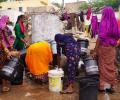
In Rajasthan's Karauli district, a decade ago, rampant drought and dwindling water sources forced many men into a life of dacoity, leaving their families in fear. However, the women of Karauli, tired of the despair, took matters into their own hands. They persuaded their husbands to give up their lives of crime and together they began reviving old water bodies and constructing new ones with the help of a local NGO. This community-led effort, which included building pokhars (water bodies) and reviving the Serni River, resulted in a remarkable transformation, bringing stability and hope to the region, and turning former dacoits into thriving farmers.
