
Industrialists have the same complaints as they did in the UPA's second stint.

Special Judge D E Kothalikar, assigned to hear cases of the NIA, had, on February 14, rejected the bail plea of Hany Babu, and the detailed order was made available on Monday.

'From his persistent fuelling of pan-Hindu nationalism to pandering to narrow Gujarati chauvinism, Rambo rides again, using fair means and foul -- and often foul -- to gain the battleground,' says Sunil Sethi.
Narendra Modi is no reformist, but here's how he could yet change the path India's economy.
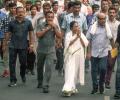
'If Mr Modi and Mr Shah have made a poisonous, polarising campaign their brahmastra for 2019, Mamata Banerjee is showing them its limitations,' says Shekhar Gupta.
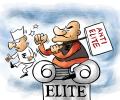
'And so, despite demonetisation, people in business feel safe with Mr Modi,' points out T N Ninan.

'For Modi, it's not just winning, but winning with style.'

"Mr Modi has utterly failed. It is clear by now that we (NDA) cannot deliver more than this (since 2014)," he said.
The Modi government's record on governance is better than that of UPA-2, but not better than UPA-1, observes T N Ninan.

'Indian democracy has become an oxymoron.I am hopeful that more people will boycott this politics of perversion and hatred and realise that this isn't sustainable for our great nation to prosper.

Will the Modi-Shah combine replace Vijay Rupani as Gujarat CM?

If Modi wants to be a man of history, he must make hard choices that will pay off down the road, says T N Ninan.
.jpg)
Modi government must push reforms at a fast pace to restore growth.
Desperate times need desperate actions, and the BJP's only option is to enforce legislation to build a Ram mandir, says Sunil Sethi.

Why the prime minister's legacy will depend on how he governs, not the number of state elections he fights as personality contests, says Shekhar Gupta.
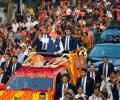
"Such are his core supporters that they will vote for him even if cooking oil sells for Rs 5,000 per litre under his leadership.' 'They don't think about inflation but Modi when they go out to vote.'
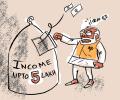
Mr Modi should be conscious that it was his choice to slash the number of tax-payers from 60 million to 15 million, notes T N Ninan.

'Mr Modi believes the world is like him. He thinks every one has a price or can be intimidated. He will never understand that those who fight for the truth have no price and cannot be intimidated,' Gandhi said in a tweet.

'What is unusual about the current period of slow growth is that it has come without an external driver -- high oil prices and/or successive monsoon failures -- as was the case with all previous periods of slowdown, going back 50 years, notes T N Ninan.
'...It won't help the party run a peaceful and equitable India,' warns Vir Sanghvi.
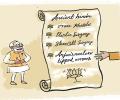
The BJP's message is that the past must be reinvented as creatively as imagination allows, states Sunanda K Datta-Ray.

When the Indian economy tanked in 1991, it did so because it ran out of foreign exchange. Today, it is tanking because it has run out of rupees even as the foreign exchange granary is overflowing, says T C A Srinivasa-Raghavan.

'BJP leaders might ponder the all-consuming arrogance that grips the Modi-Shah combine a year ahead of the next general election,' says Sunil Sethi.

The Sikhs love a good fight, and that's what the Modi government has given them.

The note ban is Modi's make-or-break gambit for 2019. Opposition leaders see a vulnerability and won't gift pre-eminence to the Congress, says Shekhar Gupta.
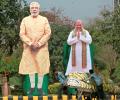
'In Chhattisgarh, MP and Rajasthan, he is far more popular than the defeated chief ministers,' notes Karan Thapar.
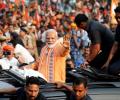
'If Mr Modi continues growing as a Hindu Hriday Samrat, better that it is done by restoring ancient temples than demolishing medieval mosques,' says Shekhar Gupta.
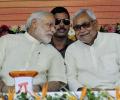
'It is an important and significant election -- but there is nothing make-or-break about it. A victory is always great, but if the BJP wins, it can't make Mr Modi any stronger in his party and government than he already is,' says Shekhar Gupta.

While seven of the suspended MPs belonged to the TMC, six were from the DMK, three from the Telangana Rashtra Samithi, two from the Communist Party of India-Marxist and one from the Communist Party of India.
The least the Opposition can do, for India's sake, is try to offer one, says Mitali Saran.

'By the time he came out after nearly five hours, he had a one-to-one conversation with the President, a delegation-level meeting, a reception, a dinner, a tour of the White House and a joint statement of a kind none of his predecessors ever had,' says Ambassador T P Sreenivasan.
Take our poll and let India know what you think of Mr Modi and his government.

Narendra Modi's speech had surprising omissions about his economics.
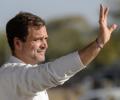
Accusing the prime minister of pushing a particular narrative in the media through the PMO, Congress president Rahul Gandhi said "Modi will not be able to deflect from real issues".

'Jockeying for that position has possibly started at this time.'

'Mr Kejriwal has played it cool in distancing himself from Delhi's hotspots, adroitly pandering to the BJP's Hindu vote.' 'He neither visited the scene of JNU violence nor has he dropped by at Shaheen Bagh,' notes Sunil Sethi.
'Differences will almost certainly arise over how the minorities are to be viewed and how educational institutions are to be treated.'
'These issues would be non-negotiable for Mr Modi's BJP.' 'So he may well refuse to lead a government in which his freedom of action is constrained by others in the coalition,' feels T C A Srinivasa-Raghavan.

'The BJP has shown signs lately of returning to its trader mindset.' 'Several strong emotions get meshed in this: Nationalism, protectionism, mercantilism, and arrogance,' points out Shekhar Gupta.

What is Narendra Modi like? What is his politics about? What will he do? What are his priorities? Sheela Bhatt/Rediff.com speaks to Swapan Dasgupta to find out more about the man of the moment.

Only a leader with sufficient moral authority with voters can pull off such experiments, notes T N Ninan.
